

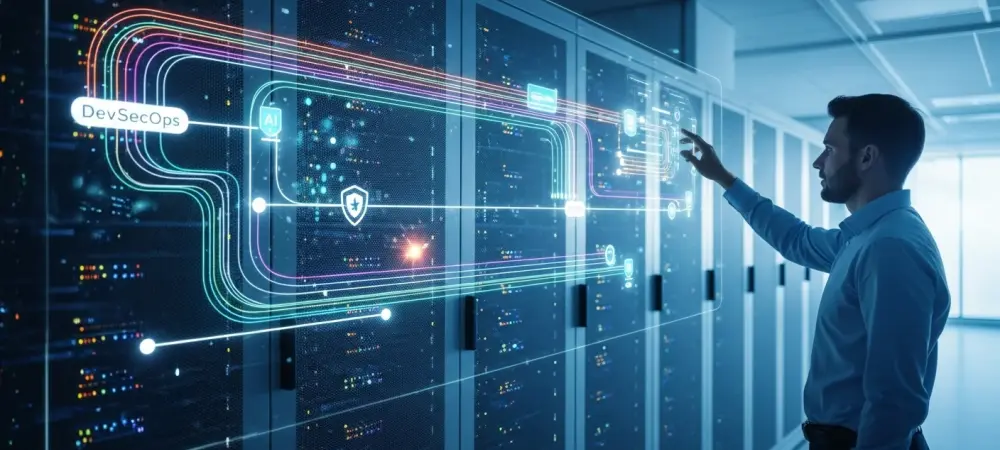
The initial wave of artificial intelligence in software development promised a revolution but delivered a modest evolution, narrowly focusing on code generation while leaving the vast majority of the complex development lifecycle untouched. This has created a “software delivery AI paradox,” where tools targeting only 20% of a developer’s work fail to produce transformative value. The industry is now pivoting toward a more holistic solution, recognizing the growing importance of integrating intelligent agents across all phases of development, security, and operations. This analysis will examine the emergence of these AI agents, their practical applications, expert forecasts, and the dawning future of autonomous software delivery.
The Rise of Autonomous Agents in Software Delivery
The Data-Driven Shift Toward AI Orchestration
A clear, data-driven trajectory is now defining the future of software delivery. Industry forecasts from IDC project that by 2030, a staggering 70% of organizations will embed AI agents directly into their DevOps and DevSecOps pipelines. This statistic signals significant market maturation, moving beyond simple, isolated AI coding assistants.
Consequently, the industry is witnessing an evolution toward sophisticated orchestration platforms capable of managing multiple, specialized agents. This trend is a direct response to the market’s need to address the other 80% of development tasks that lie outside of pure coding. These responsibilities, including project planning, security analysis, testing, and pipeline management, are where the next wave of productivity gains will be unlocked.
GitLab Duo: A Case Study in Action
The GitLab Duo Agent Platform serves as a tangible, real-world application of this overarching trend. The platform is engineered to embed a variety of intelligent assistants throughout the software development lifecycle (SDLC), all operating within a single, unified system. Its design directly confronts the limitations of siloed AI tools by providing a cohesive and context-aware experience.
At launch, the platform provided foundational agents designed to tackle specific, high-impact areas of the SDLC. For instance, the Planner Agent assists teams in structuring, prioritizing, and breaking down complex work, bringing clarity and efficiency to the crucial planning phase. In parallel, the Security Analyst Agent reviews vulnerabilities, explains their potential impact in accessible terms, and helps teams prioritize remediation efforts, embedding security expertise directly into the workflow.
This integration is unified through a seamless user experience, prominently featuring the Duo Agentic Chat. This interface allows developers to interact with various agents contextually, whether they are working in issues, reviewing merge requests, or monitoring pipeline activities. By making AI actions transparent and easy to control, such platforms empower developers to delegate tasks confidently without leaving their familiar environment.
Expert Perspectives Validating the AI Agent Revolution
Insights from leading industry analysts like IDC confirm that AI agent orchestration platforms are rapidly becoming a “critical category” for the future of enterprise software development. This validation underscores that the trend is not a fleeting fascination but a foundational technological shift driven by clear business needs for greater efficiency and security. Expert opinion reinforces that the key to successfully adopting AI in DevSecOps lies not just in deploying agents but in the ability to coordinate them effectively. The most valuable platforms will be those that can manage a diverse ecosystem of agents while maintaining clear visibility and enabling robust policy enforcement. This ensures that as automation increases, control and governance are not sacrificed.
This movement represents a strategic departure from traditional, linear development workflows. The emerging paradigm is a collaborative and asynchronous model where human developers delegate routine and complex tasks to a team of specialized AI agents. This shift is central to industry analysis, as it fundamentally redefines the role of the developer from a sole creator to an orchestrator of human and machine intelligence.
The Future of DevSecOps: An Agent-Driven Ecosystem
Looking ahead, the potential for an expanding agent-driven ecosystem is immense. Future developments will almost certainly include the rise of custom and third-party agents that integrate seamlessly into platforms like GitLab’s. This will allow organizations to tailor AI capabilities to their specific domains, technologies, and internal processes, creating a truly bespoke and intelligent development environment.
The benefits of a mature agent-driven model are compelling. It promises accelerated innovation cycles by automating time-consuming tasks, an improved security posture through continuous and intelligent analysis, and the liberation of developers to focus on high-value, creative problem-solving. By offloading the cognitive burden of routine work, these agents unlock human potential.
However, this future is not without its challenges. Ensuring that AI agents understand and align with an organization’s unique business context is a primary concern. Furthermore, managing the complexity of multiple interacting agents and maintaining robust governance and security controls will require new skills and new tooling. The ultimate implication is a fundamental change in how software is conceptualized, built, and delivered, moving steadily toward fully autonomous delivery models orchestrated by intelligent agents.
Conclusion: Embracing the New Era of Autonomous Development
The industry’s journey with AI in software development revealed that a narrow focus on coding was insufficient. The pivotal move was the shift toward embracing AI agents that could orchestrate the entire software development lifecycle. This understanding marked the true beginning of AI’s integration into DevSecOps.
Ultimately, the most significant value from AI in this domain was realized through integrated platforms. These systems proved essential for managing a diverse ecosystem of intelligent agents, ensuring they worked in concert to enhance productivity, security, and innovation from planning to deployment.
Organizations are now encouraged to build a strategic framework for a future where autonomous agents are a core component of the software factory. By preparing for this inevitable shift, businesses can position themselves to not only ship secure software faster but to redefine what is possible in the digital age.