

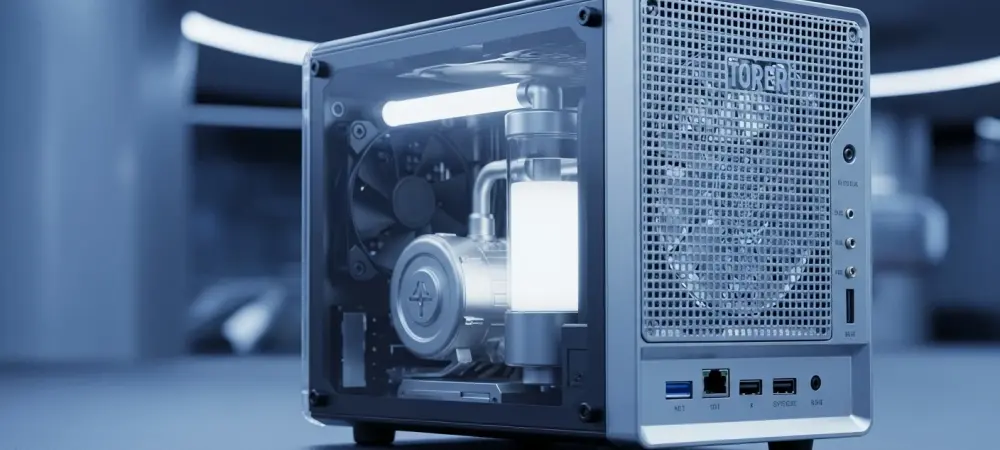
Miniaturization was once synonymous with compromise, forcing users to choose between a desk-cluttering tower or a compact system that withered under heavy computational loads. The computing industry is witnessing a dramatic shift as the boundaries between mobile efficiency and desktop-grade power continue to blur. Historically, Small Form Factor (SFF) systems were relegated to basic office tasks or media consumption due to severe thermal constraints. However, the emergence of the Strix Halo architecture and high-density liquid cooling has catalyzed a new segment: the ultra-mini workstation. Thermalright’s introduction of the AI HydroNous R1 signifies a pivotal moment where boutique thermal engineering meets bleeding-edge silicon, allowing hardware enthusiasts to access 16-core Zen 5 performance within a chassis smaller than a standard shoebox.
Examining the Strix Halo Market and Technological Advancements
Pushing the Envelope with Liquid-Cooled Mobile Silicon
The primary driver behind the AI HydroNous R1 is the integration of the AMD Ryzen AI Max+ 395, a processor that redefines the capabilities of integrated graphics and multi-threaded performance. A major industry trend is the aggressive up-clocking of mobile-series chips; by utilizing a custom liquid-cooling loop, Thermalright has pushed the standard 120W TDP to a staggering 176W. This technological leap allows the Radeon 8060S iGPU to perform at levels previously reserved for discrete graphics cards, catering to a growing consumer demand for all-in-one silicon that eliminates the need for bulky external GPUs.
Market Projections for Premium Small-Form-Factor Workstations
The market for high-end mini PCs is no longer a fringe hobbyist circle but a burgeoning professional vertical. With a launch price positioned near $3,500, the AI HydroNous R1 targets a high-margin demographic of creative professionals and AI researchers who require portability without sacrificing 128 GB of high-speed memory or 10GbE networking. Analysts project that as manufacturing processes for compact liquid cooling mature, the SFF workstation market will see a compound annual growth rate driven by the workspace minimalism trend and the increasing power-per-watt efficiency of the Zen 5 architecture.
Engineering Obstacles in High-Density Thermal Management
Transitioning 176W of thermal energy out of a 2.6-liter vertical chassis presents significant mechanical and physics-based challenges. The primary obstacle is maintaining component longevity while operating at peak power draw in such a confined space. Thermalright addresses this through aggressive ventilation and real-time telemetry displayed on integrated LCD screens, yet the complexity of miniaturized liquid pumps and reservoirs remains a hurdle for mass-market adoption. Additionally, the high cost of specialized components like 10GbE LAN controllers and dual USB4 interfaces in a mini-ITX footprint creates a steep barrier to entry for budget-conscious consumers.
Navigating Technical Standards and Global Compliance
As these high-performance mini PCs enter the global market, they must adhere to rigorous safety and connectivity standards. The implementation of USB4 and high-speed networking requires compliance with international electromagnetic interference (EMI) regulations, which become more difficult to manage as power densities increase. Furthermore, the use of liquid-cooling agents in a portable backpack-friendly device necessitates adherence to strict leak-prevention and material safety standards to ensure the units are safe for travel and long-term indoor use.
The Road Ahead for AI-Driven Mini PC Innovation
The future of the mini PC industry lies in the further integration of dedicated AI hardware and even more efficient cooling solutions. We are likely to see the ultra-mini category begin to disrupt the traditional mid-tower desktop market as integrated graphics continue to close the gap with entry-level discrete cards. Emerging technologies, such as phase-change cooling and solid-state active cooling, may eventually replace traditional liquid loops, allowing for even smaller volumes. The AI HydroNous R1 serves as a blueprint for this future, proving that the footprint of a device is no longer an accurate indicator of its computational ceiling.
Defining the Final Perspective on the AI HydroNous R1 Ecosystem
Thermalright’s debut of the AI HydroNous R1 marked a successful marriage of extreme thermal engineering and top-tier mobile silicon. By maximizing the Strix Halo architecture through a 176W power profile, the device offered a niche but powerful solution for users who prioritized power density above all else. This launch established a new baseline for how manufacturers approach thermal overhead in restricted volumes, suggesting that future developments will likely focus on modularity within liquid-cooled circuits. As professionals seek increasingly mobile high-performance tools, the industry moved toward a paradigm where integrated power no longer served as a limitation but as a primary design advantage.