

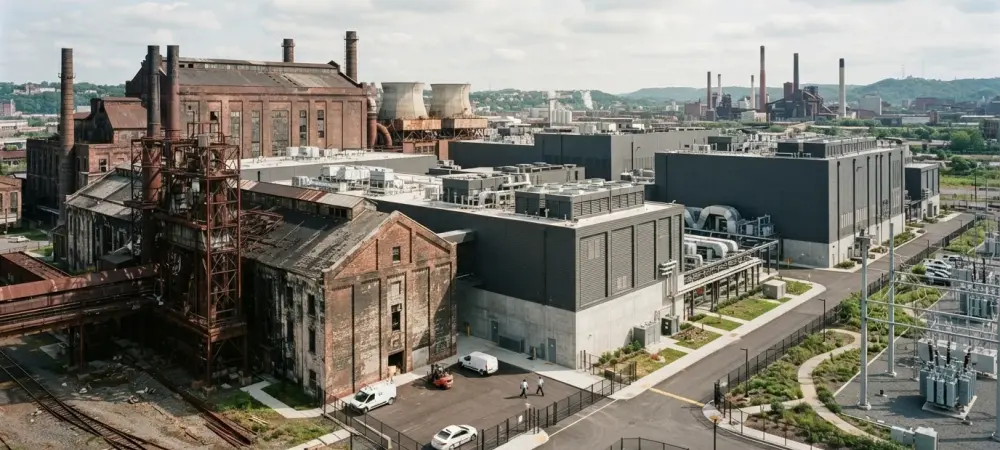
The industrial skyline of Alton, Illinois, is on the verge of a radical metamorphosis as the heat of traditional steel production gives way to the precision of a gigawatt-scale digital ecosystem. TerraWatt, an emerging developer, has unveiled a plan for the Riverbend Technology Center at a former steel mill. By repurposing this 381-acre site, the company aims to bridge the gap between manufacturing and a data-driven future. This project represents one of the largest proposed digital developments in the region, signaling a major shift in how regional economies adapt to modern industrial demands.
From Molten Steel to Digital Infrastructure
The site at 5 Cut Street served as a cornerstone of local industry for over a century before the mill shuttered in early 2026. While closures often leave a void, the existing connection to high-voltage lines and proximity to St. Louis make it an ideal candidate for tech redevelopment. This transition from a labor-intensive mill to a capital-intensive data hub reflects a global shift where power-rich brownfield sites are the most valuable real estate.
Understanding this historical context is vital to recognizing why industrial relics are now prime targets for high-density computing. The move is supported by former site leadership as a way to fulfill financial obligations after a difficult closure. By converting a legacy mill into a modern hub, the region maintains its relevance in a landscape where data processing has replaced physical manufacturing as the primary economic engine.
Transforming Brownfields into High-Capacity Tech Hubs
Engineering a Gigawatt-Scale Vision: The Riverbend Strategy
The scale of the project is massive, with a planned capacity of 1GW to be delivered in 200MW increments. This modular approach allows for scaling in alignment with market demand and grid readiness while managing the clearing of over a million square feet of antiquated buildings. TerraWatt has proposed the use of closed-loop cooling systems to minimize water consumption, turning a potential environmental liability into a sustainable, high-utility asset for the digital economy.
Economic Revitalization: Development Without Incentives
One distinctive aspect of this proposal is the financial framework where TerraWatt has committed to funding the development without local tax incentives. Instead, the project is designed to become a major source of revenue for the city and local school districts. This model suggests that the value of “shovel-ready” power access is now high enough that developers are willing to bear the full burden of infrastructure and remediation costs without seeking public subsidies.
Navigating Regulatory and Regional Challenges
Completion involves complex hurdles, including rezoning and favorable grid studies from Ameren Illinois. TerraWatt is also navigating a broader regional landscape that includes the 120MW Armory project in St. Louis and ongoing litigation regarding development conditions. These challenges highlight the necessity of strong public-private alignment when transitioning heavy industrial land to high-tech use, as legal and bureaucratic friction can impact timelines for multi-billion-dollar investments.
The Future of Industrial Reclamation and Power Demand
The Riverbend project is a bellwether for an industry increasingly hungry for power and space. As artificial intelligence and cloud computing continue to expand, the demand for massive, centralized hubs will only grow. We can expect more developers to target brownfields because they offer existing permits and transmission access that are difficult to secure elsewhere.
Furthermore, the trend toward private funding of grid upgrades suggests that developers will play an increasingly active role in modernizing the national power grid. This shift toward private infrastructure investment helps utilities accommodate high-density loads without passing all costs to traditional ratepayers. The convergence of energy availability and digital demand will continue to drive the reclamation of the industrial heartland.
Strategic Insights for Stakeholders and Communities
For municipal leaders, the repurposing of defunct sites provides a viable path for economic recovery. The willingness of developers to forgo tax incentives in exchange for power access should shift bargaining power back toward local governments. To successfully navigate these transitions, communities must prioritize transparent rezoning processes and environmental due diligence to ensure long-term sustainability.
For investors, the focus remains on a “power-first” strategy, where the availability of a gigawatt-scale interconnection is the primary driver of site value. As traditional data center markets become saturated, secondary markets with robust industrial skeletons offer the best returns. Stakeholders should look for sites where existing infrastructure can be salvaged to accelerate the deployment of high-density computing clusters.
Reimagining the American Industrial Heartland
The proposed Riverbend Technology Center stood as a testament to the evolving nature of the American economy. By transforming a century-old steel mill into a 1GW data center, the project redefined the utility of industrial land. It underscored the critical importance of power availability and the potential for sustainable, incentive-free development. The success of the Alton site served as a blueprint for other communities looking to trade industrial relics for a seat in the global technology sector. The transition from steel to silicon became a tangible reality that reshaped the Midwest. Ultimately, the project proved that legacy industrial assets could be successfully pivoted to meet the infrastructure needs of a new era.