

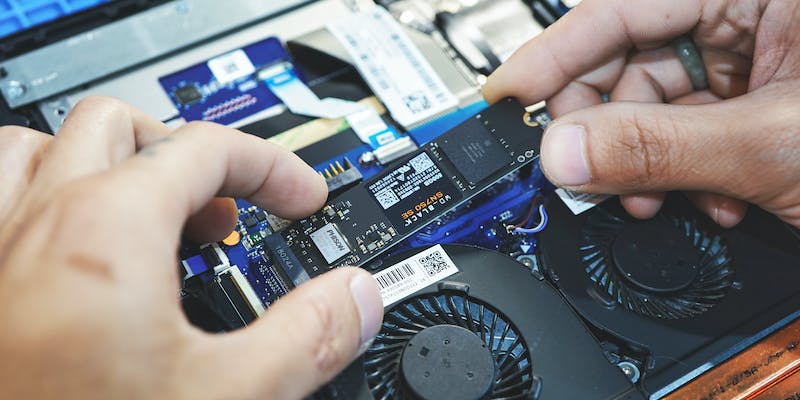
With the rapid advancement of technology, it was only a matter of time before faster solid-state drives (SSDs) entered the market. Now, fulfilling that anticipation, Team Group presents the T-Force CARDEA Z540 SSD. Designed for the high-end storage segment, this SSD brings forth impressive performance and efficient cooling capabilities. Let’s delve into the details and see what sets this SSD apart from its competitors.
Retail price and expected range
Priced at $259.99 USD, the Team Group T-Force CARDEA Z540 SSD falls within the expected range for 2TB Gen5 SSD drives. This makes it an enticing option for users requiring ample storage capacity without compromising on speed and reliability.
Target market segment
The CARDEA Z540 is part of the esteemed CARDEA Z5 lineup, specifically catering to the high-end storage segment. Team Group’s aim with this SSD is to provide uncompromising performance to power users, gamers, and content creators who demand lightning-fast data transfer speeds and smooth multitasking capabilities.
High-end Phison E26 SSD controller
At the heart of the T-Force CARDEA Z540 SSDs lies the high-end Phison E26 SSD controller. Renowned for its reliability and efficiency, this controller ensures optimal performance and endurance. With this impressive controller backing it, the CARDEA Z540 is primed for exceptional performance in demanding applications and heavy workloads.
Increased NAND speeds for enhanced performance
Team Group has increased the NAND speeds of the CARDEA Z540 SSDs from 1600 MT/s to a staggering 2000 MT/s. This enhancement allows the SSDs to deliver higher read and write capabilities, leading to accelerated data processing and reduced load times. The performance boost is a game-changer for users who need responsive performance and seamless multitasking.
Available capacities and speed ratings
The T-Force CARDEA Z540 SSDs are currently available in two capacities: 1TB and 2TB. These spacious storage options ensure you have ample room for your data, games, and multimedia files. Moreover, the SSDs boast impressive speed ratings of 12.4 GB/s for sequential read and 11.8 GB/s for sequential write operations, guaranteeing swift data access and transfer.
Efficient cooling with Frozr heatsink
One of the standout features of the T-Force CARDEA Z540 SSDs is the large Frozr heatsink. This robust cooling solution is designed to keep temperatures in check, reducing them by up to 20 degrees Celsius. The Frozr heatsink ensures optimal performance and longevity of the SSD even during intense workloads, guaranteeing stable operation.
DRAM cache and NAND flash configuration
To further enhance performance, the T-Force CARDEA Z540 features a 4GB LPDDR4-4266 memory as a DRAM cache. This cache accelerates data access, delivering lightning-fast response times. Furthermore, the SSD utilizes cutting-edge 232-layer 3D TLC NAND flash memory, offering impressive storage density and durability for years to come.
Compatibility and installation
Thanks to its efficient cooling solution and lack of additional cooling requirements apart from the graphene heat spreader, the T-Force CARDEA Z540 SSD can be easily installed in any M.2 slot without compatibility concerns. This ensures a hassle-free setup and flexibility for users with different system configurations.
Test platform details
During our review, we evaluated the T-Force CARDEA Z540 SSD using a state-of-the-art test platform. The platform comprised an Intel Core i9-13900K processor running at stock clocks paired with the reliable and feature-rich MSI Z790 ACE motherboard. This test setup allowed us to push the SSD to its limits and showcase its true potential.
The Team Group T-Force CARDEA Z540 SSD is a powerhouse, offering exceptional performance, efficient cooling, and ample storage capacities. With its high-end Phison E26 controller, increased NAND speeds, and robust cooling solution, this SSD is perfectly suited for power users and enthusiasts alike. Whether you’re a gamer, content creator, or professional requiring reliable and lightning-fast storage, the CARDEA Z540 is a remarkable choice that will undoubtedly surpass your expectations. Invest in this high-quality SSD and unleash next-level performance in your system.