

Imagine a world where the insatiable energy demands of data centers, powering everything from streaming services to AI innovations, no longer contribute to environmental degradation, and instead, sustainable solutions pave the way for a greener future. With global data center energy consumption projected to double in the coming years, the race to find sustainable cooling solutions has never been more critical. This review dives into the cutting-edge realm of eco-friendly cooling technologies, spotlighting how they address both performance and planetary concerns in an era of escalating digital dependency.
The Core of Sustainable Cooling
At the heart of modern data center design lies the urgent need to balance high-performance computing with environmental stewardship. Sustainable cooling technologies have emerged as a pivotal solution, aiming to slash energy usage and reduce carbon footprints. These systems are not mere add-ons but integral components that redefine how data centers operate amid growing scrutiny over their ecological impact.
The significance of these technologies extends beyond individual facilities, influencing broader industry standards. By prioritizing energy efficiency, companies can achieve substantial reductions in operational costs while aligning with global sustainability goals. This shift represents a fundamental rethinking of infrastructure in response to both market demands and regulatory pressures.
Analyzing Key Cooling Innovations
Closed-Loop Heat Exchange with Natural Water Sources
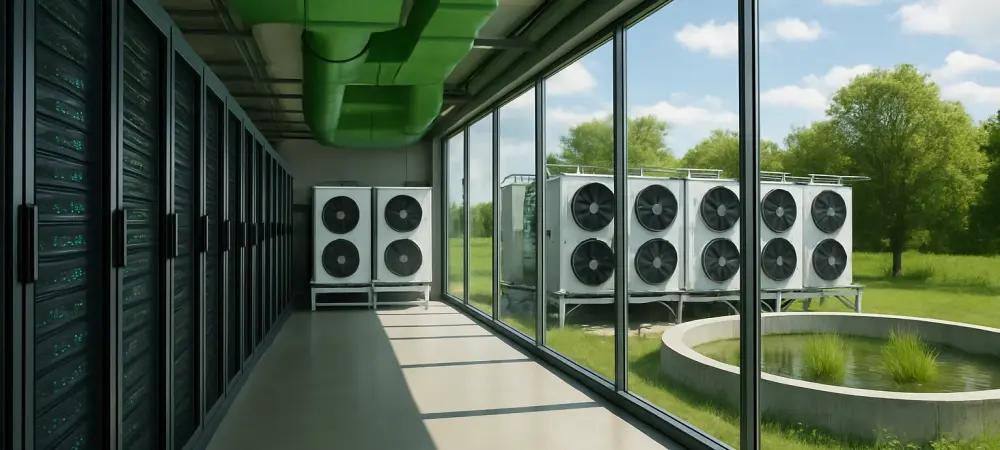
One of the standout advancements in sustainable cooling is the closed-loop heat exchange system, which harnesses natural water bodies such as rivers and canals. This method circulates water through a sealed system to absorb heat from data center equipment before releasing it back into the environment without contamination. Its ability to achieve a Power Usage Effectiveness (PUE) of less than 1.2 underscores its efficiency, setting a benchmark for minimal energy waste.
This technology’s environmental benefits are profound, as it drastically cuts down on the need for energy-intensive mechanical cooling. Facilities adopting this approach can significantly lower their carbon emissions, making it a cornerstone of green data center design. The reliance on abundant natural resources also offers scalability for regions with access to suitable water sources.
Implementation, however, requires careful site selection and engineering to ensure consistent performance. The closed-loop system stands as a testament to how nature and technology can converge to address modern challenges, paving the way for broader adoption across diverse geographies.
Direct-to-Chip Warm-Water Cooling
Another transformative innovation is direct-to-chip warm-water cooling, exemplified by systems like Neptune integrated into high-performance servers. This technique delivers cooling fluid directly to the heat-generating components, efficiently managing temperatures even in densely packed racks. Supporting rack densities of 30-60kW, it caters to the rigorous demands of AI and media processing workloads.
The technical advantages of this method include enhanced system reliability and reduced energy consumption compared to traditional air cooling. By maintaining optimal operating conditions, it extends hardware lifespan and boosts overall efficiency. Such precision cooling is particularly vital for cutting-edge applications requiring sustained computational power.
Its adaptability to various server configurations further amplifies its appeal, allowing data centers to scale operations without compromising on sustainability. As a targeted solution, direct-to-chip cooling addresses specific high-heat zones, offering a tailored approach to thermal management in compact, high-output environments.
Industry Trends and Real-World Impact
The global data center sector is witnessing a marked shift toward greener cooling practices, with industry leaders increasingly turning to natural water sources like seawater and rivers for heat dissipation. This trend reflects a collective recognition of the need to curb energy consumption amid rising digital infrastructure demands. Companies across Europe and the US are setting precedents by integrating these methods into their operational frameworks.
A prime example is Media Stream AI’s pioneering project in Manchester’s Media City, Salford, where a 2MW facility utilizes the nearby Rochdale Canal for cooling. Backed by a $67.3 million investment, this data center combines closed-loop heat exchange with advanced GPU technology to support high-performance computing while maintaining a low PUE. Scheduled to be operational by early 2026, it highlights the practical application of sustainable design on a significant scale.
Other notable implementations by firms like Digital Realty, Green Mountain, and Google demonstrate the versatility of these technologies across different climates and use cases. From powering AI-driven solutions to supporting media industries, these real-world applications underscore the dual focus on innovation and environmental responsibility, shaping a new standard for the industry.
Challenges in Scaling Sustainable Solutions
Despite the promise of sustainable cooling, several hurdles remain in achieving widespread adoption. High upfront infrastructure costs pose a significant barrier, particularly for smaller operators lacking the capital to invest in advanced systems. Additionally, site-specific constraints, such as proximity to suitable water sources, limit the feasibility of certain technologies in some regions.
Regulatory challenges also play a role, as varying environmental standards across jurisdictions can complicate deployment. Market dynamics, including resistance to change from established players reliant on conventional cooling, further slow progress. These obstacles highlight the need for strategic planning and policy support to facilitate broader integration.
Efforts to address these issues are underway, with innovations in modular cooling designs and increased investment in green technologies showing promise. Collaborative initiatives between governments and private entities are also crucial in overcoming financial and logistical impediments, ensuring that sustainable cooling becomes a viable option for all scales of operation.
Future Horizons in Cooling Technology
Looking ahead, the trajectory of sustainable cooling technologies points toward even greater integration with renewable energy sources. Advancements in heat exchange systems are expected to enhance efficiency further, potentially reducing PUE metrics closer to the ideal of 1.0. Such developments could redefine energy benchmarks for data centers over the next few years.
Media Stream AI’s planned expansions into Germany, France, and Jamaica signal a growing commitment to eco-conscious infrastructure on a global scale. These projects, set to roll out from 2025 onward, aim to replicate the Manchester model, tailoring sustainable cooling to diverse regional needs. This international push reflects an industry-wide movement toward harmonizing technological growth with environmental goals.
The long-term impact on the sector could be transformative, with reduced energy consumption aligning data centers more closely with global sustainability mandates. As these technologies mature, they are likely to become standard practice, driving down costs through economies of scale and fostering a more resilient digital ecosystem.
Reflecting on the Path Forward
Reflecting on this exploration of sustainable data center cooling, the journey revealed a landscape where high-performance computing and environmental responsibility found common ground. Each innovation, from closed-loop heat exchange to direct-to-chip cooling, demonstrated remarkable potential in curbing energy waste while meeting modern computational demands. The real-world strides made by initiatives like Media Stream AI’s Manchester facility underscored what is achievable with vision and investment. Moving forward, the industry must focus on dismantling financial and regulatory barriers through targeted incentives and international cooperation. Stakeholders should prioritize research into hybrid cooling solutions that blend natural resources with renewable energy, ensuring adaptability across varied environments. By fostering a culture of innovation and accountability, the data center sector can solidify its role as a leader in sustainable technology, setting a precedent for other industries to follow.