

The relentless pursuit of visual computing power has traditionally forced hardware engineers into a corner where massive, multi-slot cooling solutions dictate the physical size of every modern workstation. Sparkle is now reversing this trend with a remarkably slim alternative that challenges the industry to rethink the physical limits of a single PCIe slot. While most manufacturers continue to scale up their cooling shrouds, this introduction proves that high-end performance doesn’t always require a bulky footprint.
This shift toward spatial efficiency allows professional users to reclaim internal chassis space without sacrificing memory capacity. By re-evaluating the cooling requirements of high-performance silicon, a specialized tool was created that fits into dense server racks and compact desktop towers alike.
Redefining Density in the Professional GPU Landscape
The design shift addresses a critical question for modern engineers regarding how to maximize compute power without needing a server room for standard operations. The ability to stack multiple cards provides a level of versatility that was previously impossible.
This innovation allows researchers to maintain high-performance workstations in standard office environments. By prioritizing density, users can bypass the spatial constraints that once limited the number of active GPUs in a single build.
The Evolution of Battlemage and the Need for Compact Power
Intel’s “Big Battlemage” architecture represents a significant leap forward in professional hardware. It specifically targets the bottlenecks found in local AI development and complex rendering workflows where high VRAM capacity is essential.
As Large Language Models grow, the industry sees a desperate need for hardware that handles massive datasets. Local workstations now provide a viable path for professionals looking to run complex simulations without relying on expensive cloud clusters.
Breaking Down the Hardware: 32 GB of VRAM in a Slim Profile
The technical heart of this card features 32 Xe2 cores paired with an impressive 32 GB of VRAM. To fit this into a single-slot form factor, Sparkle utilized a blower-style cooling system equipped with a copper baseplate and aluminum fins.
While the power was tuned to 160W for thermal stability, the card still sustained a boost clock of 2800 MHz. Connectivity was handled through a single 16-pin connector, ensuring compatibility with modern professional power standards.
Strategic Scalability: The Road to 256 GB of System Memory
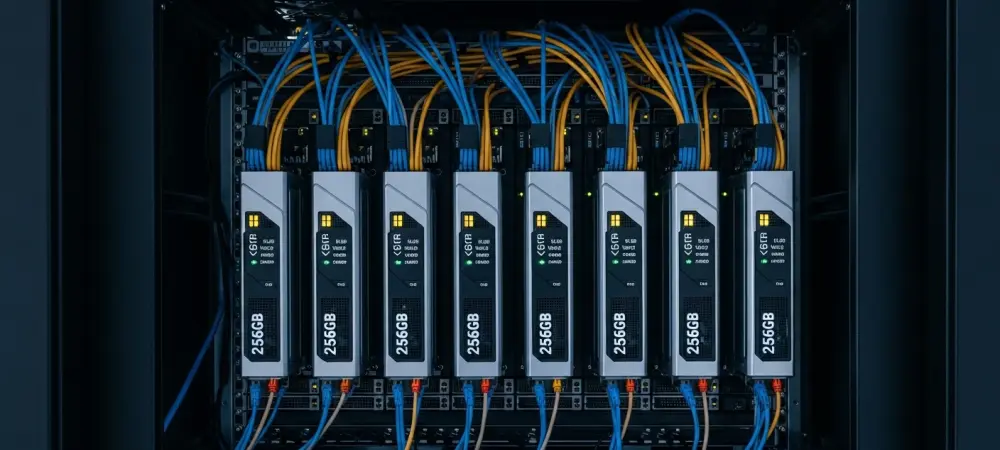
The true value was revealed when considering the aggregate power of a multi-GPU setup. By occupying only one PCIe slot per unit, a single high-end workstation theoretically housed up to eight of these cards in a standard configuration.
This resulted in a staggering 256 GB of total VRAM, which became a game-changer for researchers working with models exceeding 200 billion parameters. Expert consensus suggested that density was the key to future-proofing localized high-performance computing.
Practical Implementation for AI and Creative Workflows
Professionals integrated the Arc Pro B70 by leveraging its memory overhead for specialized rendering and development. The reduced power draw simplified the management of multiple cards, while the blower-style exhaust effectively moved heat out of the chassis.
This deployment proved that hardware density offered the most efficient path for firms seeking high-performance results within compact office spaces. The hardware established a new framework for building workstations that remained powerful yet manageable.