

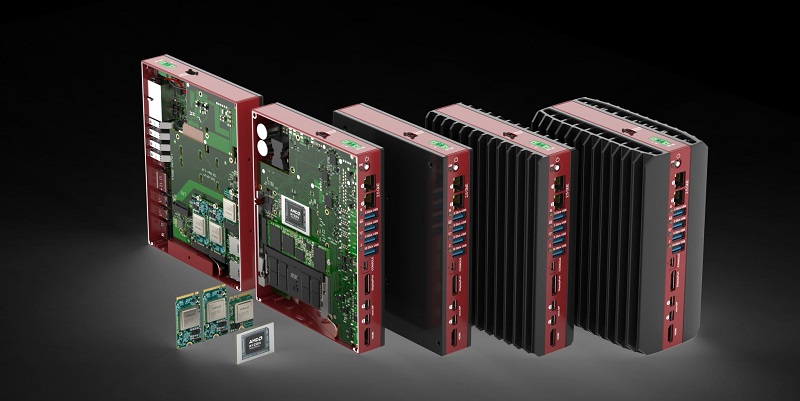
In a breakthrough for embedded systems, SolidRun has introduced the Bedrock R7000 Mini-PC, a fanless computing solution powered by the advanced Ryzen 7040 ‘Phoenix’ APUs. This mini-PC has been engineered to cater specifically to the demanding requirements of the AI industry, offering high-end hardware and exceptional performance for AI computing tasks.
High-end hardware for the AI industry
The Bedrock R7000 Mini-PC boasts cutting-edge hardware that is tailored to meet the rigorous demands of AI applications. With its AMD Ryzen 7840HS and Ryzen 7840U APU options, this mini-PC offers outstanding processing power and efficient multitasking capabilities. This ensures that AI computations are performed swiftly and accurately, enabling professionals in the AI field to develop and deploy advanced models with ease.
APU options
SolidRun provides users with two APU options for the Bedrock R7000 Mini-PC. The AMD Ryzen 7840HS and Ryzen 7840U APUs offer a perfect balance of performance and energy efficiency. Users can choose the APU that best suits their specific needs, ensuring optimal computing power for their AI workloads.
AI acceleration option
To further enhance AI computing performance, SolidRun offers the option of integrating three Hailo-8 AI accelerators. These accelerators work in tandem with the Ryzen APUs, providing a combined total performance of up to 78 TOPS (Trillions of Operations Per Second). Such immense AI processing power enables professionals to tackle complex AI tasks and accelerate their productivity.
Memory and storage capabilities
The Bedrock R7000 Mini-PC is equipped with 2x SODIMMs, accommodating up to 64 GB of DDR5 ECC/non-ECC memory. This substantial memory capacity ensures smooth and efficient multitasking, allowing users to seamlessly handle multiple AI projects simultaneously. Additionally, the mini-PC provides 3 NVMe 2280 PCIe Gen4x4 slots, enabling users to expand storage capacity as per their requirements.
Enhanced performance features
SolidRun has incorporated noteworthy features in the Bedrock R7000 Mini-PC to ensure uninterrupted performance and temperature control. The mini-PC includes “power loss protection,” safeguarding data in the case of unexpected power outages or fluctuations. Moreover, “conduction-cooling” technology effectively dissipates heat, enabling the device to maintain optimal performance levels even during intensive AI computing tasks.
Temperature range and cooling method
Designed to operate in extreme environments, the Bedrock R7000 Mini-PC can withstand temperature fluctuations ranging from -40ºC to 85ºC. This wide temperature tolerance is made possible due to the mini-PC’s efficient cooling method, which ensures that the device remains within an optimal temperature range, thereby preventing performance degradation even under extreme conditions.
Ports and connectivity options
The Bedrock R7000 Mini-PC offers a comprehensive range of onboard ports for flexible connectivity. These include HDMI 2.1 and 3x DP 2.1 for seamless display connectivity, dual 2.5 Gbit Ethernet (Intel I226) for reliable and high-speed networking, and optional WiFi 6E + BT 5.3 for wireless connectivity. Additionally, the mini-PC supports the integration of a 5G or LTE modem, enabling users to leverage high-speed connectivity for AI-related tasks. For easy peripheral connectivity, the mini-PC is equipped with 4 USB 3.2 ports.
Industrial PC application
It is essential to note that the Bedrock R7000 Mini-PC is primarily designed for industrial applications, particularly in the AI industry, and is not intended for gaming or other consumer-focused tasks. With its robust hardware, advanced cooling capabilities, and durability, this mini-PC is perfectly suited for demanding AI projects in various industrial settings.
SolidRun’s groundbreaking release of the Bedrock R7000 Mini-PC showcases technological advancements in the field of embedded systems. This fanless computing solution, powered by the Ryzen 7040 ‘Phoenix’ APUs, offers unrivaled performance and reliability for AI tasks. With high-end hardware, AI acceleration options, memory and storage capabilities, and enhanced performance features, the Bedrock R7000 Mini-PC sets a new standard for AI computing devices. Designed to withstand extreme environments and offering versatile connectivity options, this mini-PC is a game-changer in the AI industry, empowering professionals to achieve new levels of productivity and innovation.