

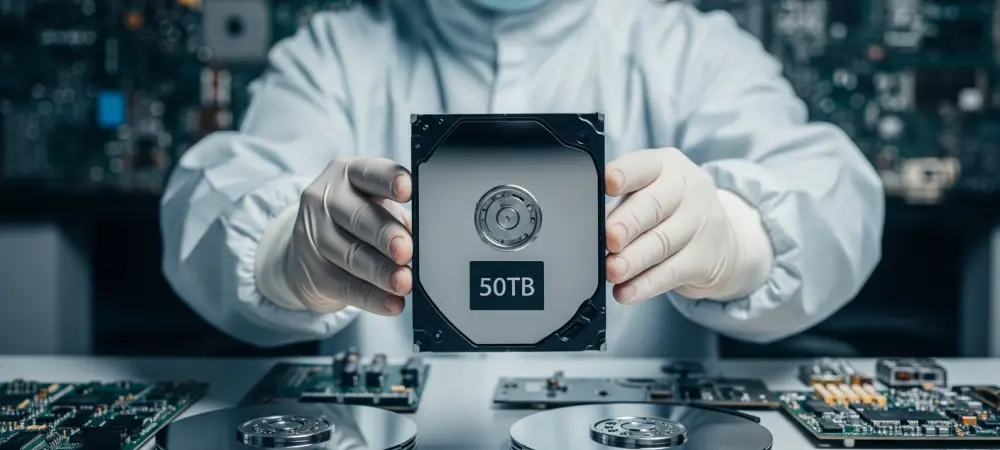
The relentless proliferation of generative artificial intelligence models has triggered an unprecedented demand for data storage solutions that can keep pace with the massive datasets required for training and inference. As hyperscale data centers grapple with the sheer volume of information generated by large language models and autonomous systems, the industry is pivoting toward high-density mechanical drives to manage long-term data retention cost-effectively. Seagate is currently positioning itself at the forefront of this evolution by aggressively expanding its roadmap to deliver 50TB hard drives by 2028, leveraging sophisticated Heat-Assisted Magnetic Recording techniques. This move represents a significant leap from the 30TB units that became the enterprise standard as of 2026, signaling a fundamental shift in how secondary storage supports the AI revolution. By focusing on increasing areal density through the Mozaic platform, the company aims to sustain the current trajectory of global digital expansion. This strategic initiative ensures that storage remains a scalable asset rather than a bottleneck for progress.
Advancing Magnetic Recording: Overcoming Physical Storage Limits
The transition to 50TB capacities necessitates a departure from traditional Perpendicular Magnetic Recording methods which have largely reached their theoretical limits regarding bit stability. To achieve higher density, Seagate utilizes Heat-Assisted Magnetic Recording technology, a process that involves a small laser diode integrated into each recording head to momentarily heat the storage medium. This localized heating reduces the coercivity of the iron-platinum alloy coating on the glass platters, allowing data bits to be written at much smaller scales than previously possible. Between 2026 and 2028, the maturation of the Mozaic 3+ and upcoming Mozaic 4+ platforms will be critical in stabilizing these microscopic bit cells against thermal fluctuations. By refining the precision of the plasmonic transducer and the durability of the media, engineers are ensuring that the 50TB milestone remains achievable while maintaining the rigorous reliability standards required by enterprise environments. These advancements represent a complex interplay of material science.
Implementing this technology at scale involves more than just shrinking the size of data bits; it requires a complete overhaul of the controller architecture and the read-write head assembly. The current generation of drives already incorporates dedicated processors built on advanced lithography nodes to manage the intricate signaling required for high-density tracking. As the roadmap progresses toward 2028, the integration of more sophisticated error correction algorithms will be essential to handle the signal-to-noise ratios inherent in such high areal densities. Furthermore, the move to glass-based substrates provides the necessary structural rigidity to spin these high-capacity platters at 7200 RPM without introducing mechanical instability. This engineering feat allows for a seamless transition for data center operators, as the physical dimensions of the drives remain consistent with the standard 3.5-inch form factor. Consequently, organizations can significantly increase their total storage capacity within existing rack configurations, maximizing the utility of their current infrastructure.
Strategic Infrastructure Integration: Optimizing Costs and Operations
For major cloud service providers and enterprise storage administrators, the shift toward 50TB drives is primarily driven by the need to optimize the total cost of ownership across massive server farms. Higher density drives directly translate to fewer total units required to reach a specific petabyte target, which in turn reduces the number of host bus adapters, cables, and power distribution units needed within a single rack. This consolidation significantly lowers the energy overhead associated with cooling thousands of spinning disks, a factor that has become a top priority for organizations aiming to meet sustainability goals while scaling their AI capabilities. By 2028, the deployment of 50TB hard drives will allow hyperscalers to drastically reduce their operational expenditures, providing the fiscal leeway necessary to invest in high-cost GPU clusters.
The advancement toward 50TB storage solutions provided a clear path for the industry to navigate the complexities of the global data explosion. Strategic planners successfully implemented multi-tiered storage architectures that prioritized high-density mechanical disks for massive cold data repositories. By adopting advanced erasure coding and optimizing RAID rebuild protocols, organizations ensured that these larger capacities did not compromise data integrity or system availability. This proactive approach allowed data centers to scale their training pipelines without encountering the bottlenecks associated with older, lower-capacity hardware. The successful rollout of the Mozaic platforms solidified the role of hard drives as a foundational component of the AI-driven enterprise. Ultimately, the industry moved toward a more sustainable and scalable model, ensuring that infrastructure was ready for the next decade of information management. This transition represented a strategic necessity that redefined how global enterprises valued and preserved their digital assets.