

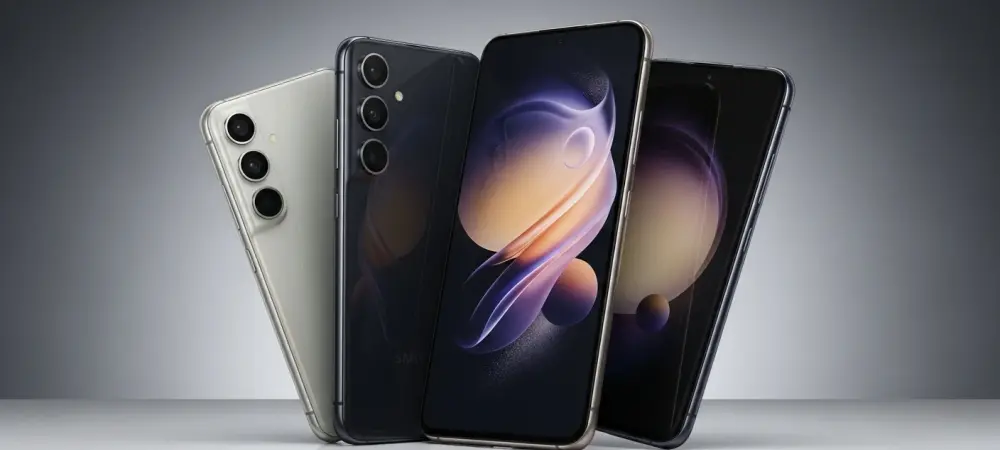
In a fiercely contested arena where yearly incremental updates often fail to inspire, Samsung’s strategic decisions for its Galaxy S26 series reveal a fascinating and risky divergence born from internal course corrections. The upcoming Samsung Galaxy S26 series represents a significant advancement in the competitive smartphone industry. This review will explore the evolution of the series based on leaks and expert analysis, its key anticipated features, performance metrics, and the potential impact it will have on the market. The purpose of this review is to provide a thorough understanding of the expected technology, its potential capabilities, and its place in the future smartphone landscape.
An Introduction to the Next Generation
This review focuses on the Samsung Galaxy S26 and S26+, slated for a February 25th launch. The development of these models reveals a significant divergence, stemming from Samsung’s last-minute cancellation of planned “Pro” and “Edge” variants. This strategic pivot, reportedly driven by the underwhelming sales of past experimental models, has distinctly shaped the features and upgrades of each device. Consequently, the S26 and S26+ are not merely different in size but in their entire developmental philosophy, positioning them uniquely within the broader smartphone market as Samsung’s newest flagships.
The decision to abandon the more ambitious “Edge” model so late in its design cycle has created a ripple effect, particularly impacting the Galaxy S26+. This last-minute change forced engineers to revert to a more familiar design, leading to a product that, in some areas, appears to be a direct continuation of its predecessor rather than a true generational leap. In contrast, the standard Galaxy S26 seems to have benefited from a more focused development, receiving a host of meaningful upgrades that could make it the more compelling option for consumers seeking tangible improvements. This internal drama sets the stage for one of the most intriguing flagship releases in recent memory.
Design and Display a Tale of Two Models
Galaxy S26 a Subtle But Significant Redesign
The standard Galaxy S26 is poised for a notable physical update, breaking from the iterative design language of the past few years. It features a larger 6.27-inch display, an increase from the 6.16-inch panel on the previous model. This change results in a slightly taller and wider frame, though the device is expected to maintain the same thickness. This modest size increase allows for key internal upgrades while aiming to preserve a comfortable one-handed user experience, a crucial selling point for the base model.
Beyond the dimensions, conflicting reports surrounding the device’s weight have created a compelling mystery. While one leak suggests a minor weight adjustment, another, more dramatic report claims a reduction to an astonishing 137 grams. If accurate, this would make the Galaxy S26 exceptionally lightweight for a modern flagship packed with its feature set. Such a significant weight reduction could become a key differentiating factor in its class, appealing to users who prioritize portability and comfort over the sheer size and heft of larger premium devices.
Galaxy S26 Plus Stagnation Born from Strategy
In stark contrast to its smaller sibling, the Galaxy S26+ appears to be a victim of circumstance, with its design and display reflecting a rushed and compromised development cycle. The late cancellation of the “S26 Edge” model, which was intended to be its direct replacement, forced a hasty pivot. The result is a display that is expected to be nearly identical to its predecessor in size, resolution, and brightness, representing a significant lack of progress for a premium device.
The only anticipated enhancement for the S26+ display is the potential use of more durable glass, an upgrade that feels more like a minor course correction than a true innovation. This stagnation is a direct consequence of the strategic shift, leaving the S26+ in an awkward position. It lacks the compelling physical redesign of the standard S26 and fails to introduce any groundbreaking visual technology, potentially making it the least exciting model in the lineup from a design perspective.
Shared Screen Enhancements
Despite the developmental differences, a welcome rumor suggests both the S26 and S26+ may adopt the superior Gorilla Armor 2 glass. This material, previously exclusive to the Ultra model, offers enhanced scratch resistance and significantly reduced screen reflections, which would be a tangible quality-of-life improvement for both devices. This move would help unify the premium feel across the non-Ultra models, providing a more consistent user experience.
However, the segmentation strategy within the S26 series remains firmly in place. The new “Privacy Screen” technology, an advanced feature designed to obscure the display from onlookers, is expected to remain an Ultra-only exclusive. This decision maintains a key technological distinction within the lineup, ensuring the top-tier model retains a unique selling proposition and encouraging consumers seeking the latest innovations to invest in the most expensive device.
Performance and Internals the Dual Chip Divide
The Exynos 2600 vs Snapdragon 8 Elite Gen 5
Samsung continues its long-standing dual-chipset strategy, creating a familiar geographical divide in performance capabilities. Models destined for the US market will receive Qualcomm’s new Snapdragon 8 Elite Gen 5, while most other regions, including Korea, will get Samsung’s in-house Exynos 2600. This year, however, the Exynos 2600 is not merely an alternative but a major technological milestone for Samsung’s semiconductor division. It is the first mobile chipset built on a cutting-edge 2nm process, promising significant gains in efficiency and power.
The new Exynos chip features an ambitious 10-core CPU architecture and a new Xclipse 960 GPU. Based on these advancements, Samsung claims it will deliver a 39% faster CPU performance, a 50% improvement in ray tracing capabilities for gaming, and a massive 113% increase in its Neural Processing Unit (NPU) for handling complex on-device AI tasks. While real-world performance will require thorough testing, these figures suggest the gap between the Exynos and Snapdragon variants could be narrower than ever, with the Exynos potentially leading in certain AI-driven applications.
Memory and Storage Upgrades
In terms of memory and storage, the Galaxy S26+ is expected to maintain its current configuration, offering a robust 12GB of RAM paired with 256GB and 512GB storage options. This specification remains more than adequate for demanding users and power-intensive applications, ensuring the Plus model continues to deliver a smooth and responsive experience without any notable bottlenecks.
The more significant news comes from the standard Galaxy S26, which receives a much-needed and long-overdue upgrade to its base storage. The entry-level model will now start with 256GB of storage, doubling the 128GB offered in previous generations. This change finally aligns the base flagship with modern standards, eliminating a key point of criticism and providing users with ample space for apps, photos, and high-resolution video right out of the box.
Battery Life and Charging Ecosystem
Powering the New Flagships
The redesigned chassis of the Galaxy S26 enables a substantial improvement in its battery capacity. The device is rumored to house a larger 4,300mAh battery, a 300mAh increase over its predecessor. This larger cell, combined with the efficiency gains from the new 2nm chipset, should translate to a noticeable improvement in daily endurance. Meanwhile, the Galaxy S26+, constrained by its recycled design, will retain the same 4,900mAh cell as the previous year’s model.
Regarding charging speeds, both phones are expected to support 45W wired charging, although some skepticism remains about whether the base S26 will actually receive this upgrade. A more certain enhancement is reserved for the S26+, which will see its wireless charging speed receive a modest boost from 15W to 20W. While not a dramatic leap, this improvement helps keep the Plus model competitive and offers slightly faster top-ups for users who have invested in the wireless charging ecosystem.
The Magnetic Accessory Conundrum
The Galaxy S26 series will not feature built-in magnets for a native MagSafe-like experience, a decision confirmed by recent certifications. Instead, Samsung will officially support the Qi 2.2.1 standard, which requires users to purchase specific magnetic cases to use compatible chargers and accessories. This approach offloads the cost and complexity of the magnetic system to third-party case manufacturers and Samsung’s own accessory line.
To support this ecosystem, Samsung is expected to launch its own branded 25W magnetic Qi2 charger and a 15W magnetic Qi2 power bank. This move signals Samsung’s commitment to the Qi2 standard while stopping short of fully integrating the technology into the phones themselves. It creates a slightly fragmented experience for users who must purchase an additional accessory to unlock the full potential of magnetic charging and mounting, a stark contrast to the seamless integration offered by key competitors.
Camera System a Familiar Story
Despite promotional materials teasing camera enhancements, multiple leaks strongly indicate that both the Galaxy S26 and S26+ will reuse the exact same camera hardware from the previous three generations. This system, now a familiar sight, consists of a 50MP main sensor, a 10MP 3x telephoto lens, and a 12MP ultra-wide sensor. Any improvements in photo and video quality will therefore have to come exclusively from software processing and the enhanced image signal processor of the new chipsets.
This lack of hardware innovation for a fourth consecutive generation could become a significant competitive disadvantage. While Samsung’s processing has proven capable, rivals are continuously pushing the boundaries with larger sensors, more advanced lens systems, and new optical technologies. Relying solely on software to keep pace is a risky strategy, and the aging camera hardware may struggle to compete with the next generation of flagship cameras from Apple and other competitors, particularly in challenging lighting conditions.
Connectivity and New Features
Bridging the Gap with Satellite Communication
A major upgrade across the entire Galaxy S26 lineup is the long-awaited integration of satellite communication. Confirmed by FCC listings, this feature will enable emergency messaging and SOS services through Non-Terrestrial Networks (NTN). This addition finally brings Samsung’s flagship devices in line with their main competitors, providing a crucial safety feature for users who find themselves in remote areas without cellular service.
The implementation of NTN support is a critical step in closing a feature gap that has existed for several years. By offering a reliable method for emergency contact, Samsung not only enhances the value proposition of its devices but also addresses a growing consumer expectation for safety and connectivity in any situation. This feature is no longer a novelty but a standard for premium smartphones, and its inclusion is a welcome and necessary evolution.
Ultra Wideband for the Standard Model
In another move to modernize its base offering, the vanilla Galaxy S26 is finally expected to gain Ultra-Wideband (UWB) connectivity. This feature, previously reserved for the more expensive Plus and Ultra models, enables high-precision spatial awareness and directional tracking. Its inclusion will significantly enhance the accuracy of finding smart tags and improve device-to-device interactions like file transfers.
Adding UWB to the standard S26 democratizes a powerful technology within Samsung’s ecosystem. It makes the base model a more capable and future-proof device, ensuring that all S26 users can take full advantage of Samsung’s growing network of connected devices and location-based services. This upgrade elevates the standard model from a compromised entry point to a more complete and compelling flagship experience.
Pricing and Market Positioning
The substantial upgrades to the base Galaxy S26, particularly the doubled storage, the new UWB chip, and its larger battery, are expected to result in a price increase for that model. This adjustment would reflect the added value and position the S26 as a more premium and feature-complete offering compared to its predecessors. Samsung will likely justify the higher cost by highlighting the tangible improvements that bring it closer to parity with the Plus model. In contrast, the Galaxy S26+, with its more iterative changes and carry-over components like the display and camera system, will likely see its price remain stable. This pricing strategy would create a clearer distinction between the two models: the S26 as the upgraded, value-driven flagship, and the S26+ as the larger-screen option for those who prioritize size above all else. To soften the impact of any price adjustments, Samsung is anticipated to offer aggressive pre-order incentives, such as free storage upgrades and generous trade-in bonuses, to encourage early adoption.
Final Verdict Evolution or Stagnation
The Galaxy S26 series presents a mixed bag of genuine innovation and frustrating iteration. The standard S26 appears to be a compelling evolution, with a larger display, a bigger battery, doubled base storage, and the addition of key features like UWB and satellite connectivity. These changes address long-standing criticisms and transform the base model into a formidable flagship in its own right, making it arguably the most interesting device in the non-Ultra lineup. The Galaxy S26+, however, risks being defined by stagnation, particularly in the critical areas of its display and camera hardware. The internal strategic shifts that hampered its development are evident in the final product, which feels more like a minor refresh than a true successor. The series’ overall success will depend on whether the impressive performance gains from the new chipsets and the crucial connectivity upgrades were enough to overshadow the lack of hardware innovation in other areas and convince consumers that Samsung’s latest flagships were more than just a tale of two very different phones.