

Dominic Jainy stands at the forefront of the modern digital infrastructure revolution, blending a deep mastery of artificial intelligence and machine learning with a pragmatic approach to blockchain and large-scale data systems. As the industry grapples with an unprecedented wave of community activism and logistical bottlenecks, Jainy’s perspective offers a vital roadmap for navigating the friction between technological expansion and local preservation. In this conversation, he explores the complex dynamics of why projects worth billions are being stalled, the technical intricacies of grid stability, and the shifting social contract between developers and the neighborhoods they inhabit.
With billions of dollars in projects currently halted or delayed due to organized opposition, what specific financial thresholds trigger a project withdrawal? How do you calculate the point where legal fees and timeline extensions outweigh the potential long-term return on investment for a new site?
The decision to pull the plug on a project is rarely about a single invoice, but rather the cumulative weight of uncertainty that erodes the projected internal rate of return. When you look at the $18 billion in projects already halted and the staggering $46 billion currently caught in limbo, you realize that time is the most expensive commodity in our industry. We start seeing red flags when legal challenges and rezoning delays push a project’s “go-live” date beyond a three-to-five-year window, as the rapid evolution of AI hardware can render an unbuilt facility’s design obsolete before the first server even arrives. For a massive development like the $14 billion Tract project in Arizona, the threshold is hit when the cost of mitigation—such as redesigning building heights or noise dampening—collides with a shrinking margin for error in power delivery. We meticulously calculate the “burn rate” of holding land and managing litigation against the potential yield of a site, and if the timeline stretches to a point where we risk losing conditional promises of tenancy or power, the financial logic dictates a withdrawal to preserve capital for more receptive markets.
Large-scale campuses can shift power utilization from zero to 100% almost instantly, potentially destabilizing local grids. How can developers use advanced power electronics to mitigate these oscillations, and what technical guarantees must be offered to utility providers to ensure local residents do not face brownouts or surges?
The rise of the “AI factory” has introduced a volatile energy profile that traditional grids simply weren’t built to handle, with campuses now scaling to 1 GW or more of capacity. These facilities can experience violent swings in utilization, snapping from nearly 100% load to almost zero in a heartbeat, which creates harmonic oscillations that can physically stress utility infrastructure. To counter this, we integrate advanced power electronics, including massive battery energy storage systems and static synchronous compensators, which act as a digital shock absorber to smooth out these spikes before they ever touch the public wires. We provide utility providers with ironclad technical guarantees through “behind-the-meter” generation and sophisticated load-shedding protocols that can drop non-essential tasks in milliseconds to protect the local residential voltage. By proving that our site can actually enhance grid reliability—effectively acting as a stabilizer rather than a drain—we can ease the fears of neighbors who worry that their lights will flicker every time our GPUs spin up for a training run.
Moving to zero-water cooling solutions can increase project costs by up to 50% compared to traditional methods. In regions facing water scarcity, how do you balance this capital expenditure against public pressure, and what specific metrics prove that closed-loop, air-cooled systems are a sufficient alternative?
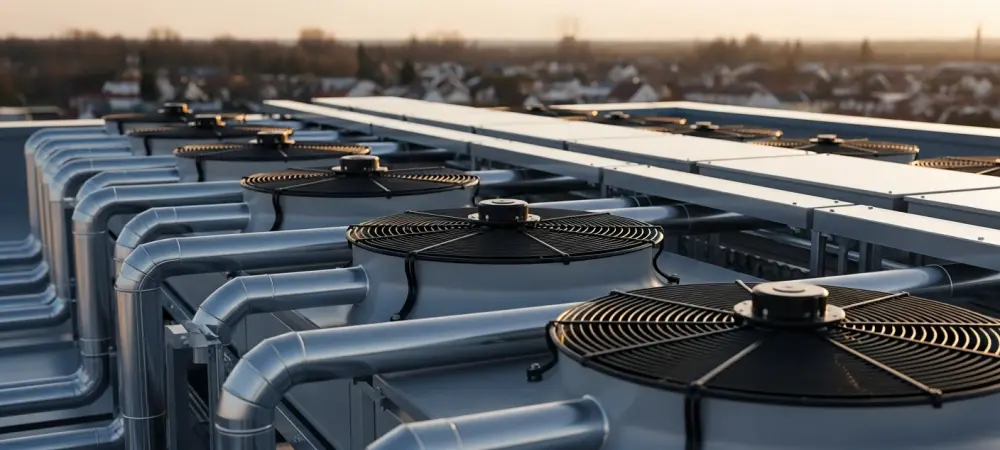
The tension between cooling efficiency and community resource conservation is perhaps the most visceral challenge we face, especially when misinformation suggests a data center will drain local aquifers. While shifting to a zero-water or closed-loop system can indeed spike capital expenditures by 35% to 50%, we view this as a “social license to operate” tax that is increasingly mandatory for long-term viability. We point to projects like the NEO-01 facility near Lake Erie, where we must prove to skeptical residents that our closed-loop, air-cooled systems consume roughly the same amount of water as a single-family home. Our primary metrics focus on the Water Usage Effectiveness (WUE) ratio, aiming for a near-zero score that demonstrates we are not “taking” water, but merely cycling a fixed volume in a sealed environment. By investing in these more expensive air-cooled technologies upfront, we eliminate the $400 million risks of projects being withdrawn over environmental conservation fears, effectively trading a higher construction cost for a guaranteed operational future.
Construction of a large facility often requires 1,500 workers, yet operational staffing typically drops to 100 positions once the site is live. What specific workforce programs can bridge this gap, and how can the skills learned during the build-out be transitioned into long-term careers within the local manufacturing sector?
The “1,500 to 100” employment drop is a significant point of friction in community negotiations, often leading to the perception that data centers are “job ghost towns” once the dust settles. To solve this, we are looking at construction not as a temporary event, but as a multi-year training academy for high-end industrial skills that the regional manufacturing sector desperately needs. We advocate for partnership programs where the electricians, HVAC technicians, and fiber installers who build the 200 MW data centers are funneled into permanent roles with local manufacturers or equipment suppliers who service the facility. By collaborating with organizations like the Society of Mechanical Engineers, we can create a sustainable workforce pipeline that ensures the person who installed the cooling plant becomes the person who maintains it for the next twenty years. This approach transforms a short-term labor spike into a long-term economic engine, providing local families with stable, well-paid careers that offer far more security than the transient nature of general construction.
Concerns regarding noise pollution and air quality from backup generators frequently lead to rezoning challenges and project cancellations. What architectural techniques effectively dampen sound for high-density facilities, and what steps should developers take to verify environmental safety facts for communities that are skeptical of industrial expansion?
The low-frequency hum of a data center and the potential for diesel emissions are often the “NIMBY” triggers that lead to projects being scrapped, such as we saw with the $1.5 billion proposal in Missouri. To combat this, we employ sophisticated architectural baffling, sound-attenuating walls, and strategic landscaping that can reduce the decibel levels at the property line to something no louder than a quiet residential street. Regarding air quality, the industry is moving away from permanent diesel dependence toward Tier 4 generators and alternative fuels like HVO, but the real solution lies in radical transparency. We encourage developers to install third-party air and noise monitoring stations that provide real-time, publicly accessible data to prove we are meeting environmental standards. By inviting the community to see the data for themselves and utilizing “NOTE” (Not Over There, Either) feedback to adjust the visual and auditory footprint of the site, we can dismantle the skepticism that often fuels legal challenges.
Approximately half of all announced data center projects never materialize due to logistical or financial hurdles. Beyond community protests, what are the primary indicators that a project is likely to fail, and how can developers better manage local expectations to avoid a backlash when plans are scaled back?
The 50% failure rate in this industry is a sobering reality, often driven by a lack of “conditional promises” for power, equipment supply, or development finance. A project is likely to fail if the developer announces a massive multi-gigawatt vision before securing a firm commitment from the utility provider, leading to a “hollow” project that collapses under its own hype. We also see failures when a project relies too heavily on a single “anchor tenant” who might pivot their strategy, leaving a partially rezoned site in a lurch. To manage local expectations, we must move away from over-promising massive campuses and instead communicate in phases, explaining that a project will scale only as the infrastructure allows. When we are transparent about the fact that a $24.7 billion project might start small and grow over a decade, we build a foundation of credibility that prevents a political backlash if the final build-out is more modest than the initial announcement.
What is your forecast for the data center industry?
I anticipate a “great consolidation” where the industry moves away from speculative, broad-scale land grabs and toward highly integrated, “good neighbor” campuses that are self-sufficient in power and water. Over the next five years, despite the high rate of project cancellations, the sheer demand for AI capacity will drive an unprecedented surge in total power requirements, forcing us to become partners in grid stabilization rather than just consumers. We will see a shift toward “behind-the-meter” power generation and the repurposing of waste heat to warm local communities, effectively turning data centers into essential public utilities. Ultimately, the successful developers will be those who stop treating community engagement as a hurdle to be cleared and start treating it as a core component of the engineering process. The future of data centers is not just about compute density; it is about how gracefully these digital giants can sit within the physical landscape of our society.