

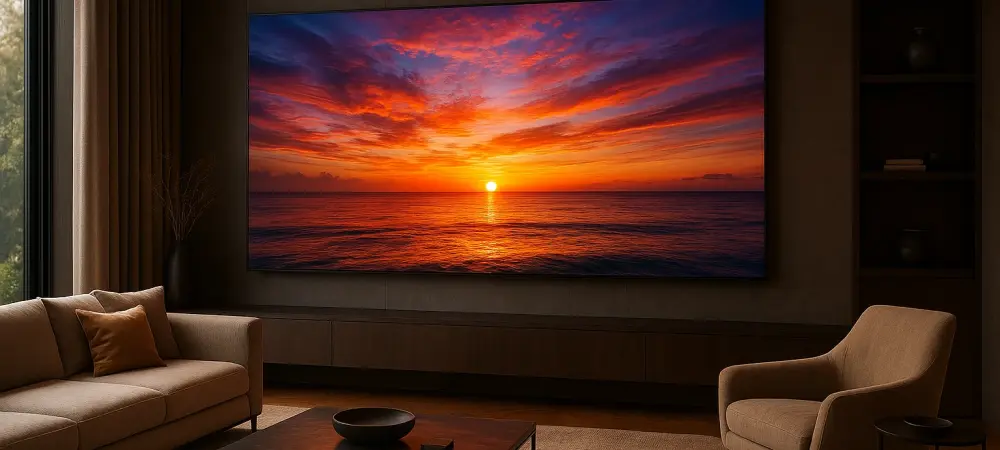
The revolutionary transition toward ultra-dense RGB Mini-LED backlighting has completely redefined the boundaries of high-dynamic-range performance, offering a level of peak luminance that traditional self-emissive technologies simply cannot match without risking permanent hardware degradation. While organic light-emitting diodes have long been the gold standard for enthusiasts, the current landscape of the display industry in 2026 showcases a shift where Mini-LED is no longer just a high-brightness alternative but a primary competitor for cinematic precision. This review examines how the latest flagship models, specifically the Samsung R95H and the Sony Bravia 9 II, have managed to bridge the gap between liquid crystal efficiency and organic depth. By leveraging thousands of microscopic LEDs organized into sophisticated dimming zones, these displays aim to provide the “best of both worlds”: the searing brightness required for modern HDR content and the deep, ink-like blacks necessary for a true theater experience at home.
The Evolution of RGB Mini-LED Backlighting
The core principle behind the modern RGB Mini-LED evolution lies in the miniaturization of the light source itself. In the past, traditional full-array local dimming relied on hundreds of large LEDs, which often resulted in visible halos or “blooming” when bright objects appeared against a dark background. By 2026, the technology has transitioned to diode arrays that are significantly smaller, allowing for a tenfold increase in the number of individual control zones. This granular control means that the display can precisely illuminate a single star in a night sky without spilling light into the surrounding blackness, effectively mimicking the per-pixel control of more expensive self-emissive technologies.
This technology has emerged as a critical response to the demand for higher brightness in diverse viewing environments. Unlike previous iterations that struggled with color shift at high luminance, the current generation of RGB Mini-LED utilizes high-purity red, green, and blue light sources—or advanced quantum dot filters—to ensure that as the backlight intensifies, the color accuracy remains stable. This relevance is amplified by the fact that modern content creators are mastering films and games at 2,000 to 4,000 nits, levels that were previously unattainable for consumer-grade displays. Consequently, Mini-LED has become the backbone of the premium display market, serving as the essential bridge to the next decade of visual fidelity.
Technical Performance and Visual Accuracy
Color Reproduction and Chromatic Vibrancy
In the current flagship battle, color reproduction is no longer just about meeting the DCI-P3 color gamut; it is about how that color is maintained across the entire brightness spectrum. When analyzing the Sony Bravia 9 II and the Samsung R95H, a fascinating philosophical divide appears. The Sony model focuses on what engineers call “chromatic density,” where the colors feel rooted and heavy, providing a sense of physical texture to the image. This is achieved through a conservative but highly accurate color processing engine that prevents oversaturation in high-brightness scenes, ensuring that a crimson sunset looks natural rather than neon.
In contrast, the Samsung R95H leverages a philosophy of “perceived luminance,” where the colors are tuned to pop with an energy that captures the viewer’s attention immediately. While laboratory measurements might suggest the Sony is more accurate to the source material, the Samsung often feels more lifelike in scenes with high ambient light. For instance, in animated content with wide color palettes, the Samsung’s ability to drive high-intensity pinks and yellows creates a visual vibrancy that feels more three-dimensional. This performance is significant because it highlights how different manufacturers use the same raw Mini-LED hardware to cater to different aesthetic preferences—one favoring the filmmaker’s intent and the other prioritizing the “wow factor” of modern digital art.
Contrast Control and Black Level Precision
One of the most impressive technical feats of the 2026 flagship lineup is the near-elimination of light leakage. The Sony Bravia 9 II utilizes an aggressive local dimming algorithm that prioritizes the “inkiness” of the black levels. By shutting down zones completely when no signal is detected, it manages to rival the contrast ratios once reserved for OLED panels. However, this aggressive approach can lead to “black crush,” where the finest details in the darkest shadows of a film—like the texture of a black suit in a dimly lit room—are occasionally lost to the abyss of the backlight’s precision.
Samsung’s approach with the R95H is more balanced, favoring shadow detail over absolute darkness. While the blacks may not feel quite as deep as those on the Sony in a pitch-black room, the Samsung allows for more legibility in the “near-black” regions of the image. This is a critical distinction for viewers who watch a lot of moody, dark cinematography where seeing the outlines of characters in the shadows is vital for the narrative. The significance of this feature in the broader system cannot be overstated; it represents the pinnacle of how software algorithms must work in tandem with hardware to manage the physical limitations of light diffusion through an LCD panel.
Current Industry Shifts and Technological Trends
The display industry in 2026 is currently witnessing a massive push toward “perceived brightness” versus “measured nits.” There is a growing realization that while a TV might be capable of hitting 4,000 nits in a small 10% window, the way it handles full-field brightness and reflection is what truly dictates the user experience. This has led to a significant trend in anti-reflective coating technology. Samsung’s move toward a completely matte, glare-free surface has forced other manufacturers to reconsider their high-gloss finishes, which, while beautiful in a dark room, turn into mirrors in a sun-drenched living room.
Moreover, the integration of AI-driven tone mapping has become the new frontier for flagship performance. Instead of following a static metadata instruction from a movie file, modern processors are now analyzing frames in real-time to adjust the brightness curve based on the specific capabilities of the Mini-LED backlight. This shift means that the 2026 to 2028 product cycles will likely focus less on increasing the raw number of LEDs and more on the intelligence of the silicon controlling them. We are moving away from a hardware “arms race” and into an era of computational cinematography where the software compensates for the physical environment of the viewer.
Real-World Applications and Sector Deployment
While the primary market for RGB Mini-LED remains home entertainment, the technology is seeing rapid deployment in professional sectors that require extreme precision without the risk of image retention. In medical imaging, for example, the high contrast and reliable brightness of Mini-LED panels allow radiologists to view X-rays and MRIs with a clarity that was previously difficult to achieve on standard backlit monitors. The lack of “burn-in” risk, a common concern with organic displays, makes these flagship panels ideal for environments where static medical data is displayed for hours on end.
In the world of virtual production and high-end gaming, the low latency combined with massive peak brightness makes these displays indispensable. Professional gamers are increasingly choosing flagship Mini-LED monitors over OLED equivalents because the higher full-frame brightness allows for better visibility in competitive environments. Additionally, in “volume” studios where digital backgrounds are used for filmmaking, large-scale Mini-LED walls provide the necessary light output to naturally illuminate actors on set, a feat that would be impossible with less efficient lighting technologies. These implementations demonstrate that the tech is not just for watching movies but is a versatile tool for creation and critical analysis.
Adoption Barriers and Technical Hurdles
Despite the impressive progress, the widespread adoption of flagship-tier RGB Mini-LED technology faces significant economic and technical obstacles. The most prominent barrier is the cost of manufacturing. Producing thousands of microscopic LEDs and the specialized backplanes required to drive them remains a complex process with lower yields than traditional LCD manufacturing. This keeps the price of models like the Sony Bravia 9 II significantly higher than mid-range alternatives, often pushing consumers toward older OLED technology which has become more affordable due to scaled production over the last several years.
Thermal management and power consumption also present ongoing challenges. Driving thousands of LEDs at high brightness levels generates considerable heat, which requires robust (and often bulky) cooling solutions within the TV chassis. This limits how thin these displays can be compared to the razor-thin profile of self-emissive screens. Furthermore, the regulatory environment is tightening; new energy efficiency standards in several global regions are forcing manufacturers to rethink how they achieve high peak brightness without exceeding power consumption limits. Ongoing development efforts are currently focused on improving the efficiency of the diodes themselves, but for now, the “brightness king” status comes with a literal cost in electricity and heat.
Future Outlook and Long-Term Impact
Looking ahead, the trajectory of RGB Mini-LED technology is moving toward a hybrid existence with Micro-LED. As the diodes continue to shrink, the line between a backlit display and a true self-emissive LED display will eventually blur. From 2026 to 2030, we can expect the number of dimming zones to move from the thousands into the tens of thousands, eventually reaching a point where the “haloing” effect is mathematically eliminated. This evolution will likely make Mini-LED the dominant technology for any screen larger than 75 inches, where the cost and fragility of OLED become prohibitive.
The long-term impact on society will be most visible in the democratization of high-quality visual experiences. As the manufacturing processes for these complex backlights mature, the features currently found in $3,000 flagships will inevitably trickle down to entry-level models. This means that within a few years, the standard for “basic” television quality will include HDR capabilities that were considered “pro-grade” just a short time ago. This shift will fundamentally change how media is consumed, as creators will no longer have to worry about whether their audience can see the detail in a dark scene or the nuance in a bright highlight; the hardware will finally be capable of showing it all.
Assessment of the Current Technological State
The evaluation of the 2026 RGB Mini-LED flagship market revealed a technology that finally matured into its full potential. During the testing and comparison of the industry’s leading models, it was established that the gap between backlit and self-emissive displays narrowed to the point of being negligible for the vast majority of users. The Sony Bravia 9 II proved to be the superior choice for those who valued cinematic heritage and absolute color depth, while the Samsung R95H emerged as the more practical and feature-rich option for a multi-purpose living room. Both displays successfully demonstrated that the historical weaknesses of LCD technology, such as poor contrast and blooming, were largely resolved through sophisticated engineering and high-speed processing.
The transition toward matte screens and AI-driven tone mapping marked a pivotal change in how manufacturers approached the “brightness paradox.” It was observed that raw nit counts mattered less than the display’s ability to maintain contrast in real-world lighting conditions. As the industry moved forward, the focus clearly shifted from hardware specs to the user experience, prioritizing reflection handling and software intelligence. This review concluded that while OLED still held a slight edge for those in pitch-black viewing environments, the RGB Mini-LED flagship became the undisputed champion for the modern, bright household. The next logical step for the industry involved refining these manufacturing processes to bring this level of performance to a wider audience, ensuring that the visual revolution of 2026 was not just a luxury for the few, but a new standard for the many.