

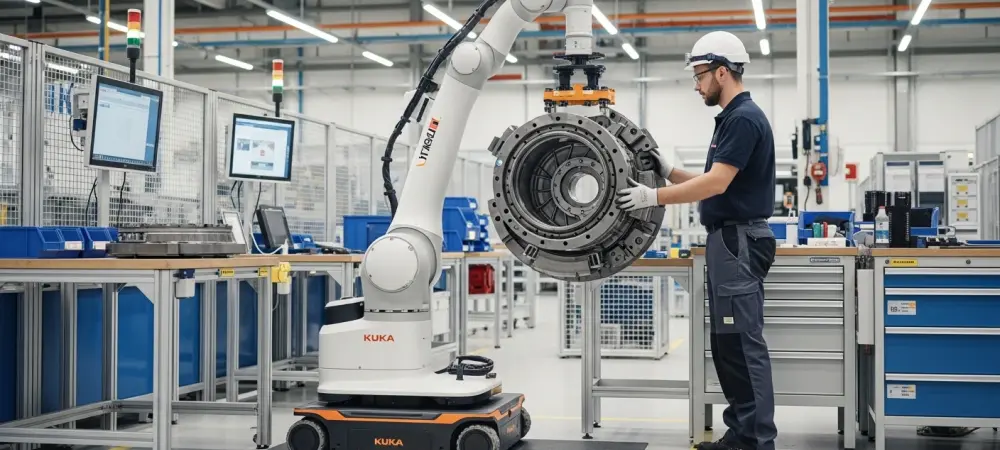
The relentless pursuit of efficiency on the factory floor has pushed traditional, fixed-path logistics systems to their breaking point, demanding a more intelligent and adaptable approach to material transport. This review assesses if KUKA’s Autonomous Mobile Robot (AMR) series is the strategic investment that modern industrial facilities need to pivot from rigid conveyance to dynamic intralogistics. The objective is to determine how KUKA’s technology addresses critical manufacturing challenges, such as enhancing material flow flexibility, overcoming persistent labor shortages, and fundamentally boosting operational efficiency across the production environment.
Setting the Stage Why KUKA AMRs Matter in Modern Manufacturing
In today’s high-mix, low-volume production landscape, the limitations of automated guided vehicles (AGVs) and manual transport are becoming increasingly apparent. Fixed magnetic strips or embedded wires create logistical bottlenecks, hindering the reconfigurability that is essential for competitive manufacturing. KUKA’s AMRs enter this space not merely as replacements for older systems but as a foundational technology for creating a truly smart factory. Their ability to navigate freely promises to untether production lines from predefined paths, enabling a fluid and responsive internal supply chain.
This analysis examines whether the KUKA platform delivers on this promise. It moves beyond technical specifications to evaluate the real-world impact of these machines. The core question is whether deploying KUKA AMRs can generate a tangible return on investment by solving pressing issues. These include reducing machine downtime caused by material starvation, enabling safer human-robot collaboration in shared workspaces, and providing the agility needed to adapt production layouts without costly infrastructure overhauls.
Under the Hood A Deep Dive into KUKAs AMR Technology
At the heart of KUKA’s offering is the KUKA Mobile Platform (KMP) series, a scalable family of AMRs designed to handle a wide spectrum of industrial payloads. The portfolio includes key models like the nimble KMP 250P for smaller components, the versatile KMP 1500P for standard pallet-sized loads, and the powerful KMP 3000P for heavy-duty transport. This tiered approach allows facilities to deploy a mixed fleet tailored to the specific weight and size requirements of different production stages, from sub-assembly lines to final packaging.
The technological core of these platforms is what sets them apart. KUKA AMRs utilize advanced SLAM (Simultaneous Localization and Mapping) navigation, which enables them to map their environment in real time and navigate without requiring any physical infrastructure like magnetic tapes or reflectors. This is complemented by sophisticated omnidirectional drive technology, granting the robots exceptional maneuverability. They can move sideways, diagonally, and rotate on the spot, allowing them to operate effectively in the tight and often congested spaces of a dynamic factory floor, a feat impossible for traditional transport systems.
Real-World Performance Assessing KUKA AMRs in Action
In practice, the combination of SLAM navigation and omnidirectional movement translates into remarkable agility. KUKA AMRs can intelligently reroute themselves to avoid temporary obstacles—whether a parked forklift or a group of workers—ensuring that material flow remains continuous even in unpredictable environments. This autonomous decision-making capability is critical for maintaining production uptime and reducing the need for human intervention in logistics management.
The platform’s integration readiness is another crucial performance metric. KUKA has engineered its AMRs to connect seamlessly with overarching factory management systems, such as a Manufacturing Execution System (MES) or Warehouse Management System (WMS). This allows for centralized fleet management and the orchestration of complex, multi-robot workflows. Furthermore, the robots are built to comply with stringent industrial safety standards, incorporating advanced sensors and safety controllers that enable safe collaboration with human personnel in shared operational zones.
The Balancing Act Strengths and Weaknesses of the KUKA Platform
The primary advantage of the KUKA AMR platform is its profound flexibility. By eliminating fixed routes, these robots empower manufacturers to reconfigure production lines quickly and cost-effectively. This inherent adaptability is supported by robust construction designed for the rigors of industrial use and a scalable product family that can address diverse payload needs within a single facility. Moreover, the backing of an established ecosystem, including expert system partners like Autotool, provides a strong foundation for tailored integration and long-term support.
However, adopting this advanced technology is not without its challenges. The initial capital investment for a fleet of AMRs and the associated fleet management software can be significant. The initial setup, including mapping the facility and programming workflows, is a complex process that requires specialized expertise. While highly capable, the performance of SLAM-based navigation can also be affected by challenging environmental conditions, such as highly reflective surfaces or rapidly changing layouts, which may require careful planning and calibration to mitigate.
The Final Verdict Is KUKA the Right Choice for Your Factory
This review concluded that KUKA’s AMR platforms represent a powerful and forward-looking solution for intelligent intralogistics. Their advanced navigation, robust design, and scalable nature directly address the modern factory’s need for agility and efficiency. The technology proved to be a significant leap beyond legacy systems, offering the autonomy required to build a truly responsive and data-driven production environment.
The overall value proposition is compelling for organizations committed to building a highly adaptable smart factory. KUKA’s AMRs are not just a tool for material transport; they are an enabling technology for creating flexible and resilient manufacturing operations. Consequently, the platform is strongly recommended for forward-thinking companies aiming to future-proof their internal logistics and gain a competitive edge through superior operational efficiency.
Strategic Considerations Who Stands to Gain the Most
The ideal adopters of KUKA’s AMR technology are organizations with highly dynamic production workflows where material flow is a critical and often variable component. This includes Tier 1 automotive suppliers, vehicle OEMs, and heavy machinery manufacturers who constantly adapt their assembly lines to accommodate new product variations or demand fluctuations. These industries stand to gain the most from the platform’s inherent flexibility and scalability.
To maximize the return on investment, a thorough needs analysis is paramount. Prospective users should not view AMRs as a simple drop-in replacement but as part of a comprehensive intralogistics strategy. Collaborating with an experienced integrator is essential for designing and implementing a system that is tailored to specific operational challenges. Ultimately, KUKA’s AMRs are more than just robots; they are a key component in advancing Industry 4.0 initiatives and creating the resilient, autonomous factory of the future.