

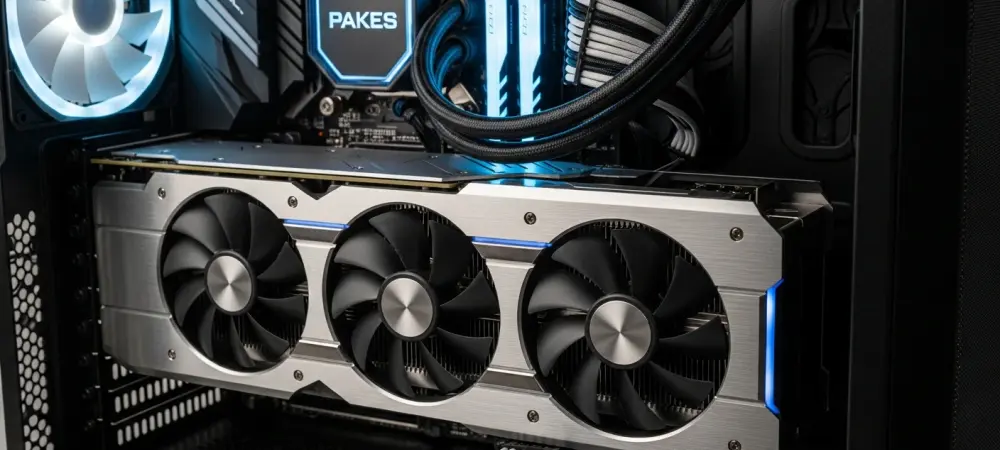
The professional workstation market is currently witnessing a tectonic shift as Intel’s Battlemage architecture pushes into territory once dominated solely by established giants. This hardware targets prosumers who require a stable environment for creative work while demanding high-tier performance for recreational activities. The Arc Pro B70 attempts to justify its cost by offering a dual-use profile that eliminates the need for separate gaming and rendering machines.
Evaluating the Professional and Recreational Value of the Arc Pro B70
Professional users often struggle to find hardware that balances rigorous stability with the leisure of high-end gaming. The Intel Arc Pro B70 emerges as a potential solution for those demanding high-fidelity output without switching systems. By addressing the needs of modern software suites, this card attempts to bridge the gap between creative productivity and recreational performance. Transitioning from legacy Intel graphics to the Battlemage architecture represents a significant leap in capability. The hardware is designed to handle modern titles that push the limits of geometry and lighting. However, the true value of the card depends on whether its workstation-grade certification translates into a seamless experience across all software categories.
Technical Architecture and Core Features of the Battlemage Platform
Central to this evolution is the BMG-G31 die, which represents the pinnacle of the current Battlemage platform. This hardware includes dedicated support for XeSS 3.0 and sophisticated Frame Generation capabilities. Furthermore, Intel utilizes a unified driver system that streamlines the experience across both discrete and integrated graphics, simplifying the workflow for complex professional environments.
This architecture prioritizes efficient data throughput and hardware-level acceleration for ray tracing tasks. By integrating these features directly into the workstation lineup, Intel ensures that professional tools can leverage the same graphical innovations found in consumer products. This synergy allows for a more versatile hardware footprint in modern offices.
Real-World Performance Evaluation and Benchmark Analysis
When tested within the demanding environment of Crimson Desert, the B70 maintained an impressive average of 70 to 80 FPS. Stability remained high even during intense combat scenarios, with 1% lows rarely dipping below 60 FPS. However, visual fidelity faced challenges; while the card excelled at Ultra settings, lower presets introduced significant shimmering and distracting artifacts.
While XeSS 3.0 provided a necessary boost to frame counts, it occasionally compromised image clarity through subtle detexturing effects. Interestingly, competitors like FSR 3.1 sometimes provided sharper visuals on this specific hardware. These observations indicate that while the raw processing power is substantial, the software stack still requires refinement to fully utilize the silicon’s potential.
Comparative Strengths and Structural Weaknesses
The primary advantage of the Arc Pro B70 lies in its ability to handle flagship titles at maximum settings where hardware limitations are less of a factor. Conversely, the card struggled with optimization flaws in mid-tier presets, often necessitating specific configuration tweaks. This reliance on fine-tuning highlights a lingering gap in the initial driver support.
Moreover, the hardware shows exceptional promise in high-load scenarios where raw bandwidth is the primary bottleneck. However, the persistence of shimmering on non-Ultra settings suggests that the current rendering pipeline needs more work. Users must weigh the high raw output against the potential for visual anomalies in less optimized scenarios.
Final Assessment and Recommendation
The B70 proved itself to be a competent workstation tool that successfully navigated the heavy requirements of modern gaming. While early adopters encountered software-related hurdles, the hardware demonstrated a solid foundation for growth. It was clear that the immediate adoption of this card offered great value for users who prioritized raw power over out-of-the-box software perfection. Ultimately, the card performed as a reliable bridge between two distinct worlds of computing. The decision to invest in this platform rested on the user’s willingness to manage occasional driver inconsistencies. Future updates were expected to smooth out the remaining visual bugs, making the B70 a forward-looking choice for the prosumer market.
Practical Guidance for Prospective Buyers and Early Adopters
Prospective buyers should focus on high-load scenarios to minimize graphical bugs and maximize the utility of the Battlemage architecture. Adjusting software settings to avoid known flickering artifacts is a vital step for achieving a smooth experience. Utilizing the Ultra preset often yields a more stable image than lower configurations due to current driver optimization paths.
Looking toward the future of Intel’s GPU ecosystem, the trajectory appears promising as driver updates continue to unlock latent capabilities. Prosumers should stay informed about third-party patches that can resolve specific texture issues. By maintaining an updated software environment, users can ensure that their workstation remains at the cutting edge of performance and visual accuracy.