

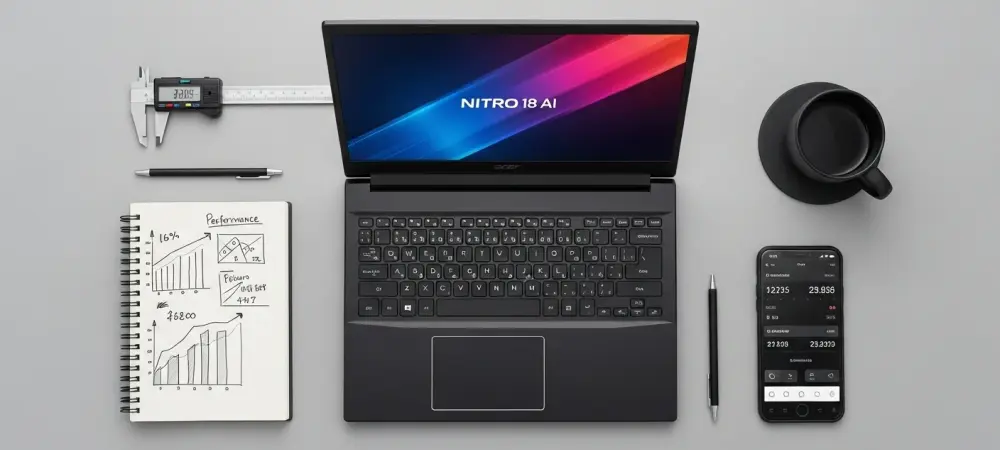
The allure of a high-performance gaming laptop often involves a delicate dance between raw power and tangible quality, a balancing act that the new Acer Nitro 18 AI attempts to perform on a very public stage. As gaming hardware becomes more powerful and AI integration promises a new era of intelligent performance, consumers are faced with a dizzying array of choices. Laptops like the Nitro 18 AI are designed to democratize access to elite-tier gaming, packaging cutting-edge components into a chassis that aims for a more accessible price point. The question, however, is not simply whether it can run the latest games, but whether the entire package delivers a user experience that justifies the investment.
This review seeks to answer that central question by dissecting the Acer Nitro 18 AI from every angle. It moves beyond raw benchmark numbers to evaluate the holistic experience of living with and using this machine daily. The objective is to determine if its powerful internals, headlined by AMD’s new AI-infused processor and Nvidia’s formidable graphics, are enough to overcome significant compromises in its physical construction and software stability. Ultimately, this analysis will illuminate whether this AI-powered gaming laptop is a savvy purchase for the budget-conscious enthusiast or a cautionary tale of cutting corners in the wrong places.
Is This AI-Powered Gaming Laptop a Smart Investment
The central purpose of this evaluation is to determine if the Acer Nitro 18 AI successfully merges next-generation gaming hardware with emerging AI capabilities to create a compelling and justifiable package. At its core, the laptop presents a value proposition built on performance-per-dollar, aiming to deliver an experience that rivals more expensive machines. This review will scrutinize that proposition, weighing the impressive on-paper specifications against the tangible, real-world experience. The focus extends beyond frame rates to encompass the day-to-day usability, build integrity, and software reliability that define a good laptop.
This analysis is particularly concerned with the trade-offs Acer has made to achieve the Nitro 18 AI’s competitive price. High-end gaming laptops are complex systems where every component choice impacts another, from thermal management to structural rigidity. The investigation will explore whether the cost-saving measures, particularly in build materials and quality control, create compromises that are too severe for the average user to overlook. By examining the balance between its powerful performance and its documented flaws, this review aims to provide a clear verdict on whether the Nitro 18 AI stands as a smart investment or a machine whose potential is ultimately held back by its weaknesses.
Technical Specifications and Design Philosophy
At the heart of the Acer Nitro 18 AI is a formidable array of components engineered for high-fidelity gaming. The configuration under review features the AMD Ryzen AI 9 365 processor, a chip that not only provides robust processing power but also integrates a dedicated Neural Processing Unit (NPU) for AI-driven tasks. This is paired with an Nvidia GeForce RTX 4070 Ti Laptop GPU, a powerhouse capable of driving graphically intensive titles with features like ray tracing and DLSS. The visual centerpiece is an expansive 18-inch WQXGA display with a 2560 x 1600 resolution and a 16:10 aspect ratio, providing a sharp, immersive canvas for both gaming and productivity. A generous port selection, including multiple USB-A and USB-C ports, HDMI, and Ethernet, solidifies its credentials as a versatile hub for peripherals.
The design philosophy of the Nitro 18 AI leans toward functional understatement rather than aggressive gamer aesthetics. Its all-black chassis presents a clean, utilitarian look, with customizable RGB keyboard lighting serving as the primary visual flourish. Acer has positioned this machine as a large-format desktop replacement, a role underscored by its sheer size and weight. Despite its large footprint, the profile is surprisingly slim for its class, with a thoughtfully truncated rear protrusion for cooling and port management. The integration of AI-specific hardware marks a clear step toward future-proofing, positioning the laptop not just as a gaming device but as a platform ready to leverage the next wave of AI-enhanced applications, from creative software to system optimization.
Real-World Performance and Stability Assessment
In its intended arena of high-end gaming, the Acer Nitro 18 AI performs admirably. The synergy between the Ryzen AI 9 processor and the RTX 4070 Ti GPU delivers impressive frame rates across a suite of modern AAA titles. Demanding games like Cyberpunk 2077 run smoothly, even at high graphical settings. With the highest ray tracing preset enabled, the game achieves a playable 30 frames per second, a figure that jumps to a fluid 50-70 fps when Nvidia’s DLSS Frame Generation technology is activated. This demonstrates the laptop’s capacity to leverage modern graphical technologies to provide a premium gaming experience without significant compromise on visual fidelity.
The laptop’s thermal and acoustic performance is another highlight. Under sustained heavy load from gaming, the cooling system works with remarkable efficiency. The chassis remains surprisingly cool to the touch, with key contact areas like the keyboard deck staying comfortably lukewarm. Moreover, the fans operate at a much lower volume than many competitors, even in the higher “Performance” mode. This allows the built-in speakers to be heard clearly over the fan noise, a rare achievement for a high-powered gaming machine. While a “Turbo” mode is available for maximum cooling, its acoustic footprint is still relatively restrained compared to the jet-engine roar of some rivals. However, the laptop’s sterling gaming performance is starkly contrasted by documented stability issues in general use. The experience was marred by intermittent and frustrating software problems that detract from its overall reliability. Common applications, including the native Windows Explorer and the Google Chrome browser, were observed to freeze unexpectedly, requiring forced restarts. More concerningly, the system repeatedly failed to complete the 3DMark Fire Strike benchmark, a standard diagnostic tool, and a routine Windows 11 security update consistently failed to install. While these could potentially be resolved with future software patches, their presence out of the box on a premium device is unacceptable and points to a lack of polish and quality control.
Strengths and Weaknesses at a Glance
The Acer Nitro 18 AI presents a balanced but polarized set of attributes. On the positive side, its primary strength is its raw gaming power. The combination of its AMD processor and Nvidia GPU provides exceptional performance that can handle the most demanding modern games with ease, making it a formidable machine for pure gaming enthusiasts. This power is supported by a surprisingly quiet and effective cooling system that keeps temperatures and noise levels in check, a significant advantage in the often-loud world of gaming laptops. Furthermore, the keyboard is a standout feature, offering a comfortable and responsive typing and gaming experience that is a joy to use for extended periods. All these strengths are packaged at a competitive price point that makes its high-end specifications accessible to a broader audience.
In contrast, the laptop is burdened by several significant weaknesses that severely limit its appeal. The most glaring issue is its poor build quality. The chassis and display lid exhibit noticeable flex, and the materials used feel non-premium, detracting from any sense of durability or value. This is compounded by a severely flawed touchpad that, on the tested unit, was plagued by phantom clicks and unresponsiveness, rendering it nearly unusable. Portability is also a major concern; its substantial weight of over 6.6 pounds makes it a cumbersome device to transport regularly, firmly rooting it in the desktop replacement category. Finally, the out-of-the-box software instability, with application freezes and update failures, casts a shadow over its reliability and suggests a rushed or incomplete quality assurance process.
Summarizing the Experience: A Capable but Flawed Machine
The comprehensive review of the Acer Nitro 18 AI reveals a machine of profound contradictions. It is a laptop that successfully delivers on its core promise of providing high-end gaming performance at a price that undercuts many of its direct competitors. For users whose sole priority is achieving high frame rates in the latest titles, the Nitro 18 AI offers a compelling package. Its processor and GPU combination is potent, its display is large and immersive, and its thermal management system is both effective and impressively quiet, creating an excellent environment for focused gaming sessions.
Despite these considerable strengths, the laptop is ultimately a flawed product. The compromises made to reach its attractive price point are not subtle; they are evident in nearly every aspect of the user experience outside of raw gameplay. The subpar build quality, characterized by a flexible chassis and cheap-feeling materials, inspires little confidence in its long-term durability. Coupled with the deeply problematic touchpad and concerning software instability, the overall package feels unpolished. Therefore, while the Nitro 18 AI is a capable gaming rig, the significant drawbacks in its construction, usability, and reliability prevent it from receiving a straightforward recommendation.
Final Thoughts and Purchase Advice
The experience with the Acer Nitro 18 AI was a study in paradoxes. It was a machine that simultaneously impressed with its gaming prowess and disappointed with its fundamental execution. This laptop is best understood as a specialized tool built for a very specific type of user: the stationary gamer who prioritizes raw performance above all else, including build quality, portability, and even day-to-day software reliability. For this individual, who plans to keep the laptop on a desk, use an external mouse, and primarily launch into games, the Nitro 18 AI offered a powerful and cost-effective solution. However, for the majority of potential buyers seeking a more well-rounded and dependable investment, this laptop was difficult to endorse. The compromises in chassis integrity, the failure of a critical input device like the touchpad, and the out-of-the-box software glitches were too significant to ignore. Prospective buyers were advised to carefully consider these shortcomings. For those with a slightly more flexible budget, exploring rivals from brands like Asus or even stepping up to Acer’s own more premium Predator line would likely result in a more satisfying and reliable long-term purchase. The Nitro 18 AI proved itself a capable performer, but its flaws suggested that a truly smart investment lay elsewhere.