

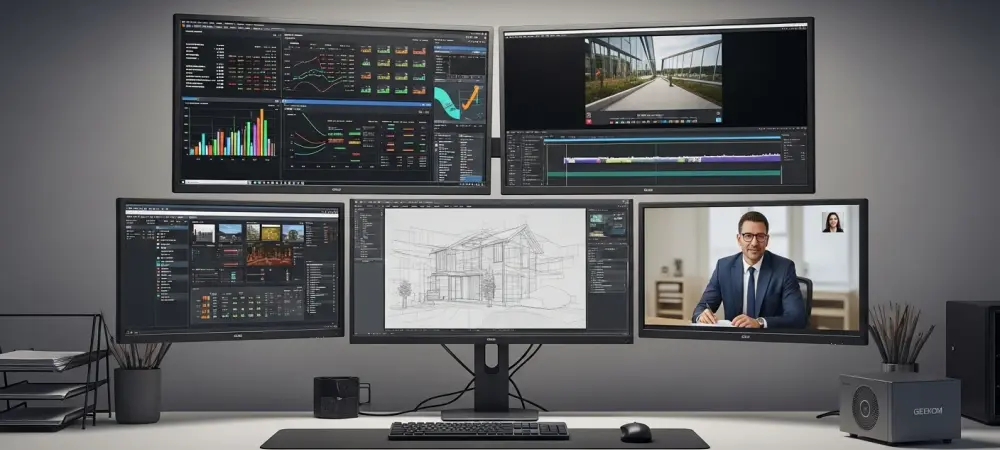
The long-held belief that high-performance computing requires a large, cumbersome tower is rapidly becoming a relic of the past as the mini PC market continues to mature. These compact devices are redefining expectations by packing immense power into space-saving designs. This review examines the Geekom AX8 Max, analyzing its core features, performance capabilities, and overall value proposition, especially considering its current promotional pricing. The goal is to provide a clear understanding of what this machine offers and for whom it is best suited.
An Introduction to the Power Packed Mini PC
The Geekom AX8 Max establishes itself as a formidable competitor in the crowded mini PC arena, meticulously engineered for users who refuse to compromise on power but demand a minimal footprint. It is built upon the foundation of AMD’s impressive Ryzen 8000 series processors, delivering a complete, out-of-the-box experience with Windows 11 Pro pre-installed. This positions the device as an ideal solution for productivity experts, creative professionals, and power users in search of a versatile computing workhorse.
In Depth Look at Core Features and Components
CPU Performance and System Memory
At the heart of the AX8 Max is the AMD Ryzen 7 8745HS, an eight-core, 16-thread processor that boasts boost clocks of up to 4.9GHz. This formidable CPU is more than capable of handling resource-intensive applications and complex multitasking with remarkable ease. To complement this processing power, the system comes equipped with a generous 32GB of high-speed DDR5 RAM and a 1TB NVMe SSD. This combination ensures lightning-fast boot times, swift application loading, and a consistently responsive user experience from the moment it is powered on.
Expansive Connectivity and Display Support
One of the standout features of the AX8 Max is its comprehensive array of I/O, designed to accommodate modern, multi-display workflows. It includes two advanced USB4 ports, each capable of driving an 8K display, alongside two HDMI 2.0 ports for 4K monitors, enabling a productivity-boosting quad-monitor setup. Furthermore, its networking capabilities are top-tier, featuring Wi-Fi 6E for fast wireless speeds, Bluetooth 5.3 for peripheral connections, and dual 2.5GbE LAN ports for ultra-reliable, high-bandwidth wired connections.
Innovative Cooling and Compact Design
Managing the thermal output of such powerful components within a small enclosure is a critical engineering challenge. Geekom addresses this with its proprietary “IceBlast 2.0” cooling system, a technology designed to maintain optimal temperatures and peak performance even under sustained heavy loads. Critically, this system achieves its cooling efficiency while keeping fan noise to a minimum. Users are also given the flexibility to choose between different performance modes, allowing them to prioritize either maximum computational power or near-silent operation, all within the device’s sleek and compact chassis.
Real World Performance and Application
The synergy between the potent Ryzen CPU and rapid DDR5 memory translates into exceptional capability across a wide range of real-world scenarios. While the AX8 Max handles standard office tasks and daily computing with effortless grace, its true potential is unlocked in more demanding environments. The machine excels in tasks like multimedia editing, complex data analysis, and heavy-duty productivity workflows. Performance benchmarks from independent reviews consistently place it in the upper echelon of mini PCs within its price bracket, validating its claims of desktop-class power.
Upgradability and Long Term Value
Geekom has designed the AX8 Max with an eye toward the future, incorporating significant potential for user-driven upgrades. The chassis is engineered for easy access to its internal components, a thoughtful touch that enhances its long-term viability. This design allows users to expand the system memory up to a massive 128GB. In addition, the pre-installed NVMe SSD can be easily swapped out for a larger capacity drive, giving users the freedom to adapt the machine’s storage as their needs evolve over time, thereby extending its useful lifespan and overall value.
Market Positioning and Price to Performance
Currently available at a promotional price of $639, a notable discount from its $749 retail price, the Geekom AX8 Max presents a truly compelling value proposition. It directly challenges competitors by offering a suite of specifications—including a high-end CPU, 32GB of next-generation RAM, and premium connectivity options—that are typically reserved for systems with a much higher price tag. This aggressive pricing strategy solidifies its position as an exceptionally attractive option for budget-conscious power users who are unwilling to sacrifice performance.
The Future of Compact Computing
The Geekom AX8 Max is a prime example of the prevailing industry trend toward miniaturization without compromise. Devices like this are effectively pushing the boundaries of what is achievable in a small form factor, demonstrating that a large desktop tower is no longer a prerequisite for high-end performance. This trajectory signals a shift where efficient, powerful, and compact mini PCs are poised to become a mainstream choice for a diverse range of professional and personal computing needs.
Final Verdict and Recommendation
The Geekom AX8 Max proved to be an exceptionally well-rounded mini PC that delivered on its promise of impressive performance and extensive connectivity. Its powerful processor and generous memory configuration handled demanding tasks with remarkable proficiency. Considering its upgradability and robust feature set, the machine represented excellent long-term value. At its discounted price point, it stood out as a premier choice, and it was a highly recommended system for anyone who sought to maximize performance while minimizing their desktop footprint.