

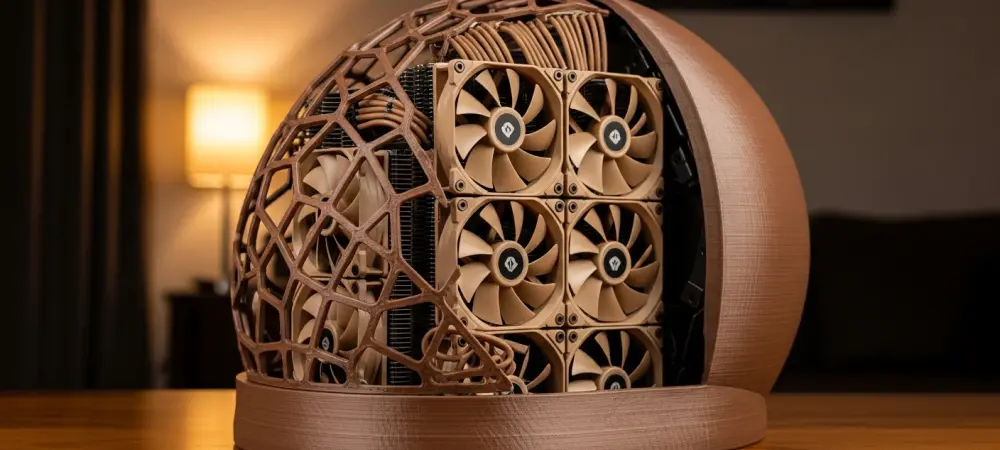
High-performance computing continues to push the boundaries of thermal management, often forcing enthusiasts to choose between complex liquid cooling loops and noisy, high-speed air intake systems. The emergence of a custom-engineered cooling solution known as the Superdome represents a radical departure from conventional PC case designs by utilizing a massive 3D-printed hemispherical structure to house fifteen high-efficiency fans. This project challenges the long-standing belief that internal airflow is a solved problem within the desktop hardware community, demonstrating that strategic placement and volume can overcome thermal plateaus. While most modern enthusiasts rely on standard chassis ventilation patterns, this experimental setup prioritizes high-volume air pressure directed specifically at the heat-generating components. By integrating fifteen Noctua NF-A12x25 fans into a single unified intake array, the creator sought to determine if overwhelming a system with ambient air could outperform even the most expensive custom liquid loops currently available on the market today.
Engineering a Hemispherical Airflow Powerhouse: Design and Efficiency
The structural foundation of the Superdome relies on sophisticated 3D printing techniques to create a geometry that is impossible to manufacture using traditional injection molding or sheet metal stamping. By designing a geodesic or hemispherical cap that replaces the entire side panel of a standard PC chassis, the engineer created a centralized air distribution hub that focuses airflow directly onto the motherboard and cooling radiators. Each of the fifteen Noctua fans is positioned at a specific angle, ensuring that there are no dead zones or pockets of stagnant hot air within the case interior. Despite the sheer number of moving parts, the design remains surprisingly elegant, utilizing a modular assembly process to secure each fan into its respective slot within the lattice. This construction method ensures structural rigidity while minimizing the vibrations that typically plague systems with high fan counts. Furthermore, the selection of premium components ensures that the mechanical load on the power supply remains within manageable limits.
Efficiency and acoustic performance are often the first casualties in extreme cooling experiments, yet the Superdome manages to maintain a sophisticated balance between raw power and silent operation. During standard workloads and intensive stress tests, the combined power draw of all fifteen fans remained remarkably low, typically consuming less than thirty watts of energy. This level of efficiency is a testament to the motor design of modern fans, which can move significant volumes of air without requiring an excessive electrical footprint. Perhaps even more impressive is the acoustic profile of the system, which avoids the high-pitched drone usually associated with server-grade cooling solutions. By utilizing high-quality bearings and optimized blade geometry, the array operates at a decibel level that is comfortable for daily use in a home office or gaming environment. The creator intentionally avoided high-speed industrial modes, proving that massive surface area and volume are often more effective than high-velocity turbulence when attempting to maintain a quiet floor.
Thermal Benchmarks and Future Considerations: Results and Analysis
The most compelling aspect of the Superdome project lies in the statistical data gathered during rigorous thermal testing on a high-end AMD Ryzen 9 5950X processor. Prior to the installation of the 15-fan array, the system utilized a high-end custom liquid cooling loop, which is generally considered the gold standard for thermal management in enthusiast-grade hardware. Under sustained load with a traditional glass side panel, the CPU stabilized at temperatures hovering between eighty-six and eighty-seven degrees Celsius. Once the Superdome was introduced, however, the results were instantaneous and dramatic, with temperatures plummeting to a steady sixty-six degrees Celsius. This twenty-degree reduction is particularly noteworthy because it occurred in a system that was already optimized with liquid cooling. The massive influx of ambient air effectively increased the heat dissipation rate of the existing radiators by preventing the buildup of heat within the chassis. This proved that even the most advanced liquid cooling solutions were still limited by the thermal environment.
The Superdome experiment successfully demonstrated that unconventional chassis geometry could fundamentally alter the thermal performance of high-end hardware. Designers and engineers who observed these results recognized that the standard rectangular enclosure often restricted the potential of even the most expensive cooling components. This project provided a clear blueprint for improving component longevity by essentially eliminating the thermal throttling that previously hindered performance during intensive workloads. By bridging the gap between raw experimental power and practical daily usability, the creator proved that massive airflow was a viable alternative to more complex cooling methods. The industry gained valuable insights into how localized air pressure could enhance existing liquid loops, leading to a new perspective on case design that prioritized fluid dynamics over aesthetic tradition. This approach offered a practical path for enthusiasts to achieve professional-grade results through the strategic application of 3D printing and high-volume intake arrays.