

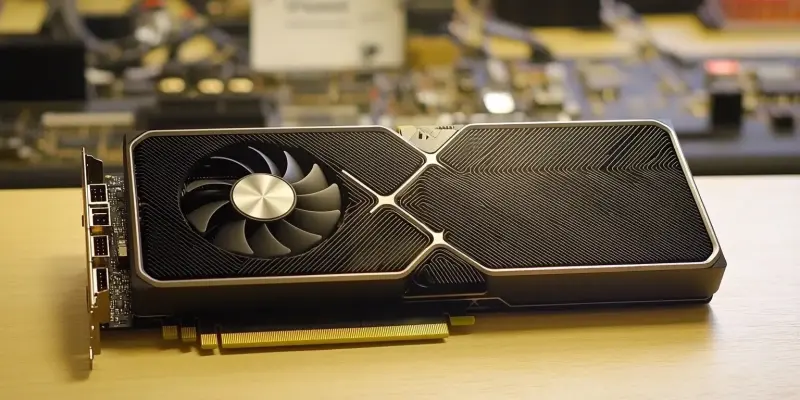
In a move that could significantly transform the landscape of GPU memory management, Nvidia has announced a groundbreaking texture compression technology designed to minimize VRAM usage. Known as Neural Texture Compression (NTC), this AI-based solution aims to reduce VRAM requirements by an impressive 95%, addressing a critical bottleneck faced by modern GPUs. This innovative technology, though still in its beta phase, has already shown promising results in a demo presented by Compusemble, offering a glimpse into the future of memory-efficient rendering.
Reducing VRAM Through AI Innovation
During the Compusemble demo, three distinct rendering modes were showcased, demonstrating the effectiveness of NTC. The “Reference Material” mode displayed the original uncompressed textures, while the “NTC Transcoded to BCn” mode utilized block-compressed formats for data compression. The most compelling of the three, “Inference on Sample,” dynamically decompressed textures in real-time. With a resolution set to 1440p and DLSS enabled, the NTC transcoded mode achieved a 64% reduction in texture memory usage. However, it was the “Inference on Sample” mode that truly stood out, achieving an astonishing 95.8% reduction in VRAM usage. This demonstrated the massive potential of NTC to alleviate VRAM constraints on contemporary GPUs, paving the way for more advanced and detailed graphics in future applications.
While the notable reduction in VRAM usage is a significant advantage, implementing NTC technology isn’t without its challenges. One notable issue is the additional load it places on Tensor Cores, the specialized AI processing units within Nvidia’s GPUs. This extra load, while manageable, can impact frame rates, particularly at higher resolutions. This is because Tensor Cores are already heavily utilized in AI-based tasks, including Nvidia’s Deep Learning Super Sampling (DLSS). Nonetheless, as Nvidia continues to refine their AI-powered rendering techniques, newer GPUs are expected to handle these demands more efficiently. This improvement is crucial for maintaining optimal performance while benefiting from the substantial VRAM savings that NTC offers.
Long-Term Impact on the Gaming Industry
The introduction of Neural Texture Compression signifies a significant milestone in the evolution of game rendering and other graphics-intensive applications. With VRAM being a finite resource, especially on consumer-grade GPUs, NTC’s ability to compress textures so effectively can lead to richer, more detailed visuals without the need for prohibitively expensive hardware upgrades. By shifting some of the computational workload to AI, game developers can push the boundaries of graphical fidelity, creating more immersive and intricate game worlds. This capability opens up new avenues for innovation in game design and development, as the constraints imposed by VRAM limits become less of a barrier.
Moreover, the broader implications of NTC extend beyond gaming. Industries relying on 3D graphics, such as virtual reality, film production, and architectural visualization, stand to benefit from this technology. As AI continues to advance, the efficiencies and improvements introduced by NTC could lead to faster rendering times, reduced hardware costs, and enhanced overall performance. The scalability of AI-driven solutions like NTC represents a paradigm shift in how computer graphics are handled, moving away from purely hardware-based approaches to more sophisticated, software-centric methodologies.
Future Considerations and Potential
Nvidia has unveiled a groundbreaking advancement in GPU memory management with the introduction of its Neural Texture Compression (NTC) technology. This AI-driven innovation is designed to drastically cut down on VRAM usage, achieving reductions of up to 95%. Modern GPUs have constantly struggled with the critical issue of VRAM bottlenecking, and NTC aims to address this problem effectively.
NTC, still in its beta phase, has already demonstrated significant potential. During a demo presented by Compusemble, it showcased the ability to enhance memory-efficient rendering, offering a promising look at the future of GPU performance. This demo showed how the technology can manage textures more efficiently, leading to enhanced gaming and graphic design experiences.
The implications of Neural Texture Compression extend beyond just gaming. It has the potential to revolutionize various industries that rely heavily on graphical processing, such as virtual reality, artificial intelligence, and professional visualization. By easing the VRAM demands, NTC could unlock new possibilities, making high-quality rendering more accessible and efficient for a broader range of applications.