

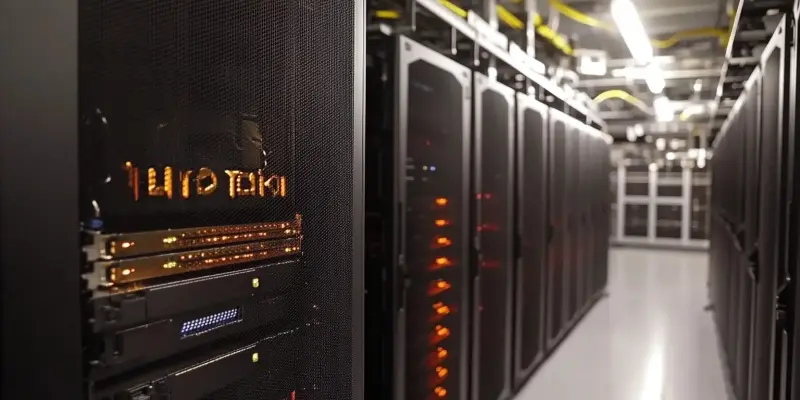
The pace of technological advancement continues unabated, captivating anyone with an interest in computing and national security. El Capitan, the world’s fastest supercomputer, exemplifies this trend by making significant strides that were unimaginable just a few years ago. Located at the Lawrence Livermore National Laboratory (LLNL) in California, this powerful machine has achieved a staggering milestone with 1,742 PetaFLOPS on the High-Performance Linpack (HPL) benchmark, outperforming its nearest competitor by 400 PetaFLOPS and achieving a peak performance exceeding 2,700 PetaFLOPS. Let’s delve deeper into the impressive specifications and applications of El Capitan.
Unmatched Performance
Cutting-Edge Hardware
El Capitan’s incredible performance can be attributed to its cutting-edge hardware, which includes 44,544 AMD MI300A APUs. These APUs integrate AMD’s Epyc Genoa CPUs and CDNA3 graphics cores, combining substantial computational and graphical power in a single package. Each APU is outfitted with 128GB of high-bandwidth memory (HBM), which, despite being more expensive and less common compared to GDDR6, GDDR6X, and GDDR7, delivers unparalleled speed and efficiency crucial for high-performance computing tasks. This marriage of technology ensures that El Capitan outperforms even the most formidable supercomputers available today.
The impressive synergy of AMD’s APUs enables El Capitan to handle both computational and graphical tasks with remarkable efficiency. This dual capability is pivotal in workflows involving complex simulations such as nuclear stockpile management and high-energy-density physics. By leveraging HBM, El Capitan ensures minimal latency and maximum throughput, effectively pushing the limits of what is achievable in real-time simulations. Consequently, the supercomputer has rapidly positioned itself as an indispensable asset within the realm of national security and advanced scientific research.
ExaFLOP Scale Performance
El Capitan is the third supercomputer to achieve exaFLOP scale performance. Though Aurora and Frontier have also reached exaFLOP scale, El Capitan surpasses their average performance significantly. This milestone underscores the United States’ commitment to maintaining its technological edge, particularly in fields where computational power is essential. The sheer scale of El Capitan’s performance opens new frontiers in capabilities, allowing for simulations and computations that were previously unattainable.
This exascale computing capability means that El Capitan can process at least 1 quintillion (that’s a billion billion) calculations per second. Such unprecedented power equips researchers to undertake more complex problems and provides insights that can drive innovations across various scientific and technical domains. From simulating astrophysical phenomena to analyzing large data sets for climate modeling, El Capitan’s exaFLOP capabilities pave the way for groundbreaking discoveries and contribute to maintaining national security.
Applications in National Security
Enhancing Nuclear Stockpile Management
One of the most critical roles of El Capitan is in managing and modernizing the United States’ nuclear stockpile. This supercomputer, developed by Hewlett Packard Enterprise for the National Nuclear Security Administration (NNSA) under the Department of Energy’s Coral-2 program, replaces the older Sierra supercomputer with a speed that is 15 times faster. The ability to perform highly detailed simulations means El Capitan can virtually predictive-test nuclear weapons, potentially replacing the need for underground testing.
El Capitan’s remarkable speed and computational power ensure that the U.S. remains at the forefront of nuclear security. Sophisticated simulations generated by this supercomputer help scientists and defense experts better understand the intricacies of nuclear reactions. They can more precisely predict the behavior of nuclear materials under various conditions, thereby ensuring the reliability and safety of the stockpile. This capability is essential not only for national security but also for global stability, as it enables more effective arms control and nonproliferation efforts.
Broader Defense Applications
Beyond nuclear stockpile management, El Capitan contributes significantly to other critical national security missions. The capabilities of this supercomputer extend to realms such as cybersecurity, where computational power is essential for detecting and responding to cyber threats in real-time. Additionally, its high-performance capabilities assist in reconnaissance and surveillance operations by efficiently processing and analyzing large volumes of data collected from various sources, including satellites and unmanned aerial vehicles (UAVs).
El Capitan’s versatility ensures it plays a pivotal role in both current and emerging defense strategies. Whether it’s optimizing logistics and supply chains or simulating potential combat scenarios for tactical advantage, the applications of El Capitan in national defense are numerous and far-reaching. The supercomputer’s ability to deliver quick and accurate data results enhances decision-making processes, ensuring preparedness and responsiveness to an ever-evolving array of national security threats.
Beyond Military Applications
Advancements in High-Energy-Density Physics
In addition to its critical defense applications, El Capitan helps advance scientific endeavors, particularly in the field of high-energy-density (HED) physics. This area of research, which studies matter under extreme conditions of temperature and pressure, benefits enormously from El Capitan’s ability to perform highly complex simulations with great precision. Researchers are making significant strides in understanding the fundamental properties of materials and their behaviors, potentially leading to innovative solutions in everything from energy generation to novel material design.
El Capitan’s unparalleled computational power allows scientists to simulate scenarios impossibly re-creatable in a physical lab, offering unprecedented insights into matter’s behavior under such conditions. This capability can lead to breakthroughs in creating more efficient energy solutions, potentially influencing everything from fusion energy research to advanced aerospace materials. Thus, while its primary mission remains national security, El Capitan’s contributions to fundamental science are equally transformative, with the potential to benefit society at large.
Facilitating Scientific Discovery
El Capitan’s impressive capabilities open new doors for a range of applications, from complex scientific research to enhancing national security measures. Its unparalleled processing power allows researchers to tackle problems of unprecedented scale and complexity. As we delve deeper into the specifications and potential uses of this technological marvel, El Capitan emerges as a symbol of how far computing power has evolved, setting new standards for innovation and capability in the field.