

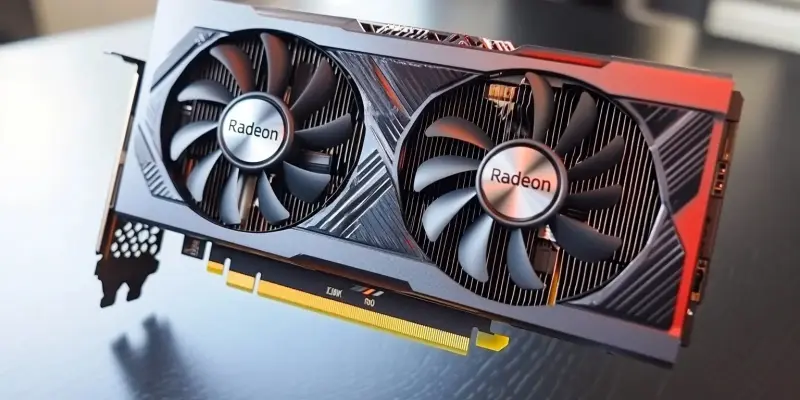
As the competition in the graphics processing unit (GPU) market intensifies, AMD is gearing up to challenge Nvidia with its forthcoming Radeon RX 9070 series, aiming to secure a notable position in the mid-range segment. This strategic move is particularly aimed at providing an affordable yet high-performance alternative to Nvidia’s GeForce RTX 50 series. With aggressive pricing and enhanced performance features, AMD is set to shake up the market dynamics.
AMD’s Pricing Strategy and Market Positioning
Competitive Pricing of Radeon RX 9070 Series
AMD is gearing up to price the new Radeon RX 9070 series competitively, aiming to undercut Nvidia’s offerings and attract price-conscious gamers and professionals. The expected MSRP of the Radeon RX 9070 XT at $599, which is $150 less than Nvidia’s RTX 5070 Ti, puts AMD in a strong position in the mid-range GPU market. Additionally, the standard RX 9070 is anticipated to be priced below the $549 RTX 5070, further enhancing its appeal to a broader market segment.
This aggressive pricing strategy reflects AMD’s commitment to delivering value without compromising performance. By significantly lowering the entry price for high-performance GPUs, AMD aims to lure gamers and content creators who seek top-notch performance without breaking the bank. This approach is crucial in a market where consumers are constantly looking for the best bang for their buck, and it sets the stage for fierce competition against Nvidia.
Radeon RX 9070 Series Specifications
The Radeon RX 9070 XT is expected to feature a Navi 48 GPU with impressive specs, including 4,096 cores, a 2.97 GHz boost clock, and 16GB of GDDR6 VRAM. These specifications highlight AMD’s shift toward catering to mid-range users who demand robust performance for gaming, content creation, and other GPU-intensive tasks. Moreover, the anticipated retirement of the RX 7800 XT further underscores AMD’s focus on the RX 9000 series as its new flagship in the mid-range segment.
By offering powerful hardware at a competitive price, AMD is poised to attract a significant share of the mid-range GPU market. The RX 9070’s specifications promise a substantial improvement in performance, allowing users to enjoy smoother gameplay, faster rendering times, and enhanced multitasking capabilities. This strategic shift aligns with AMD’s broader goals of democratizing access to high-quality GPU performance across different market segments.
Performance and Competitive Challenges
Real-World Performance Expectations
While the Radeon RX 9070 series shows promise on paper, its true competitive edge will hinge on real-world performance. Preliminary reports from sources like IGN and Hardware Unboxed suggest that the RX 9070 series delivers impressive rasterization performance and upscaling image quality. However, comprehensive testing is imperative to confirm how these GPUs stack up against Nvidia’s RTX 50 series, particularly in ray tracing and overall performance.
AMD’s ability to challenge Nvidia in hardware-accelerated ray tracing has historically been a weak point, but the increasing prevalence of ray-tracing-bound games underscores the importance of these capabilities. As such, AMD’s success will depend on its ability to provide effective ray tracing solutions without compromising other performance aspects. The RX 9070 series must demonstrate balanced performance across a range of applications to hold its own in the highly competitive GPU market.
Evolving Market Dynamics
Nvidia’s imminent release of the RTX 5070 Ti, expected on February 20, along with subsequent models like the RTX 5070, 5060 Ti, and 5060, sets the stage for a highly competitive landscape for AMD. AMD’s planned early March release of the RX 9070 series places it in immediate competition with Nvidia, making it essential for AMD to deliver on its performance promises. The GPU market’s dynamics are constantly evolving, with advancements in VRAM technology and other innovations influencing consumer preferences and performance benchmarks.
AMD’s success in this competitive arena will likely depend on its ability to meet the evolving demands of GPU-driven applications and games. The transition to GDDR7 VRAM in Nvidia’s new offerings brings higher speed and bandwidth advantages, potentially posing a significant challenge for AMD. Therefore, the Radeon RX 9070 series must deliver exceptional value and performance to capture the attention of a discerning audience in a rapidly changing market environment.
Conclusion
As the competition in the graphics processing unit (GPU) market heats up, AMD is preparing to take on Nvidia with the introduction of its much-anticipated Radeon RX 9070 series. This new lineup is designed to carve out a strong position within the mid-range segment, presenting a direct challenge to Nvidia’s GeForce RTX 50 series. AMD’s strategic initiative aims to offer consumers a viable, high-performance alternative without the hefty price tag often associated with Nvidia’s offerings.
By leveraging aggressive pricing strategies and integrating enhanced performance features, AMD is poised to disrupt the current market landscape significantly. This move is expected to attract a broader audience, particularly those looking for top-tier performance at a more accessible price point. The Radeon RX 9070 series is not just about affordability; it’s about meeting and exceeding performance expectations, ensuring that users get the best value for their investment. As the GPU market continues to evolve, AMD’s new series might just be the game-changer needed to shift consumer preferences and market dynamics.