

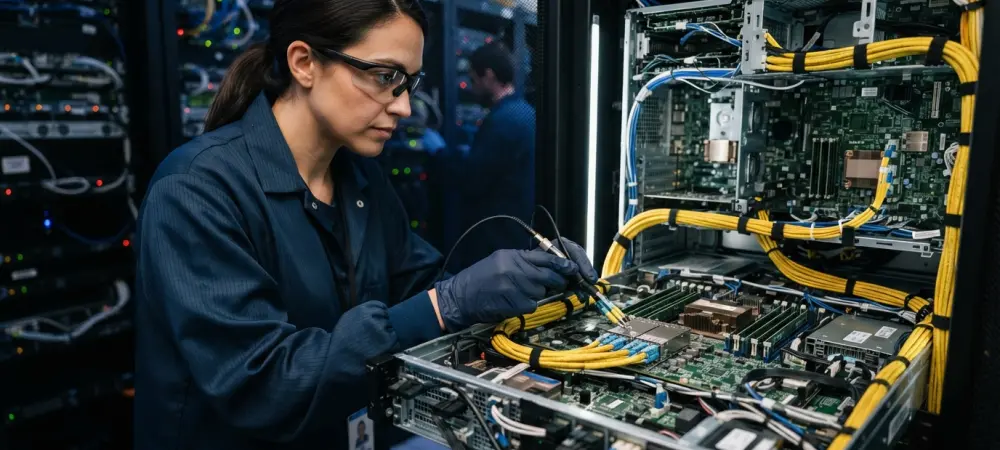
The traditional concept of a computer as a collection of separate chips is rapidly dissolving into a unified architecture where the entire server rack functions as a singular, massive processing unit. This transition represents a fundamental shift in how hyperscale data centers operate, moving away from modular components toward a holistic, rack-scale approach. As the demand for generative AI and complex simulation grows, the underlying hardware must do more than just increase clock speeds; it must redefine the relationship between memory, interconnects, and thermal management.
The Dawn of the Rack-Scale Superchip
The emergence of the Rubin Ultra architecture signals a departure from the era of discrete GPUs. While previous generations focused on individual card performance, this technology treats the entire rack as a single “Superchip.” By integrating compute, memory, and networking into a tightly coupled environment, the architecture minimizes the latency issues that typically plague distributed systems. This shift is essential for handling the massive datasets required by contemporary artificial intelligence research, where moving data between nodes often becomes a larger bottleneck than the actual computation.
This unified approach is particularly relevant in the current technological landscape because it addresses the physical limits of silicon scaling. As individual chips reach the boundaries of Moore’s Law, the industry has turned toward vertical integration and rack-level optimization. The Rubin Ultra ecosystem exemplifies this trend by consolidating 576 GPUs into a logical unit, allowing developers to treat a massive array of hardware as a single, programmable entity. This evolution streamlines the development of trillion-parameter models, making high-level AI more accessible to enterprise-scale operations.
Architectural Innovations and Hardware Specifications
The Kyber Rack System and Liquid Cooling
The infrastructure supporting this architecture has undergone a radical transformation with the introduction of the Kyber rack system. Moving away from the air-cooled Oberon designs of the past, Kyber utilizes a sophisticated liquid-cooling environment to manage the intense thermal output of high-density compute nodes. This transition is not merely an incremental upgrade; it is a necessity for maintaining operational stability when packing hundreds of high-performance GPUs into a single enclosure. The liquid-cooling system effectively doubles the thermal efficiency of the rack, allowing for higher clock speeds without the risk of thermal throttling.
Furthermore, the Kyber rack serves as the physical backbone for the Vera Rubin Ultra compute trays. Each tray houses a pairing of Rubin Ultra GPUs and a specialized Vera CPU, all interconnected via a direct liquid loop. This design allows for a much higher power density than traditional air-cooled data centers could ever support. By optimizing the physical layout for thermal dissipation, the architecture enables a smaller footprint for the same amount of computational power, which is a critical consideration for data center operators facing rising real estate and energy costs.
Memory Breakthroughs: HBM4e and TB-Scale Bandwidth
The integration of HBM4e memory marks a significant leap in data accessibility, providing up to 1 TB of capacity per individual GPU. This massive local memory pool is vital for storing the weights of enormous language models directly on the chip, reducing the need for frequent and slow off-chip data transfers. When scaled to the rack level, the aggregate memory capacity reaches an unprecedented 365 TB. This ensures that even the most memory-intensive tasks, such as high-resolution climate modeling or massive-scale financial simulations, can run without hitting traditional memory walls. The aggregate bandwidth of 4.6 PB/s at the rack level is perhaps the most impressive metric within this memory subsystem. Such high throughput is achieved by utilizing wider memory interfaces and improved signaling protocols that allow data to flow almost instantaneously between the HBM4e stacks and the processing cores. This level of bandwidth effectively solves the problem of “starving” the cores, ensuring that the computational power of the Rubin Ultra GPUs is never left idling while waiting for data. This synchronization between storage and processing is what defines the architecture’s efficiency.
Computational Throughput and FP4 Performance
In terms of raw processing power, the Rubin Ultra NVL576 system delivers a staggering 15 Exaflops of FP4 inference performance. This specific focus on FP4 precision reflects a strategic move toward more efficient numerical formats that maintain accuracy while significantly reducing the computational and energy cost per operation. For organizations running large-scale inference workloads, this translates to a massive increase in throughput, allowing for the real-time processing of complex queries that were previously too slow or expensive to execute at scale. Training efficiency has also seen a dramatic improvement, with a 14-fold increase over previous generations. This leap is not just about raw speed; it is about the ability to train 10-trillion-parameter models in a fraction of the time and with significantly less energy consumption. By optimizing the hardware for the specific mathematical requirements of deep learning, the architecture provides a platform that can keep pace with the exponential growth of AI complexity. This performance profile cements the Rubin Ultra as the primary tool for the next frontier of foundational model development.
Strategic Shifts in Interconnects and Optical Networking
To sustain these performance levels, the architecture implements the seventh generation of NVLink, which provides 1.5 PB/s of internal bandwidth. This interconnect technology is essential for maintaining the “Giant GPU” illusion, as it allows all 576 GPUs to share data with minimal overhead. However, the most transformative shift is the move toward Co-Packaged Optics (CPO). By integrating optical engines directly into the package, the system replaces traditional copper wiring with fiber optics for long-distance data transfer within the rack.
This shift to CPO is a direct response to the “memory wall” and the physical limitations of electrical signaling at high frequencies. Copper traces generate significant heat and suffer from signal degradation over even short distances, whereas optical signals can travel further with much lower power consumption. By utilizing these “yellow fibers” for networking, the system achieves a level of interconnect density that was previously thought impossible. This transition ensures that the networking hardware does not become a bottleneck as the number of processing cores continues to scale upward.
Real-World Applications in Hyperscale AI
The primary application for this architecture lies in the training and deployment of 10-trillion-parameter AI models. These models require a level of compute density that only a rack-scale system like Rubin Ultra can provide. In sectors such as pharmaceutical research, these systems are being used to simulate protein folding and molecular interactions at a scale that was previously restricted to national supercomputing labs. The ability to run these massive simulations in-house allows companies to accelerate their research cycles and bring new discoveries to market more quickly.
To streamline the adoption of such complex hardware, reference designs like the DSX Pod have been introduced. these designs act as blueprints for deploying massive supercomputing clusters, reducing the time required for physical installation and configuration. Organizations can now go from a bare data center floor to a fully operational AI cluster in roughly 14 days. This modularity is crucial for hyperscalers who need to scale their infrastructure rapidly to meet the fluctuating demands of the global AI market.
Implementation Hurdles and Market Obstacles
Despite its advantages, the deployment of Rubin Ultra technology faces significant implementation hurdles, most notably the extreme Capital Expenditure (CapEx) required. Outfitting a data center with liquid-cooled optical systems is a massive financial undertaking that many smaller organizations cannot afford. Additionally, the technical complexity of maintaining these systems is high; liquid cooling requires specialized plumbing and monitoring to prevent leaks, and optical interconnects demand precise alignment and clean environments to function at peak efficiency.
To mitigate these challenges, there is an ongoing effort to align the technology with Open Compute Project (OCP) standards. By creating modular “plug-and-play” designs, the goal is to make these high-density systems easier to service and more compatible with existing data center infrastructure. This push for standardization helps lower the barrier to entry by allowing third-party vendors to provide compatible components and maintenance services. This ecosystem-wide collaboration is essential for ensuring that the technology can be adopted beyond a few select tech giants.
The Future of NVIDIA’s Compute Roadmap
Looking toward the 2027–2028 rollout, the roadmap indicates a continued push for even higher integration densities. Future iterations of the Rubin architecture are expected to further refine the use of Co-Packaged Optics, potentially moving toward fully optical backplanes that eliminate copper entirely within the high-speed data path. This would represent the final step in the transition from electrical to optical computing, unlocking bandwidth levels that are currently unimaginable.
Furthermore, the long-term impact of the “Giant GPU” philosophy will likely redefine global data center architecture. We are seeing a move away from general-purpose servers toward specialized AI factories where the entire building is designed around the needs of a single, massive compute fabric. As optical signaling becomes more pervasive, the physical distance between compute nodes will become less of a constraint, allowing for more flexible and sprawling data center designs that can scale to meet the needs of future artificial intelligence.
Final Assessment of the Rubin Ultra Ecosystem
The Rubin Ultra architecture effectively synchronized memory, networking, and compute into a singular, high-performance ecosystem. This integration allowed for a level of efficiency that set a new benchmark for AI infrastructure, particularly in the handling of trillion-parameter models. The transition to liquid cooling and optical interconnects proved to be the right technical gamble, as it enabled the density required to sustain modern AI growth. The platform successfully addressed the most pressing bottlenecks in data center engineering, providing a clear path forward for hyperscale computing. The ecosystem established a definitive standard for how future supercomputers would be built. The industry recognized that the era of the individual GPU had passed, replaced by a world where the rack became the fundamental unit of compute. The strategic move toward HBM4e and NVLink 7 ensured that the architecture remained relevant even as model sizes continued to explode. Ultimately, the Rubin Ultra served as the critical bridge between traditional silicon-based computing and the burgeoning era of optical, rack-scale intelligence.