

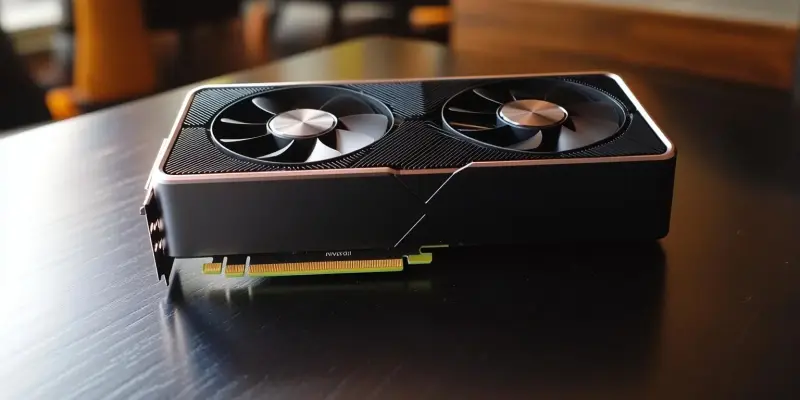
NVIDIA has once again pushed the boundaries of GPU technology with the release of the GeForce RTX 5070 Ti, a member of the RTX 50 “Blackwell” family unveiled in February 2025. As part of the latest generation, RTX 5070 Ti showcases several significant technological advancements, including new streaming multiprocessors, next-gen Tensor Cores, innovative Ray Tracing Cores, and cutting-edge AI management processors. These enhancements are designed to elevate both gaming and professional workloads to new heights, ensuring a blend of power, efficiency, and versatility.
The Enthusiast GPU Segment
Competitive Pricing and Positioning
The RTX 5070 Ti is strategically positioned within the enthusiast segment of the GPU market, carrying a competitive price tag of $749. This pricing is $50 less than its predecessor, the RTX 4070 Ti SUPER, making it an attractive option for gamers and professionals looking for high-end performance without the premium cost. This model aims to capture the interest of dedicated enthusiasts who demand top-tier performance but are conscious of value.
A standout within the lineup is the custom variant from Colorful, known as the Battle NX. This model is noteworthy for its extensive cooling capabilities, ensuring consistent performance even under heavy loads. Retailing at the manufacturer’s suggested retail price (MSRP), it offers a balanced package of cutting-edge technology and user-friendly features. The focus is clearly on delivering excellent value without compromising on the performance that GPU enthusiasts crave.
Architectural Innovations
At the core of the RTX 5070 Ti lies the Blackwell architecture, NVIDIA’s latest innovation that emphasizes AI optimization alongside traditional GPU functionalities. This architecture integrates a host of new features that collectively enhance gaming performance, computational efficiency, and versatility. The new streaming multiprocessors are designed to handle complex tasks more effectively, while the 5th Gen Tensor Cores and 4th Gen Ray Tracing Cores bring a significant leap in both AI-driven and ray tracing workloads.
The introduction of a high-performance GDDR7 memory subsystem also marks a substantial improvement in memory bandwidth and overall data handling capabilities. This subsystem ensures that the GPU can keep up with demanding tasks, from high-resolution gaming to intricate simulations. Additionally, the inclusion of Max-Q mode for both desktops and laptops highlights NVIDIA’s commitment to optimizing energy efficiency alongside raw performance, making the RTX 5070 Ti a well-rounded solution for a variety of uses.
Performance Benchmarks and Analysis
Synthetic Benchmarks
Performance benchmarks are a critical aspect of any GPU review, providing empirical data to support or refute performance claims. In synthetic benchmarks, the RTX 5070 Ti demonstrated impressive scores, consistently outperforming its predecessors and competing closely with higher-end models such as the RTX 5080. These benchmarks measure performance across a range of standardized tests, offering a comprehensive view of the GPU’s capabilities in controlled scenarios.
In tests involving computational workloads, the RTX 5070 Ti showed marked improvements, thanks to its advanced cores and enhanced architectural design. The GPU handled tasks with higher efficiency and speed, making it a viable tool for professionals engaged in computational research, 3D rendering, and other data-intensive applications. These synthetic benchmarks served as a testament to the significant engineering improvements brought by the Blackwell architecture.
Gaming Benchmarks and Ray Tracing
In gaming benchmarks, the RTX 5070 Ti excelled across various titles and graphics settings, offering an immersive experience that gamers expect from a high-end GPU. The focus was on evaluating its performance with up-to-date gaming technologies such as Vulkan, DirectX 12, and advanced ray tracing capabilities. The introduction of DLSS4 provided a notable performance boost, enabling smoother framerates and higher resolutions without compromising image quality.
Comparing DLSS3 versus DLSS4 and native 4K resolutions showcased the RTX 5070 Ti’s ability to handle demanding gaming environments with ease. Ray tracing performance, in particular, was a highlight, bringing lifelike lighting and shadow effects that added a new level of realism to gaming. This GPU’s ability to generate frames efficiently, combined with its cutting-edge cores, made it an excellent choice for gamers aiming for both visual fidelity and high performance.
Thermal Performance and Power Consumption
Efficient Cooling Systems
Thermal performance is a key consideration for enthusiasts who push their GPUs to the limit, and the RTX 5070 Ti did not disappoint in this regard. The Colorful Battle NX variant was equipped with extensive cooling systems that ensured the GPU maintained optimal temperatures even during prolonged gaming or computational sessions. The focus was on assessing how well the cooling solutions managed the heat generated by the powerful hardware.
The design of the cooling system involved a combination of large heatsinks, multiple fans, and heat pipes strategically placed to dissipate heat effectively. During stress tests, the RTX 5070 Ti performed admirably, keeping temperatures within safe ranges and preventing thermal throttling. This efficient cooling contributed to the overall stability and longevity of the GPU, making it a reliable choice for rigorous applications.
Power Efficiency
Power consumption is another crucial aspect, especially for users who run high-performance systems. The RTX 5070 Ti showcased an impressive balance between performance and power efficiency, thanks in part to the Blackwell architecture’s emphasis on energy optimization. The Max-Q mode played a significant role in this, adjusting power consumption based on the workload to ensure minimal energy wastage.
In various power consumption tests, the GPU demonstrated its ability to deliver top-tier performance without drawing excessive power. This made it suitable for both desktop and laptop configurations, catering to a wide range of user preferences. The RTX 5070 Ti’s power efficiency was a standout feature, aligning with broader industry trends towards sustainability and reduced environmental impact.
Conclusion and Future Prospects
NVIDIA has once again shattered the limits of GPU technology with the introduction of the GeForce RTX 5070 Ti. This card is part of the RTX 50 “Blackwell” series, which debuted in February 2025. Representing the newest generation in NVIDIA’s lineup, the RTX 5070 Ti excels with several groundbreaking technological enhancements. These include new streaming multiprocessors, next-gen Tensor Cores, innovative Ray Tracing Cores, and state-of-the-art AI management processors. Each of these components works together to deliver an unparalleled experience, driving advancements in both gaming and professional workloads. The RTX 5070 Ti is designed to seamlessly blend power, efficiency, and versatility, aiming to set new standards in the GPU market. Whether you’re a gamer seeking immersive experiences or a professional needing robust graphic performance, the RTX 5070 Ti promises to meet and exceed expectations, making it a cornerstone for high-performance computing in various demanding scenarios.