

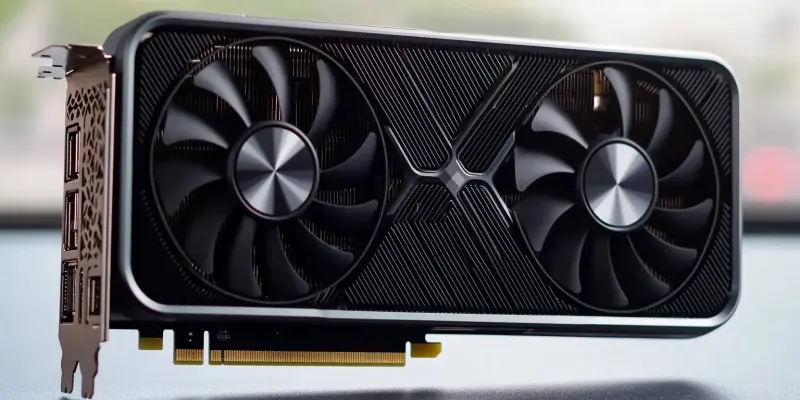
As Nvidia launches the GeForce RTX 5070 Ti, the graphics card aims to present significant advancements over its predecessor, the RTX 4070 Ti Super, particularly in terms of gaming and productivity performance. This new addition to Nvidia’s mid-range market is characterized by enhanced ray tracing, CUDA cores, and deep learning capabilities. The central question for users remains whether these improvements justify an upgrade from the RTX 4070 Ti Super. Let’s delve into the details to ascertain if the RTX 5070 Ti stands as a noteworthy successor deserving of investment.
Specifications and Architectural Differences
The architecture of the Nvidia GeForce RTX 5070 Ti and RTX 4070 Ti Super reveals several distinctions despite their shared heritage and similar manufacturing process. Both utilize TSMC’s 4N process and possess nearly identical die sizes, with the RTX 5070 Ti at 378mm² and the RTX 4070 Ti Super at 379mm². However, the RTX 5070 Ti sports the GB203 GPU, codenamed Blackwell, and the RTX 4070 Ti Super houses the AD103 GPU, known as Ada Lovelace. These architectural differences are pivotal in driving the improved performance of the RTX 5070 Ti.
Enhancements in the RTX 5070 Ti extend to the number and efficiency of CUDA cores, RT cores, and Tensor cores. Specifically, it features 8,960 CUDA cores compared to 8,448 in the RTX 4070 Ti Super, translating to a 6% increment. The fourth-generation RT cores in the RTX 5070 Ti increase to 70 from 66, and fifth-generation Tensor cores rise to 280 from 264, collectively fostering a significant 31% boost in RT TFLOPS and a 10% improvement in FP16 TFLOPS. These metrics underscore the RTX 5070 Ti’s superiority in gaming, rendering, and computation tasks.
Performance Enhancements
Performance is the bedrock of any GPU upgrade justification, and the RTX 5070 Ti offers marked improvements over its predecessor. With the adoption of GDDR7 modules clocked at 28Gb/s, compared to the GDDR6X at 21Gb/s in the RTX 4070 Ti Super, the RTX 5070 Ti experiences a 33% leap in memory bandwidth. This upsurge to 896GB/s from 672GB/s notably enhances the card’s capacity to handle high-demand applications and graphics-intensive tasks, ensuring smoother operation even under heavy loads.
These enhancements are vividly seen in increased frame rates and rendering efficiency. The RTX 5070 Ti’s architectural upgrades and superior CUDA core count lead to a more efficient processing mechanism, especially beneficial for real-time ray tracing and deep learning tasks. Analyzing benchmarks, there is consistently a noteworthy generational uplift which includes a demonstrated 24% improvement in ray tracing and a 21% improvement in rasterized rendering when evaluated through platforms like 3DMark Speed Way and Steel Nomad. These performance strides underline the RTX 5070 Ti’s prowess in delivering richer and more immersive visual experiences.
Gaming Performance
Gaming has always been a significant focus area for Nvidia, and the RTX 5070 Ti continues this legacy by pushing the boundaries of what’s achievable within the mid-range market segment. Benchmarks in gaming scenarios reveal a substantial generational uplift, most clearly in titles that leverage ray tracing features. For instance, in ray tracing-enabled games like Forza Motorsport and Cyberpunk 2077, the RTX 5070 Ti delivers enhanced performance, primarily attributed to advancements like Multi Frame Generation and DLSS (Deep Learning Super Sampling).
The ray tracing capabilities benefit exponentially from the RTX 5070 Ti’s fourth-generation RT cores and increased CUDA core count, both resulting in higher frame rates and improved graphics fidelity. Cyberpunk 2077 with the RT Overdrive preset showcases the card’s potential, obtaining a 19% boost in FHD native performance and a 21% increase at QHD. These gains are further enhanced through DLSS 4’s Multi-Frame Generation, which provides ultra-smooth gameplay in UHD resolutions. Consequently, gamers experience a more fluid and visually stunning gaming experience, significantly greater than what the RTX 4070 Ti Super offers.
Productivity Performance
While gaming performance often grabs the spotlight, productivity benchmarks also reflect the RTX 5070 Ti’s versatility. Though more modest, the productivity performance improvements are still noteworthy. For instance, in Blender, the card exhibits an 8% performance uplift, a seemingly small percentage that can nevertheless have substantial impacts over extended use. Similarly, the RTX 5070 Ti shines in deep learning tasks, a testament to its fifth-generation Tensor cores.
Geekbench AI tests reveal an 18% improvement over its predecessor, while the Procyon AI Text Generation benchmark indicates a 17% lead. These augmented performances underscore the RTX 5070 Ti’s capacity to handle AI-driven processes and tasks involving large datasets and complex computations more efficiently. As a result, professionals engaged in AI and deep learning fields may find the RTX 5070 Ti’s enhancements significantly beneficial. This broadens the GPU’s appeal, making it a viable option not just for gamers but also for users engaged in demanding productivity tasks.
Power Consumption and Thermal Performance
Higher performance naturally comes with increased power consumption, and the RTX 5070 Ti demonstrates this trade-off. Compared to its predecessor, it consumes 9W more at idle and 31W more under load, with a total power budget of 300W. This increase is expected and is reasonable, especially considering the substantial performance gains provided by the newer GPU architecture.
Thermal performance and acoustics are critical factors as well, often depending on the manufacturer’s cooling solutions. While neither the RTX 5070 Ti nor the RTX 4070 Ti Super has a Founders Edition to set a standardized comparison, general trends show acceptable thermal performance. In practical use, RTX 4070 Ti Super’s tests showed superior acoustics despite minor differences in chassis design. This suggests that while cooling efficiency may vary, the RTX 5070 Ti generally maintains respectable thermal performance without significant overheating, making it a reliable choice for extended gaming or productivity sessions.
Pricing and Availability
The cost-benefit analysis is crucial when considering an upgrade, and here the RTX 5070 Ti makes a compelling case. With an MSRP of $749, it emerges as a more economical option compared to the RTX 4070 Ti Super’s launch price of $799. This $50 reduction is particularly appealing to those seeking superior performance without a proportionately high increase in expenditure. However, the question of availability complicates the narrative.
Stock issues have plagued the RTX 50 Series, including the RTX 5070 Ti, limiting the models available at or near the MSRP. This scarcity could hinder accessibility for many potential buyers, necessitating a premium purchase over the suggested retail price. Nonetheless, for those securing the RTX 5070 Ti at its MSRP or a reasonable margin above, the investment promises justifiable returns in terms of enhanced performance and advanced features.
Final Thoughts
With the launch of the GeForce RTX 5070 Ti, Nvidia aims to deliver significant improvements over its predecessor, the RTX 4070 Ti Super, particularly in gaming and productivity performance. This new graphics card, positioned in Nvidia’s mid-range market, boasts advanced features like enhanced ray tracing, an increased number of CUDA cores, and improved deep learning capabilities.
For gamers and professionals alike, the central question is whether these upgrades justify making the switch from the RTX 4070 Ti Super. To assess whether the RTX 5070 Ti is a worthy successor, it’s crucial to examine its new attributes in detail. Moreover, considering the investment involved in transitioning to a new graphics card, potential buyers need to evaluate the card’s impact on performance enhancements and overall user experience.
The RTX 5070 Ti’s advancements in ray tracing contribute to more realistic lighting and shadow effects in games, pushing visual boundaries further than ever before. Its increased CUDA cores facilitate more efficient computations, enhancing productivity software performance and enabling smoother multitasking. Additionally, the card’s improved deep learning capabilities support more sophisticated AI applications and offer better performance in machine learning tasks.
In conclusion, evaluating if the RTX 5070 Ti deserves an upgrade involves weighing these substantial improvements against the needs and expectations of the user. Whether it’s gaming immersion or productivity enhancements, this new card promises considerable advancements. However, the decision ultimately hinges on individual preferences and specific use-case scenarios.