

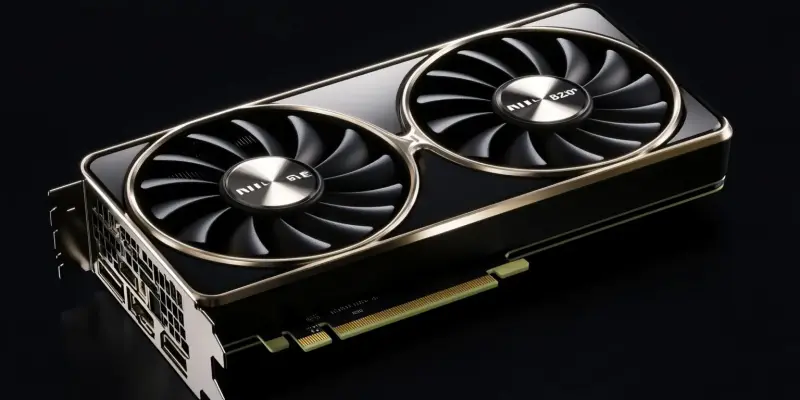
The MLPerf Inference v5.0 benchmarks have once again set the stage for an exciting showdown in the world of GPUs, featuring the latest powerhouses from NVIDIA and AMD. At the forefront of this high-stakes performance battle are NVIDIA’s Blackwell B200 and AMD’s Instinct MI325X, both pushing the limits of AI and machine learning capabilities. These benchmarks offer a glimpse into the future of artificial intelligence, with each company’s offerings demonstrating significant advancements in throughput, memory capacity, and software optimization.
NVIDIA’s Blackwell B200 GPUs have raised the bar significantly, highlighted by the formidable GB200 NVL72 system that integrates 72 Blackwell GPUs. This intricate configuration allows the system to function as a single, cohesive entity, dramatically boosting performance. On the Llama 3.1 405B benchmark, the GB200 NVL72 system delivered an astounding 30 times higher throughput compared to its predecessor, the ##00 NVL8 system. The remarkable increase primarily stems from over triple the per-GPU performance and a ninefold enhancement in the NVIDIA NVLink interconnect domain. This unprecedented performance boost is not just a testament to hardware prowess but also illustrates strategic advancements in NVIDIA’s systemic integration.
NVIDIA also demonstrated its supremacy on the Llama 2 70B Interactive benchmark, where the DGX B200 system excelled by tripling the performance of the previous ##00 system. This system’s performance translated to five times shorter TPOT (time per output token) and 4.4 times lower TTFT (time to first token), significantly improving user experience and efficiency. Such metrics underscore NVIDIA’s ability to optimize AI workloads and deliver superior interactive experiences, which are crucial in modern AI applications where real-time processing and responsiveness are pivotal.
AMD’s Instinct MI325X: Competitive but Unmatched
In contrast, AMD’s submission for the MLPerf Inference v5.0 benchmarks with the Instinct MI325X 256 GB accelerator exhibited a commendable yet less dominant performance. The larger memory capacity of the Instinct MI325X indeed provided an edge, especially in handling large language models, positioning it as a competitive alternative to NVIDIA’s ##00 system. Nonetheless, when put head-to-head with the Blackwell B200, the Instinct MI325X fell short in delivering the same level of breakthrough performance.
AMD’s Instinct MI325X showcased the company’s dedication to growing its AI and machine learning capabilities. However, to match NVIDIA’s Blackwell B200, AMD must focus on substantial advancements in both hardware design and software optimization. Despite its larger memory offering evident advantages in specific scenarios, the overall efficacy of the GPU was not enough to outshine NVIDIA’s advancements. This disparity underscores a critical focal point for AMD in its future endeavors to remain competitive—the need for a more holistic enhancement in its technology.
Moreover, looking forward, NVIDIA’s announcement of the B300 Ultra platform later this year casts a looming shadow over AMD’s current offerings. The anticipation surrounding the B300 Ultra’s capabilities may potentially widen the performance gap even further, suggesting a highly challenging environment for AMD to compete in the GPU space. This intensifies the urgency for AMD to innovate and possibly reassess its approach to developing next-generation AI accelerators to carve a stronger foothold in this evolving market.
Continuous Improvement and Future Challenges
The analysis of the MLPerf Inference v5.0 benchmarks also brings to light the iterative improvements seen in NVIDIA’s Hopper ##00 benchmarks. With a 50 percent increase in inference performance compared to the results from the previous year, these benchmarks reflect NVIDIA’s ongoing commitment to optimization. This upwards trajectory highlights how iterative refinements in hardware and software can significantly boost AI workload efficiencies, suggesting a continual evolution in GPU technologies.
Such incremental progress emphasizes the future challenge for all competing firms in the GPU space—continuous improvement is essential. As NVIDIA pushes the boundaries with each new generation of their systems, rivals like AMD must similarly adopt a strategy of relentless innovation and fine-tuning. The importance of software optimizations plays a central role in elevating raw hardware capabilities, and as AI and machine learning applications grow more complex, this aspect will become increasingly critical.
Ultimately, this dynamic landscape of GPU advancements beckons a broader reflection on the role of memory capacity and integrative software solutions. Superior inference performance hinges not merely on raw hardware superiority but also on how these elements are orchestrated through intelligent software frameworks. This interconnected approach defines the cutting edge of today’s AI and machine learning performance metrics.
The Path Ahead
The MLPerf Inference v5.0 benchmarks have once again ignited an intense GPU competition, spotlighting the latest from NVIDIA and AMD. At the forefront are NVIDIA’s Blackwell B200 and AMD’s Instinct MI325X, both vying to push AI and machine learning boundaries. These benchmarks provide insights into the future of artificial intelligence, showcasing substantial improvements in throughput, memory, and software optimization.
NVIDIA’s Blackwell B200 has notably raised the bar, with the GB200 NVL72 system featuring 72 Blackwell GPUs. This sophisticated setup enhances performance by functioning as a unified entity. In the Llama 3.1 405B benchmark, the GB200 NVL72 system achieved 30 times the throughput of its predecessor, the ##00 NVL8 system, primarily due to over three times the per-GPU performance and a ninefold NVLink interconnect improvement. This exceptional boost underscores advancements in both hardware and systemic integration.
NVIDIA also excelled in the Llama 2 70B Interactive benchmark, where the DGX B200 system tripled the performance of the ##00 system, resulting in five times shorter TPOT and 4.4 times lower TTFT. These improvements highlight NVIDIA’s ongoing efforts to optimize AI workloads, delivering superior interactive experiences that are crucial for modern AI applications needing real-time processing and responsiveness.