

A single unrecorded fifteen-minute delay on a high-velocity assembly line often ripples through a manufacturing facility, eventually ballooning into thousands of dollars in lost throughput by the end of a single production shift. In the current industrial landscape, where every second on the production line translates directly to the bottom line, manufacturers find that relying on manual estimates to track their most expensive resource is a recipe for fiscal disaster. The transition from simple attendance monitoring toward granular operation timing is no longer a luxury reserved for the industrial elite; it is a fundamental requirement for operational survival. When a manufacturer successfully eliminates the gap between the factory floor and the back office, they transform labor from a vague overhead cost into a strategic asset that can be optimized in real time. This digital transformation allows leaders to move beyond the guesswork that has historically plagued production schedules, replacing intuition with cold, hard data that reflects the actual state of the shop floor at any given moment.
The High Cost of the Information Lag in Modern Production
The persistent delay between an event occurring on the factory floor and its appearance in management reports creates a phenomenon known as the information lag, which carries a staggering price tag. This gap in visibility prevents supervisors from making informed decisions, forcing them to rely on historical data that may already be irrelevant by the time it is reviewed. In a high-speed environment, a delay of even a few hours in identifying a bottleneck can lead to missed shipping deadlines and strained customer relationships. By the time the paperwork reaches the front office, the opportunity to pivot resources or adjust machine assignments has often vanished, leaving the company to deal with the fallout rather than preventing the issue in the first place. When labor is treated as a vague, aggregated expense rather than a series of precise, value-added actions, the ability to calculate true product profitability becomes nearly impossible. Manufacturers often find themselves overproducing low-margin items while neglecting high-profit orders, simply because they lack the granular insight into how much time is actually spent on each specific task. Closing this visibility gap turns the production process into a transparent flow where every movement is measured against the plan. This level of oversight ensures that labor is not just a cost to be managed, but a resource to be deployed with surgical precision, ensuring that the most valuable assets of the company are always working on the most profitable tasks.
Furthermore, the psychological impact of a visible, real-time tracking system on the workforce should not be underestimated. When employees realize that their contributions are being recorded with accuracy, it often fosters a culture of accountability and pride in performance. Conversely, the absence of such systems can lead to a sense of apathy, where the lack of measurement suggests that efficiency is not a priority for leadership. By establishing a direct link between the physical work performed and the digital record of the company, manufacturers create a unified environment where every participant understands their role in the broader success of the enterprise.
From Paper Trails to Digital Precision: Why Tracking Matters
The manufacturing sector has long struggled with a visibility vacuum created by legacy systems that rely on the physical movement of paper through a facility. Whether it is paper-based timecards, handwritten production logs, or disconnected spreadsheets, manual data entry remains the primary enemy of accuracy. Relying on an operator’s memory at the end of a grueling shift inevitably leads to rounding errors, transcription mistakes, and lost information. This data friction does more than just muddy the books; it forces management into a reactive mode, where problems are discovered days or weeks after they occur. Connecting the shop floor directly to the enterprise resource planning system is the only way to ensure that financial decisions are based on the reality of the floor rather than optimistic guesswork.
Manual systems also create an enormous administrative burden that siphons time away from productive activities. Office staff often spend hours deciphering illegible handwriting or tracking down missing signatures, a process that adds no value to the final product but increases the overhead costs of the business. This administrative drag slows down the entire organization, delaying the closing of financial periods and making it difficult to generate accurate quotes for new business. By moving toward digital precision, companies can automate these clerical tasks, allowing their administrative teams to focus on higher-level analysis and strategic planning rather than data entry and correction. Accuracy in tracking also serves as the foundation for continuous improvement initiatives. Without a reliable baseline of how long tasks actually take, it is impossible to measure the effectiveness of new tools, processes, or training programs. Digital tracking provides the objective evidence needed to validate Lean or Six Sigma projects, ensuring that investments in efficiency are actually delivering the expected results. When every minute is accounted for, the company can identify the specific points where time is being wasted, whether it is due to excessive setup times, machine idle periods, or inefficient material handling, allowing for targeted interventions that yield the highest return.
The Foundation: Leveraging Microsoft Dynamics 365 Business Central
Modern efficiency begins with a robust, cloud-based foundation like Microsoft Dynamics 365 Business Central, which serves as the central nervous system for a manufacturing enterprise. This platform allows companies to move away from disparate data silos by centralizing production data, inventory levels, and labor records in a single, accessible location. By integrating these different facets of the business, the system provides a comprehensive view of the operation that was previously unattainable. The ability to see how a delay in a raw material delivery affects the labor schedule and, ultimately, the delivery date for a customer is a powerful tool for maintaining competitiveness in a crowded market.
Within the framework of Business Central, manufacturers utilize digital production journals to log labor against specific work centers with high precision. This integration allows for the definition of complex routings, including detailed setup and run times, which automatically update the status of production orders as work progresses. When workers interact with these digital journals, they are not just recording their time; they are providing the system with the information it needs to calculate the remaining capacity of the facility. This real-time update of capacity is essential for accurate scheduling, ensuring that the sales team does not promise delivery dates that the shop floor cannot possibly meet.
The financial integration provided by this platform ensures that labor costs are instantly reflected in the valuation of finished goods. When a worker posts time against a specific operation, the system calculates the cost based on the worker’s rate and the overhead of the work center, applying that cost directly to the production order. This provides an accurate picture of job costing that manual systems simply cannot match, allowing management to see the true margin of every item produced. This level of financial transparency is critical for identifying which products are truly profitable and which may require a price adjustment or a more efficient production method.
Overcoming the Keyboard Barrier on the Shop Floor
While a robust enterprise resource planning system provides the necessary infrastructure for data management, its standard interface is often designed for an office environment rather than the rugged reality of the factory. Asking a machinist with gloved hands to navigate a complex software menu on a standard laptop can actually decrease productivity and lead to frustration among the workforce. This mismatch between the software and the physical environment creates what is known as the keyboard barrier, where the difficulty of entering data becomes a deterrent to accurate reporting. For a tracking system to be effective, it must be as easy to use as the tools the workers use to build the products.
Furthermore, native enterprise systems often lack the automated logic required for the complex payroll rules that are common in manufacturing settings. Features such as shift differentials, mandatory break deductions, and overtime calculations often require manual intervention if the software is not specifically tailored for the shop floor. These technological gaps create a significant need for specialized solutions that act as a bridge between the high-level financial modules and the fast-paced demands of the production line. Without this bridge, the data collected remains incomplete, and the administrative burden of reconciling shop floor hours with payroll records persists.
The challenge is to provide a user interface that is intuitive enough for a new hire to use with minimal training, yet powerful enough to capture all the necessary data points. On the shop floor, every second spent interacting with a computer is a second not spent on production. Therefore, the goal of any modern tracking solution should be to minimize the time spent on data entry while maximizing the quality of the information gathered. By removing the friction associated with traditional software interfaces, manufacturers can ensure higher compliance rates and more accurate data, leading to a more reliable system of record for the entire organization.
Bridging the Gap with Shop Floor Insight
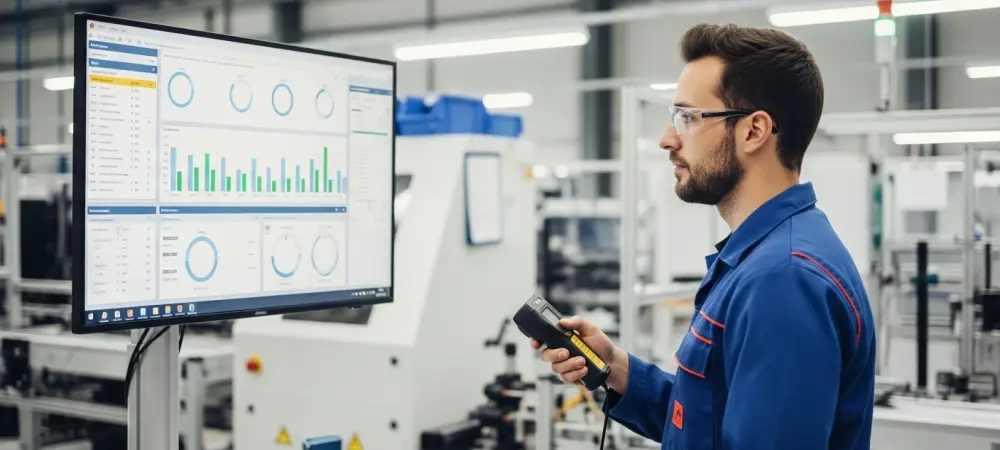
To transform a standard enterprise system into a high-performance manufacturing execution system, industry leaders turn to integrated solutions like Shop Floor Insight. These specialized tools are designed to simplify data capture while significantly enhancing the depth and accuracy of the information collected. By focusing on the specific needs of the operator, these solutions remove the barriers to data entry and provide a more streamlined experience. This specialized software acts as a translator, taking the complex requirements of the production schedule and presenting them to the worker in a simple, actionable format that encourages accurate reporting. The use of barcode-centric workflows is a primary method for achieving this rapid and accurate data entry. By replacing manual typing with simple barcode scanning, operators can clock into jobs, initiate setup times, or record the output of a machine with a single swipe of a scanner. This approach virtually eliminates human error, as there is no risk of mistyping a production order number or a work center code. The time required for an operator to log their activities is reduced from minutes to seconds, ensuring that the tracking process does not interfere with the primary task of manufacturing. This speed and accuracy are essential for maintaining a real-time view of the factory’s progress.
Advanced tracking systems also enable a philosophy of management by exception, allowing supervisors to focus their attention where it is most needed. Instead of reviewing every single time entry for every employee, the system highlights anomalies, such as unauthorized overtime, missed breaks, or production runs that are taking significantly longer than the standard estimate. This allows leadership to spend more time on the floor solving problems and less time in front of a screen auditing logs. Additionally, capturing non-productive time spent on maintenance or meetings provides a comprehensive view of labor allocation, revealing the hidden costs that often go unnoticed in less sophisticated systems.
Mobility and the Future of the Connected Workforce
The modern manufacturing environment is a fluid space that requires systems to be device-agnostic and mobile-ready to keep up with the pace of change. Whether using fixed industrial terminals, rugged tablets, or even smartphones, workers and supervisors need the flexibility to manage their tasks from anywhere in the facility. This mobility ensures that data is captured at the point of activity, rather than hours later at a centralized kiosk. By bringing the technology to the worker, manufacturers eliminate the dead time spent walking back and forth to a computer, further increasing the efficiency of the entire operation.
Enhanced tracking also allows for the total integration of material handling and production tasks, creating a seamless flow of information throughout the warehouse and the shop floor. A worker used a single handheld device to pick the necessary raw materials for a job and then immediately clocked into the production operation, ensuring that the digital twin of the factory stayed perfectly in sync with the physical movement of goods. This level of integration reduced the risk of errors and ensured that inventory levels were always accurate, preventing the dreaded situation where a production run was delayed due to a missing component that the system claimed was in stock.
The integration of artificial intelligence within the industrial ecosystem marked the next major frontier in efficiency. By analyzing the granular data collected by shop floor tools, intelligent agents identified patterns that suggested machine failures or process inefficiencies before they resulted in actual downtime. These predictive capabilities allowed maintenance teams to intervene at the optimal moment, extending the life of the equipment and maintaining a steady flow of production. This synergy between human labor and intelligent analysis ensured that the factory was always operating at its peak potential, turning data into a powerful tool for long-term competitiveness.
Practical Steps for Implementation and ROI
The transition to an automated shop floor tracking system represented a strategic move that typically yielded a substantial return on investment within a short timeframe. The first step in this process involved auditing current workflows to identify instances of labor leakage, which were those small, unrecorded gaps in time that accumulated into significant financial losses. Automated systems eliminated these ghost hours by providing a clear audit trail for every minute spent on the factory floor, ensuring that the company only paid for the work that was actually performed. This initial transparency often revealed surprising insights into where time was being lost in the existing process.
Modern solutions were often priced on a per-employee basis, which made them highly accessible for mid-sized manufacturers who needed to scale their operations without incurring massive upfront costs. A typical implementation was completed within a period of four to six weeks, allowing companies to capture efficiency gains of twenty to thirty percent almost immediately. These gains were achieved through improved scheduling, a reduction in administrative overhead, and the ability to identify and eliminate bottlenecks in real time. The speed of the implementation ensured that the disruption to daily operations was kept to a minimum, while the benefits were realized quickly.
As the system became more integrated into the daily routine, the focus shifted toward using the data for long-term strategic growth. Manufacturers analyzed historical performance to refine their quoting process, ensuring that every new contract was priced accurately based on proven labor requirements. This data-driven approach to business development allowed companies to compete more effectively in the global market, as they had a much clearer understanding of their own cost structure. The conclusion of the implementation phase was not the end of the journey, but rather the beginning of a new era of data-driven manufacturing where continuous improvement was built into the very fabric of the organization. Companies that embraced these changes successfully moved away from reactive management and toward a future of proactive optimization.