

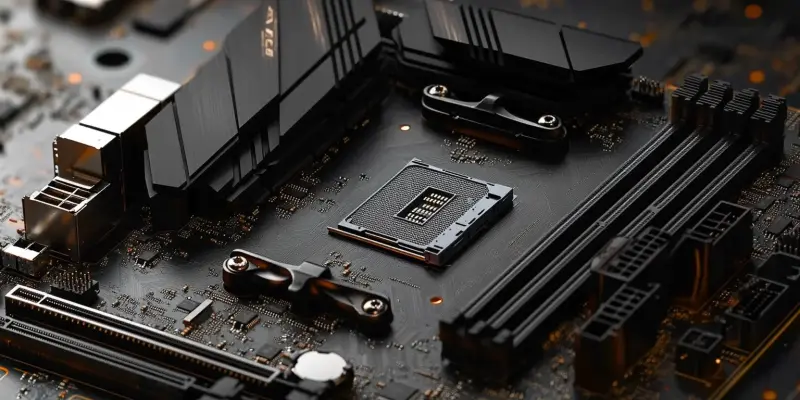
In the ever-evolving world of technology, the year 2025 sets a new benchmark for what PC builders and tech enthusiasts expect from their hardware. Budget constraints often push builders to consider motherboards priced below $200, but these come with notable limitations. While these motherboards generally perform well in areas such as performance, connectivity, and input/output (I/O) options, they often fall short in several crucial aspects expected by contemporary PC builders and tech enthusiasts. This article delves into the essential features that many motherboards priced below $200 commonly lack as of the year 2025.
Essential Features Often Missing
When diving into the specifications of motherboards under $200, several critical features are consistently absent. Among these, the insufficient number of M.2 slots is particularly notable. Multiple M.2 slots have become a necessity, especially with the rise of NVMe SSDs, which offer superior speed and performance for modern computing needs. Builders find one or two slots inadequate for their storage needs, limiting system expansion and future upgrades. Adding to this, Gen5 support is increasingly important for future-proofing systems. Unfortunately, this support is rare in budget motherboards, leaving users with fewer options for expanding their storage capabilities effectively. Another significant shortfall in sub-$200 motherboards is the lack of USB 20 Gbps ports. The importance of USB 20 Gbps ports can’t be overstated, as faster data transfers are essential in the modern computing environment. The absence of these ports restricts performance, particularly when using high-speed external devices or transferring large amounts of data. Moreover, modern peripherals and devices require these high-speed connections, making their absence felt during daily use. The lack of USB-C and 20 Gbps ports represents a substantial drawback, especially for users who depend on external devices for their workflows.
Critical Cooling and Customization Elements
Cooling and aesthetic customization play a significant role in contemporary builds, and budget motherboards often fail to meet these needs. Adequate cooling is paramount to maintaining system performance and longevity, yet many budget motherboards lack sufficient fan headers. This poses a challenge for system temperature management, particularly in high-performance or gaming setups that generate more heat. The inadequate number of fan headers forces users to employ splitter cables or compromise on their cooling solutions, leading to potential overheating issues and reduced system stability.
ARGB headers are another pain point for PC enthusiasts, as aesthetic customization is a significant aspect of modern PC builds. Enthusiasts looking to personalize their setups find the limitations of budget motherboards frustrating, as the lack of ARGB headers stifles lighting and design flexibility. The ability to control and synchronize lighting effects across various components is a key factor for many builders, and the absence of adequate ARGB headers in sub-$200 motherboards makes it difficult to achieve the desired visual appeal. This limitation often forces builders to look for alternative solutions or settle for a less visually striking build.
Design and Aesthetic Compromises
Design plays a crucial role in the appeal of custom builds, and budget motherboards often compromise on aesthetics. One of the most notable design limitations is the absence of all-white designs. The demand for all-white or predominantly white components is significant, as builders seek to create clean, cohesive, and visually appealing setups. However, such designs are rarely available in the sub-$200 segment, making it challenging to achieve a uniform look. Ensuring a clean, cohesive look becomes difficult without matching components, particularly when other parts like cases and RAM are available in white. This aesthetic compromise is a drawback for builders who prioritize the visual harmony of their systems. Furthermore, budget motherboards often skimp on design elements such as heatsinks and overall build quality. Limited M.2 heatsinks represent another crucial oversight. Thermal management of SSDs is essential to maintain optimal performance, as overheating can lead to thermal throttling and reduced speeds. Most budget motherboards only provide a heatsink for the primary M.2 slot, leaving other slots exposed to potential throttling. This oversight can significantly impact performance, especially during extended use or under heavy loads, where thermal efficiency is crucial. The lack of comprehensive heatsink coverage forces builders to seek aftermarket solutions or compromise on storage performance.
Evaluating Cost vs. Feature Availability
Balancing functionality with cost is a common dilemma for PC builders. Crafting a system that satisfies both performance and budget constraints often requires making deliberate trade-offs. One of the primary considerations is investing over $200 to secure comprehensive features. This includes multiple M.2 slots, extensive heatsink coverage, USB 20 Gbps ports, and sufficient fan and ARGB headers. Achieving a motherboard with all desired features typically necessitates exceeding the $200 mark. Building a well-rounded, future-proof system demands that enthusiasts recognize the limitations of budget options and plan their investments accordingly to ensure they meet their specific needs.
Navigating aesthetic constraints is another challenge builders face when working with a limited budget. Aiming for specific aesthetics, such as an all-white build, often necessitates a budget stretch. Without increasing the budget, compromises are inevitable, affecting the overall design harmony. Builders must weigh the importance of aesthetic appeal against functional requirements, often leading to difficult decisions about which features to prioritize. By carefully evaluating these trade-offs, users can make informed choices about where to allocate their resources, ensuring that they achieve a balance between cost and desired features.
Conclusion
In the rapidly advancing world of technology, the year 2025 sets new standards for what PC builders and tech enthusiasts expect from their hardware. Often, budget constraints push builders to consider motherboards priced below $200. While these budget-friendly options generally offer acceptable performance, connectivity, and a variety of input/output (I/O) ports, they frequently lack several crucial features that modern PC builders and tech aficionados look for.
This article explores the essential aspects that many motherboards under $200 tend to miss in 2025. For instance, one common limitation is the absence of advanced cooling solutions and high-quality voltage regulation modules (VRMs) that are vital for overclocking and maintaining system stability. Additionally, these budget boards often skimp on robust build quality and durability, which can be a significant concern for those aiming to build a long-lasting PC.
Moreover, newer connectivity options like the latest PCIe generations and high-speed USB ports might be limited or entirely absent, restricting the motherboard’s future-proofing capabilities. Enhanced audio features and additional M.2 slots, essential for expanding storage options, are also typically compromised in these lower-priced models. As technology continues to progress, the trade-offs involved in choosing a motherboard under $200 in 2025 become even more apparent to discerning PC builders and tech enthusiasts.