

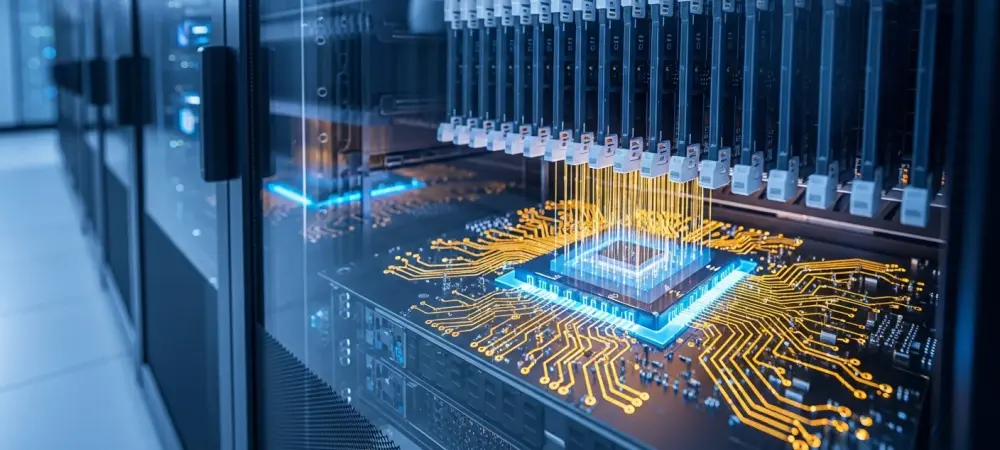
The structural integrity of modern computing has reached a definitive breaking point where the raw speed of a processor no longer dictates the true ceiling of artificial intelligence performance. For decades, the industry operated under a compute-centric philosophy, assuming that faster transistors would naturally lead to faster results. However, as large language models and generative agents become the standard, a new reality has emerged: the “memory wall.” This phenomenon occurs when the energy and time required to move data between storage and the processor far exceed the effort of the computation itself. The industry is now pivoting toward a memory-centric paradigm, where the architecture of the data center is being rebuilt from the ground up to prioritize data proximity and fluid movement over sheer arithmetic throughput.
This shift is not merely a technical adjustment but a fundamental reconfiguration of how hardware is valued. In the current landscape, data-movement constraints have replaced clock speeds as the primary metric of success. The traditional von Neumann architecture, which separates processing and memory, is being challenged by designs that integrate these components more tightly than ever before. As AI workloads demand instantaneous access to trillions of parameters, the industry is witnessing the emergence of specialized hardware that treats memory as a first-order constraint rather than a secondary support system.
Evolution of the Memory-Centric Paradigm
The transition toward memory-centric design was born out of necessity as data centers struggled with the thermal and latency penalties of traditional setups. In earlier iterations of server design, the central processing unit was the undisputed king, with memory acting as a passive reservoir. This worked well for deterministic software, but AI is inherently stochastic and data-hungry. Today, the focus has shifted toward reducing the “friction” of data transport. By minimizing the physical distance data must travel, engineers can significantly reduce power consumption, which has become the ultimate gating factor for scaling AI infrastructure.
The relevance of this evolution in the broader technological landscape cannot be overstated. We are moving away from general-purpose servers toward workload-specific silicon. This evolution is driven by the realization that an idle processor waiting for data is a wasted investment. Consequently, the industry is seeing a convergence of networking, storage, and compute, where the lines between these categories are blurring to create a cohesive, data-first environment.
Core Components of Modern Memory Hierarchies
High Bandwidth Memory and SRAM Integration
High Bandwidth Memory (HBM) has become the cornerstone of the modern GPU accelerator, utilizing vertical stacking to achieve throughput that traditional architectures simply cannot match. By placing memory layers directly on top of or adjacent to the logic die using through-silicon vias, HBM provides a massive, multi-lane highway for data. This is crucial for the “prefill” phase of AI execution, where massive datasets must be ingested simultaneously to initialize a task. Without HBM, the most powerful processors in the world would essentially be throttled, unable to realize their full potential due to a lack of data “fuel.”
In contrast, Static RAM (SRAM) continues to serve as the low-latency backbone for on-chip caching. While HBM offers volume and speed, SRAM provides the near-instantaneous response times needed for immediate calculations. The unique implementation of modern AI chips involves a delicate balance between these two: using SRAM for the high-frequency “decode” phase—where a model generates output token by token—and HBM for the heavy lifting of model weights. This dual-layer approach ensures that neither capacity nor speed becomes a terminal bottleneck during complex inference tasks.
The Rise of LPDDR5X in Server Ecosystems
Perhaps the most surprising trend in the data center is the migration of Low Power Double Data Rate (LPDDR) memory from mobile devices into high-density rack environments. LPDDR5X is gaining traction because it offers a superior power-to-performance ratio compared to standard DDR5. In an environment where power delivery is a fixed constraint, the lower voltage requirements of LPDDR5X allow operators to pack more compute nodes into a single rack without exceeding thermal limits. This transition represents a pragmatic response to the energy crisis facing modern cloud providers.
The technical appeal of LPDDR5X lies in its efficiency during idle and low-load states, which are common in distributed AI inference. Unlike traditional server memory that maintains high power states to ensure stability, LPDDR5X can scale its energy consumption more granularly. This makes it an ideal candidate for edge AI and large-scale cloud services where the goal is to maximize “work per watt.” This shift marks the end of the mobile-versus-server memory divide, as efficiency becomes the universal currency of the semiconductor world.
Emerging Trends in Hardware Design
Current hardware development is characterized by a move toward heterogeneous architectures that reject the “one-size-fits-all” approach. Engineers are increasingly designing systems that mix and match different memory types on a single substrate. This move away from standardized Dual In-Line Memory Modules (DIMMs) allows for silicon configurations that are tuned for specific mathematical operations. By moving the memory closer to the logic, or even integrating it into the package, designers can bypass the signal degradation issues that plague traditional modular setups.
Furthermore, the influence of power-density limits is forcing a rethink of physical infrastructure. Modern racks are no longer limited by how many servers can physically fit, but by how much heat can be dissipated. This has led to the adoption of liquid cooling and sophisticated power management systems that treat memory and compute as a single thermal entity. The result is a highly specialized environment where every milliwatt is accounted for, driving the industry toward custom-tailored silicon that prioritizes efficient data flow over general versatility.
Real-World Applications and Implementation
In the realm of large-scale cloud services, memory-centric design is already proving its worth in the execution of Large Language Models (LLMs). The distinction between the prefill and decode phases of AI model execution is a perfect example of how memory types are deployed strategically. During prefill, the system relies on the massive bandwidth of HBM to process the input prompt. Once the generation begins, the system switches its reliance to lower-latency memory to handle the sequential generation of tokens. This choreography allows for a seamless user experience in applications like real-time translation or complex coding assistants.
Beyond consumer AI, industries like high-frequency trading and genomic sequencing are leveraging these architectures to handle massive datasets in real-time. In these sectors, the ability to process data at the “edge” of the memory controller can save precious microseconds. By utilizing workload-specific memory configurations, these organizations can achieve levels of throughput that were previously impossible with traditional, compute-heavy server designs, demonstrating that the memory-centric approach is the new standard for data-intensive industries.
Technical and Operational Challenges
Despite its advantages, the memory-centric shift introduces significant operational hurdles, most notably regarding serviceability. Because high-performance memory like LPDDR5X is often soldered directly to the board to maintain signal integrity, a single chip failure can render an entire motherboard useless. This lack of modularity is a nightmare for data center maintenance teams who are used to swapping out faulty DIMMs in seconds. The industry is currently struggling to balance the physical requirements of high-speed data transfer with the practical need for repairable hardware.
To mitigate these risks, the introduction of SOCAMM (Small Outline Compression Attached Memory Module) represents a vital middle ground. This technology attempts to provide the signal quality and power efficiency of soldered memory while maintaining a level of modularity. However, signal integrity remains a persistent challenge; as speeds increase, the physical tolerances for connectors become incredibly tight. Engineers must constantly innovate to prevent electromagnetic interference and data corruption, all while trying to keep the hardware accessible for human technicians.
Future Outlook and Breakthrough Potentials
Looking ahead, the potential for pooled memory and new interconnect standards like CXL (Compute Express Link) promises to further decouple resources within the data center. Memory pooling allows multiple processors to share a common reservoir of high-speed RAM, reducing the amount of “stranded” memory that sits unused in individual servers. This flexibility will likely become the cornerstone of the next generation of cloud infrastructure, allowing for dynamic resource allocation that can adapt to the fluctuating demands of AI training and inference. The long-term impact of efficient data movement will be the primary driver of the economic viability of artificial intelligence. As the cost of energy continues to rise, the ability to execute complex models with minimal power will determine which companies can afford to compete. Breakthroughs in optical interconnects and 3D-stacked logic-on-memory could eventually eliminate the concept of a “bottleneck” entirely, creating a fluid computing environment where data exists in a state of constant, high-speed availability.
Summary and Final Assessment
The shift to a memory-centric architecture was a necessary response to the exhaustion of traditional compute-centric scaling. By identifying that data movement, rather than raw calculation, was the true barrier to AI progress, the industry successfully pivoted toward a more efficient and specialized hardware ecosystem. The integration of HBM and the adoption of low-power standards in the server room have already demonstrated that memory is a first-order constraint. This review suggests that the days of general-purpose, modular servers are waning, replaced by tightly integrated, workload-specific systems that prioritize the thermal and energy costs of every bit moved.
The transition was not without its trade-offs, particularly regarding the loss of traditional serviceability and the increased complexity of hardware design. However, the emergence of new form factors like SOCAMM and the promise of memory pooling indicated a path toward a more sustainable and flexible future. Ultimately, the memory-centric paradigm transformed the data center into a more specialized environment, ensuring that the economic and technical demands of the AI era could be met with precision. This architecture proved to be the essential foundation for the next generation of scalable, intelligent computing.