

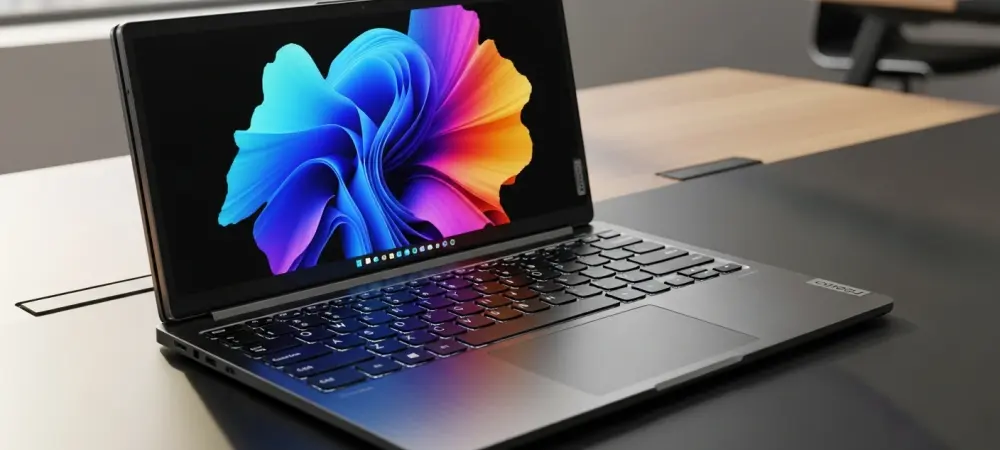
Dominic Jainy stands at the forefront of the intersection between hardware engineering and emerging software ecosystems, bringing a specialized perspective to the evolution of mobile computing. In this discussion, we explore the intricate design of Lenovo’s “Project Swan,” a leaked ThinkBook concept that challenges the traditional static screen format with a motorized, rollable OLED display. Our conversation moves through the mechanical complexities of expanding chassis, the shift from vertical to horizontal screen orientations for professional multitasking, and the subtle clues found in early-stage hardware regarding the future of integrated artificial intelligence.
How does the engineering behind the motorized rail system in Project Swan fundamentally change our expectations for the physical utility of a business laptop?
The engineering here represents a massive leap from the static hinges we have relied on for decades. By integrating a motorized rail system within the lid, Lenovo allows the flexible OLED panel to be stored and then pulled outward from both sides of the screen to flatten it into a much wider canvas. When the motor activates, you can practically feel the precision as the two-tone finish of the lid slides apart through its side cutouts to reveal the hidden screen real estate. This allows a standard-looking ThinkBook to transform into a wide-format workstation that is ideal for managing massive spreadsheets or multiple browser windows simultaneously. It is a sensory and mechanical evolution that turns a portable device into a dynamic environment that adapts to the task at hand.
What specific structural innovations were required to accommodate this expanding display without compromising the portability of the ThinkBook chassis?
To make this horizontal expansion possible, the engineering team had to completely rethink the internal layout, particularly the hinge mechanism. Instead of a full-width hinge that would block the motorized rails, Project Swan uses a much shorter hinge positioned closer to the center of the chassis. You can see the clever economy of space on the left side, where they have still managed to fit two USB-C ports despite the complex internal housing needed for the rolled-up screen. The centering of the webcam housing along the top bezel also ensures that the user experience remains familiar even as the screen boundaries are moving. It’s a delicate balance of maintaining the professional ThinkBook aesthetic while hiding a sophisticated mechanical ballet underneath the surface.
When comparing Project Swan to previous concepts like the vertically expanding ThinkPad XD, what are the distinct advantages of a horizontal expansion for productivity?
The difference between vertical and horizontal expansion is really about the specific type of work being performed. While the ThinkPad Rollable XD concept expanded vertically from 13.3 inches to 16 inches to provide more document height, Project Swan’s horizontal expansion feels like having a built-in multi-monitor setup. This horizontal 21:9 style approach, similar to what was seen in the Legion Pro Rollable, is far superior for multitasking and side-by-side window management. It provides a panoramic field of view that makes the device feel much larger than its physical footprint suggests. For a professional who needs to compare data sets or keep a video call open alongside their work, the horizontal stretch is a game-changer for workflow efficiency.
The leaked images show the system running Windows 11 with the Recall feature, yet the keyboard lacks a Copilot key; what does this tell us about the current state of this hardware?
The presence of Windows 11 with Recall pinned to the taskbar suggests that this hardware is being tested in a very modern software environment, yet the missing Copilot key points toward its status as early-stage or pre-production hardware. It is quite interesting to see a device designed for the future of productivity without the physical key that Microsoft has been pushing so heavily on newer PCs. This discrepancy might just reflect the fact that the internal development of the “Swan” began before the keyboard mandates were finalized, or it could be a deliberate choice for this specific business render. Regardless, the hardware is clearly being built to handle high-level multitasking and AI-integrated features, even if the physical layout hasn’t fully conformed to current marketing trends yet.
What is your forecast for rollable laptops?
I believe that rollable-screen technology will remain a high-end, niche category until we reach events like Lenovo Innovation World 2026, where we will likely see more refined, consumer-ready versions of these concepts. While the mechanical and manufacturing complexity currently adds a significant premium to the price, the desire for larger screens in smaller packages is a permanent trend in the PC market. As the motorized components become more durable and less prone to failure, we will see a shift where flexible OLEDs aren’t just a novelty but a standard feature for premium mobile workstations. Eventually, the ability for a laptop to change its physical size to match the user’s workload will become the new benchmark for professional-grade hardware.