

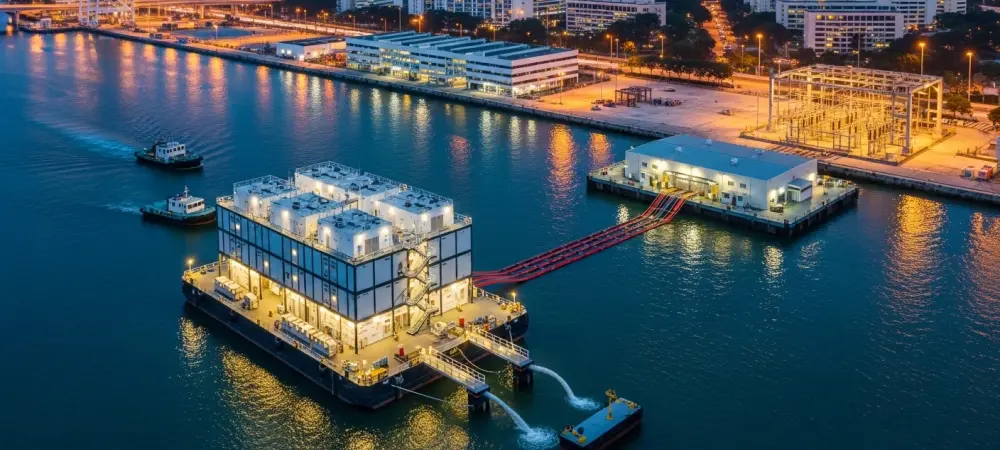
Rising cloud demand colliding with scarce urban land, capped grid capacity, and tropical heat has forced Singapore’s data center strategy to spill beyond the shoreline and into the harbor. Building on regulatory approval granted in 2023, Keppel began constructing a 25MW Floating Data Centre designed as a modular, commercial-scale facility intended to prove that high-density compute can operate on water without sacrificing reliability. The design paired a four‑story, 19.2MW waterborne unit with shoreside equipment at 25 Loyang Crescent, allocating roughly 9,870 square meters on land and 7,580 square meters at sea. Cooling drew on seawater to cut mechanical load and free up power for IT, a critical lever where efficiency shaped capacity. Funding came through Keppel Data Centre Fund II, and a global hyperscaler pre‑committed capacity, signaling that large buyers would accept nontraditional siting when governance, financing, and operations aligned. The target go‑live date was set for 2028, providing a near‑term runway to validate performance.
What The Waterborne Model Unlocked
Keppel’s move landed at the nexus of modularity, sustainability, and siting flexibility, three priorities that had defined coastal markets under pressure. By shifting megawatts onto a floating platform, the project conserved scarce freehold land while enabling high‑density racks cooled by abundant seawater, reducing freshwater use and chiller footprints. Equally important, modular hulls offered a path to scale in phases, relocate capacity if demand shifted, and standardize fabrication under shipyard timelines instead of bespoke on‑site builds. The concept was not entirely new—Nautilus deployed a 6.5MW barge in California before pivoting to cooling technology sales; Denv‑R tested a smaller pilot in Nantes; and a Japanese consortium trialed an offshore unit near Yokohama with solar and batteries—but Keppel’s integrated, pre‑committed, and regulated approach marked one of the first attempts to commercialize at meaningful scale.
The Stakes For Operators, Policymakers, and Capital
The initiative’s timing intersected with a broader Singapore build‑out on land: KDC SGP 9 broke ground at the Genting Lane campus in mid‑2026, following recent completions of SGP 7 and SGP 8, signaling a dual track that balanced proven terrestrial capacity with maritime innovation. For operators, the practical next steps had been clear: codify corrosion management and marine safety in design reviews, secure long‑tenor power purchase agreements that accounted for pump and intake loads, and publish thermal discharge and biodiversity monitoring to de‑risk permitting. Policymakers, meanwhile, had prioritized harmonizing maritime and data center codes, defining mooring and access standards, and allowing modular expansions under streamlined approvals. Investors had focused diligence on uptime metrics, hull life‑cycle costs, and tow‑back contingencies. Taken together, these actions advanced floating infrastructure from concept to credible option.