

Dominic Jainy is a seasoned IT professional whose expertise sits at the intersection of artificial intelligence, machine learning, and blockchain technology. With a career dedicated to securing complex digital ecosystems, he has become a leading voice on the vulnerabilities inherent in interconnected smart environments. In this conversation, we explore the alarming mechanics of the MajorDoMo remote code execution flaw, a vulnerability that highlights how minor architectural oversights can lead to total system compromise. Jainy provides a deep dive into the risks of unauthenticated access, the dangers of lateral movement within IoT networks, and the critical defensive strategies required to protect the central hubs of modern automation.
The following discussion examines the technical specifics of the CVE-2026-27174 vulnerability, covering themes such as the exploitation of unsafe dynamic evaluation, the evolving threat landscape fueled by automated scanning tools, and the long-term architectural shifts necessary to secure legacy PHP codebases.
When a server issues a redirect but fails to terminate the backend execution flow, how can attackers leverage that window to bypass authentication? Please explain the technical mechanics of this flaw and describe how unsafe dynamic evaluation functions like eval() turn a simple HTTP request into full server compromise.
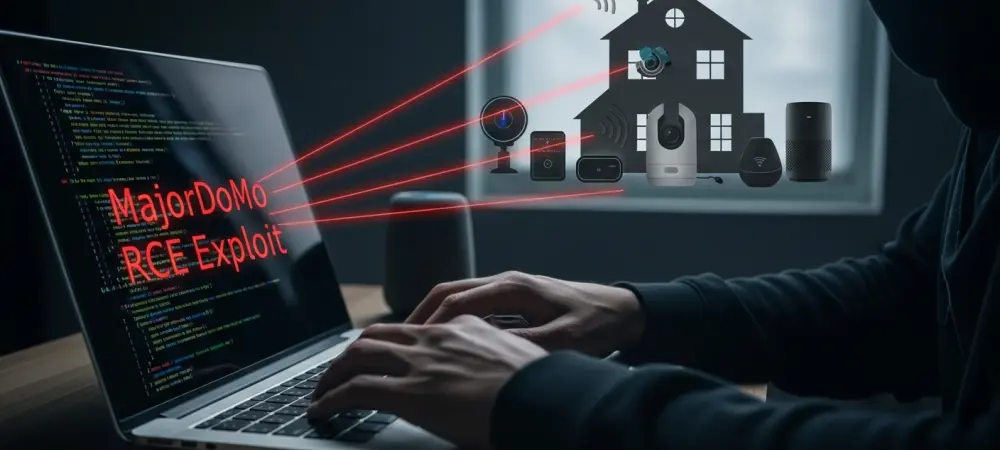
The core of this vulnerability lies in a classic architectural oversight where the server sends a 302 or 301 redirect response to the user’s browser but fails to stop the PHP interpreter from processing the rest of the script. In the case of MajorDoMo, a request to /admin.php might trigger a redirect for unauthorized users, yet the backend continues to churn through logic that it should never reach. This creates a “phantom” execution window where an attacker can interact with internal functions despite being technically “unauthenticated.” Within this window, the application exposes an internal AJAX console handler that accepts user-supplied input through the command parameter. Because this input is passed directly into the eval() function, the server effectively treats the attacker’s malicious string as legitimate code to be executed immediately. This turns a single, crafted GET request into a total takeover, allowing a threat actor to bypass every intended security gate and run arbitrary instructions with the same privileges as the web server.
IoT orchestration engines often manage sensitive assets like surveillance cameras and environmental sensors. If an attacker gains a foothold in a central hub through remote code execution, what specific steps do they take to pivot laterally into the internal network? Please elaborate with a detailed scenario involving credential extraction or data interception.
Once an attacker secures remote code execution on a central hub like MajorDoMo, the server is no longer a neutral tool but a weaponized foothold inside the home or office. The first move is typically to establish persistence, often by writing a web shell into a hidden directory to ensure they can return even if the initial exploit is blocked. From there, the attacker can pillage local configuration files to extract stored network credentials, such as Wi-Fi passwords or API keys for connected cloud services. With these credentials in hand, they can begin “pivoting,” or moving laterally, to other devices on the same subnet that were never meant to be exposed to the public internet. Imagine a scenario where a hacker intercepts a live surveillance feed from a nursery or a front door, using the hub’s privileged access to watch the residents in real-time. By acting as a man-in-the-middle, they can also sniff local traffic to capture sensitive data from other unencrypted IoT devices, turning a smart home into a surveillance apparatus for the criminal.
With automated detection templates now publicly available for specific vulnerabilities in smart-home software, how does the threat landscape change for exposed systems? What specific patterns should security teams look for in web logs, and what metrics or indicators of compromise help distinguish a routine scan from a successful administrative panel breach?
The release of detection templates in public repositories like ProjectDiscovery’s Nuclei drastically lowers the barrier to entry for amateur attackers, effectively turning a sophisticated exploit into a “point-and-click” operation. This leads to a massive surge in automated scanning activity, where thousands of internet-facing servers are probed for the /admin.php path within hours of a vulnerability disclosure. Security teams need to look beyond simple access logs and hunt for specific patterns, such as GET requests that include the ajax_panel, op, and command parameters coming from unfamiliar or external IP addresses. A routine scan usually stops at a 403 or 302 response, but a successful breach is signaled by more aggressive indicators, such as the web server spawning unusual child processes like www-data or apache calling out to a system shell. Furthermore, any outbound connection from the MajorDoMo host to an unknown external IP is a massive red flag, likely indicating that the server is communicating with a command-and-control node or exfiltrating private data.
Restricting administrative interfaces to trusted IPs or using VPNs are common defensive strategies for internet-facing controllers. How should an organization structure its network to prevent unauthorized console operations from reaching the application layer? Please provide a step-by-step guide on hardening these environments.
To truly secure an automation hub, you must treat the administrative console as a high-value target that should never be visible to the open web. The first step is to implement strict IP whitelisting at the firewall level, ensuring that only specific, known internal addresses can even attempt to connect to the /admin.php endpoint. Second, organizations should deploy the entire management interface behind a robust Virtual Private Network (VPN) or an identity-aware reverse proxy, requiring a second layer of strong authentication before the traffic ever reaches the MajorDoMo application. Third, it is vital to monitor for host-level changes, such as the appearance of unexpected PHP files in temporary or web-accessible directories, which could be signifiers of a web shell. Finally, administrators must prioritize rapid patching; while network layers provide defense-in-depth, only updating the software to remove the unsafe eval() calls will permanently close the door on this specific remote code execution pathway.
Beyond immediate patching, what long-term architectural changes should developers implement to eliminate unsafe dynamic code execution pathways in automation software? Can you share anecdotes regarding the challenges of securing legacy PHP codebases and how to effectively audit for hidden backdoors?
The long-term solution requires a fundamental shift away from using high-risk functions like eval(), which have historically been used in PHP for their flexibility but are essentially “security debt.” Developers should move toward structured data formats and strictly defined command mapping, where user input never touches the execution engine directly but instead triggers pre-defined, safe functions. Securing legacy codebases is often like navigating a haunted house; you might fix one “ghost” in the authentication logic only to find another backdoor hidden in an obscure AJAX handler written a decade ago. A thorough audit must involve automated static analysis to flag every instance of system(), exec(), or eval(), followed by a manual review of how those functions handle variables. We often find that hidden backdoors aren’t just malicious additions, but rather “convenience features” left by past developers that become catastrophic vulnerabilities when discovered by the wrong person.
What is your forecast for MajorDoMo and the broader smart-home security landscape?
I predict that we are entering an era of “IoT Reckoning,” where central orchestration hubs like MajorDoMo will face unprecedented scrutiny from both researchers and malicious actors because they represent a single point of failure for an entire physical environment. As these platforms become more integrated with our daily lives—controlling everything from locks to climate—the impact of an RCE vulnerability shifts from a digital nuisance to a physical safety risk. We will likely see a move toward “Security by Default,” where vendors are forced by consumer demand or regulation to disable remote administrative access by default and replace dynamic code execution with more rigid, sandboxed architectures. However, until the massive install base of legacy systems is either updated or replaced, we will continue to see these orchestration engines weaponized as entry points for sophisticated network-wide intrusions.