

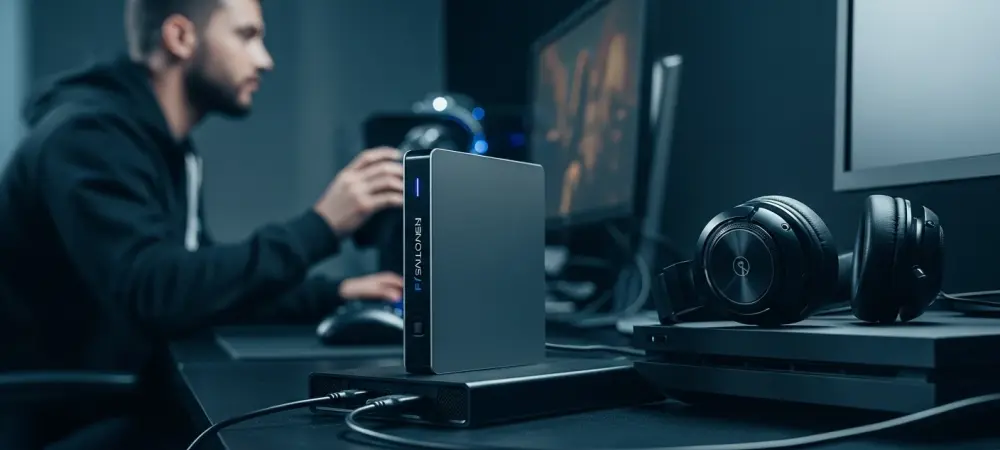
Maintaining a comprehensive digital library has become an increasingly complex logistical challenge for enthusiasts as the average size of premium interactive software titles continues to exceed the storage thresholds of standard internal solid-state drives. When high-fidelity textures and uncompressed audio files push modern installations toward the three-hundred-gigabyte mark, the traditional method of rotating games through limited console or PC space feels archaic. This friction creates a distinct market demand for high-capacity external solutions that prioritize volume without sacrificing the specialized aesthetic preferred by the gaming community. The WD_BLACK 8TB Game Drive addresses this specific pain point by offering a massive repository capable of housing hundreds of titles simultaneously. While solid-state technology currently dominates the conversation regarding raw loading speeds, the sheer economic efficiency of an eight-terabyte mechanical drive provides a compelling argument for those who value archive breadth. This storage solution serves as a central hub, effectively eliminating the need for frequent redownloads that tax both bandwidth and patience in a data-heavy landscape.
Evaluating Performance and Long-Term Utility: Is Capacity King?
Building on the necessity for massive storage volume, the technical trade-offs between mechanical hard drives and modern solid-state expansions required careful consideration. While an external hard disk drive could not match the instantaneous seek times of an NVMe interface, the WD_BLACK D10 model mitigated these limitations through a high-performance 7200 RPM motor and active cooling components. This hardware configuration proved essential for maintaining consistent data transfer rates during the migration of large file clusters from primary system drives. Furthermore, the unit functioned as a versatile archival system, allowing for the storage of older generation titles that did not require extreme throughput. The integration of high-speed USB ports on the chassis offered a convenient method for charging peripherals, adding utility beyond simple data management. Moving forward, enthusiasts paired these high-capacity drives with internal SSDs to create a tiered storage strategy that maximized both speed and volume. This hybrid approach enabled the immediate playability of high-demand titles while maintaining a deep library of accessible content.