

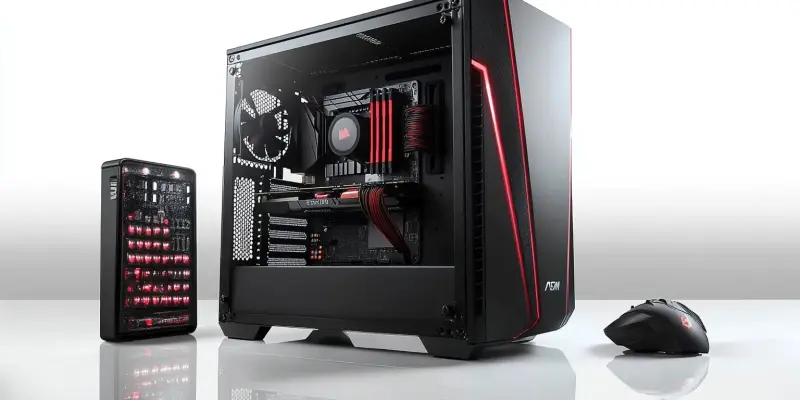
In the realm of cutting-edge desktop computing, System76 has launched a groundbreaking contender that has quickly garnered attention. The new Thelio Astra desktop PC, touted as the fastest Arm desktop computer in the world by developer Jeff Geerling, represents a notable leap in computing performance. The impressive capabilities of the high-end Thelio Astra variant, powered by a 128-core Ampere Altra Max M128-30 processor, have propelled it to achieve an unparalleled 5,003 points in Cinebench 2024’s multi-threaded mode. This accomplishment has significantly surpassed the previous record held by AMD’s powerhouse EPYC 7713. Delving further into its capabilities, the Thelio Astra’s performance in Blender rendering demonstrated 1.7 TFLOPS of double-precision compute power, reinforcing its stature as a formidable tool for demanding computational tasks.
Performance and Specifications
The Thelio Astra comes in various configurations to cater to different user needs and budgets. The entry-level model, which starts at $3,299, features 64 cores, 64GB of RAM, and an RTX A4000 GPU. For those seeking unparalleled performance, the top-tier configuration, priced just under $7,000, includes 128 cores, 512GB octa-channel RAM, 40TB storage, and an RTX 6000 Ada GPU. The sleek and quiet tower design is not just functional but also aesthetically pleasing, making it a standout addition to any workspace. Manufactured in Denver, USA, the Thelio Astra’s American origins may also appeal to buyers seeking to support local industry. The combination of its cutting-edge hardware and meticulous craftsmanship positions it as an attractive option for developers and tech enthusiasts alike.
However, the Thelio Astra is not without its critiques. Geerling pointed out some significant drawbacks, starting with the underwhelming single-threaded performance, which barely surpasses AMD’s 2017 Threadripper 1950X in the Cinebench single-threaded test. Additionally, the choice of using PCIe 4.0 and DDR4 RAM may feel outdated in the face of newer technologies like PCIe 5.0 and DDR5. Another concern was the lack of front I/O ports, which can be a point of inconvenience for users needing quick and easy access to USB and other inputs. Furthermore, some physical rattling from the PCIe brackets was noted, which might be a distraction or indicate issues with the build quality.
Target Audience and Market Position
System76 has targeted the Thelio Astra at developers, especially in the automotive software sector where fast prototyping is crucial. With powerful performance, ample RAM, and significant storage, it is perfect for handling large datasets and running complex simulations. In demanding development scenarios, the Thelio Astra provides an impressive, though costly, solution. However, its high price and certain drawbacks may restrict its appeal to a wider audience, confining its usefulness to niche markets that need such high-performance features.
A notable limitation is its unsuitability for gaming on Windows, as Nvidia has not released Arm-compatible drivers. This reduces its flexibility as a desktop computer for users who may want it for both development and personal gaming. Despite this, for developers needing top-tier performance and having substantial budgets, the Thelio Astra stands as a significant asset. It is a highly specialized machine, excelling in specific tasks, making it less of a general-purpose desktop and more of a tool designed for advanced development work.