

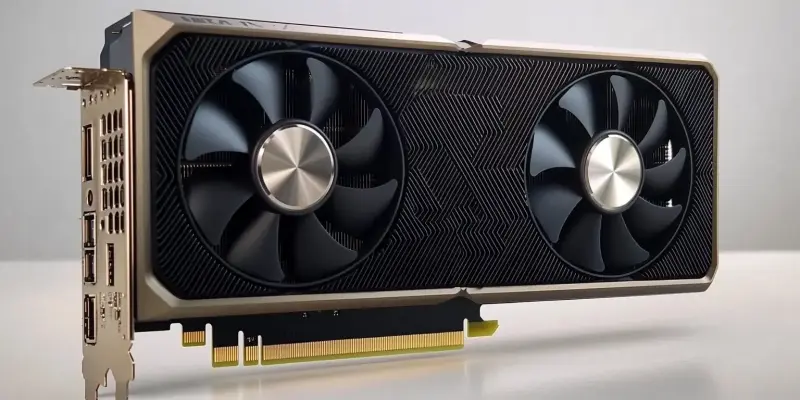
In a move that is bound to shake up the GPU market, NVIDIA is set to release its highly anticipated GeForce RTX 5070 Ti on February 20th. Noted French retailer Topachat provided a detailed listing that has enthusiasts buzzing. This launch comes after months of speculation and aligns with earlier reports hinting at the upcoming availability. The excitement surrounding this release isn’t without reason; the RTX 5070 Ti promises improved performance and competitive pricing, making it a significant contender in NVIDIA’s esteemed lineup of GPUs.
Unveiling the Next-Gen Graphics Card
Pricing and Specifications: Balancing Cost and Capability
The NVIDIA GeForce RTX 5070 Ti will retail at $749, which is $50 less than its predecessor, the RTX 4070 Ti. This pricing strategy showcases NVIDIA’s consistent effort to offer competitive products within an accessible range for a broader audience. With 16 GB of GDDR7 VRAM and a boost clock speed of 2.45 GHz, the RTX 5070 Ti is engineered to provide a substantial leap in performance. The GPU utilizes the GB203 die, integrating 8,960 CUDA cores and operating on a 256-bit memory bus, thereby positioning itself as a cutting-edge option for modern gamers and creators alike.
Despite these promising improvements, some skepticism remains about the RTX 5070 Ti’s raw performance capabilities. The card is marketed as over twice as fast as the RTX 4070 Ti; however, this claim heavily relies on the implementation of Multi-Frame Generation technology. Enthusiasts are cautiously optimistic, awaiting real-world benchmarks to validate these performance claims. Nevertheless, the price-to-performance ratio appears favorable, potentially making the RTX 5070 Ti a game-changing solution for end-users seeking the latest in graphical prowess without breaking the bank.
Comprehensive Lineup and Strategic Positioning
Within NVIDIA’s broader series lineup, the RTX 5070 Ti is strategically positioned as the third fastest GPU, trailing only the RTX 5090 and RTX 5080, which have already seen their share of success. The upcoming card is poised to deliver a balanced mix of high-end capabilities and affordability. Interestingly, future releases are anticipated to include models like the RTX 5070, RTX 5060 Ti, and RTX 5060, expected to debut in March. NVIDIA has laid out a clear roadmap, catering to different performance needs and budget constraints, fortifying their dominance in the GPU market.
The company has also prepared custom editions for the RTX 5070 Ti through partnerships with leading brands such as ASUS, MSI, and Gigabyte. These variants, likely to offer enhanced cooling solutions and factory overclocks, ensure that there is a version tailored to each user’s demands. However, a potential caveat to the launch remains the possibility of product shortages. If demand significantly outstrips supply, prices could soar beyond the MSRP. Previous high-profile releases, such as the RTX 5090 and RTX 5080, faced similar challenges, underscoring the importance of sufficient stock levels.
Anticipations and Market Readiness
Technical Advancements Over Previous Models
The GeForce RTX 50 series, especially the RTX 5070 Ti, brings notable technical advancements and optimizations over its predecessors. Among these, the transition to GDDR7 VRAM stands out as a significant upgrade, promising higher bandwidth and more efficient data processing. The 256-bit memory bus width further augments this performance, enabling seamless handling of demanding tasks like 4K gaming and real-time ray tracing. Coupled with 8,960 CUDA cores, the RTX 5070 Ti is well-equipped to tackle an array of computationally intensive applications, from gaming to content creation and AI workloads.
Moreover, the GB203 die represents a significant leap in NVIDIA’s architecture, poised to improve overall energy efficiency and thermal performance. This evolution in chip design aims to address the criticism gnawing at previous generations regarding power consumption and heat output. As a result, users can expect a quieter and cooler experience under load, translating to improved system stability and longevity. In essence, the RTX 5070 Ti is shaping up to be a holistic upgrade, addressing both raw performance metrics and long-standing consumer concerns.
Managing Supply and Demand Dynamics
In a development sure to jolt the GPU market, NVIDIA is slated to launch the eagerly awaited GeForce RTX 5070 Ti on February 20th. This announcement has come to light through a detailed listing by reputable French retailer Topachat, which has already set the tech community abuzz. The anticipation has been building for months, fueled by consistent rumors and reports pointing towards this release date. The fervor surrounding this launch is justified; the GeForce RTX 5070 Ti is expected to offer significant performance enhancements and competitive pricing. This new model aims to establish itself as a key player in NVIDIA’s highly regarded lineup of GPUs, promising to deliver both cutting-edge technology and value to consumers. As the tech world watches closely, this release could set new standards and expectations for what GPUs can achieve. With the launch date approaching, enthusiasts and professionals alike are eager to see how the RTX 5070 Ti will perform in real-world applications, potentially redefining computing and gaming experiences.