

Passive VRM heatsinks and M.2 thermal guards work in tandem to provide a silent yet effective thermal management system for high-core-count processing tasks. This design philosophy is central to the identity of the Gigabyte TRX50 AERO D, a motherboard that has arrived at a time when the high-end desktop market is more specialized than ever before. While the industry once treated the HEDT segment as a bridge for wealthy gamers and extreme enthusiasts, it has now firmly moved into the realm of professional creators, AI researchers, and data scientists. These users demand a platform that offers significantly more I/O and computational density than standard consumer sockets can provide, yet they often find enterprise-grade server hardware to be overly restrictive and prohibitively expensive. The AERO D seeks to bridge this specific gap by utilizing the AMD TRX50 chipset, which provides a more streamlined and cost-effective alternative to the ultra-high-end WRX90 workstation platform. By balancing the massive power of the Threadripper ecosystem with a design focused on usability and efficiency, this board positions itself as a versatile workhorse for those who require 80 PCIe lanes and quad-channel memory support without the complexity of a full-scale server deployment.
Bridging the Gap in Processor and Memory Performance
The sTR5 Socket: Foundations of Power
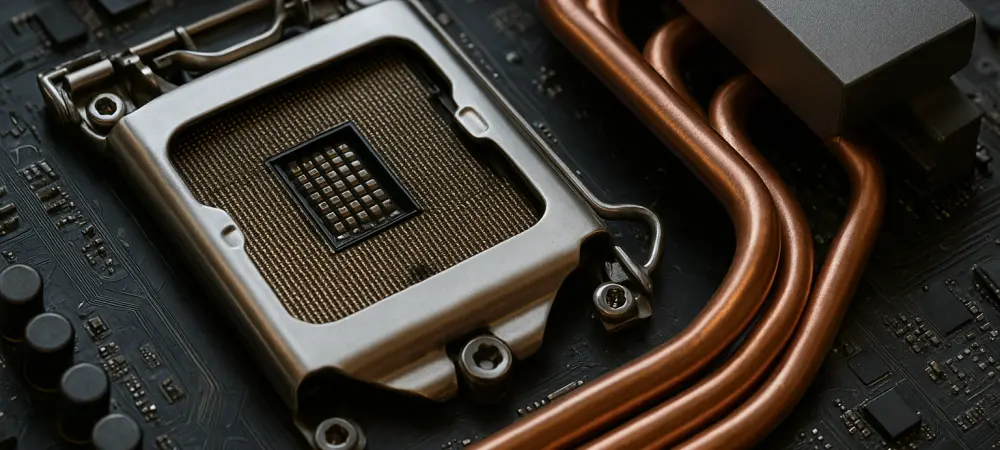
At the structural core of the TRX50 AERO D is the massive sTR5 socket, a physical behemoth featuring 4,844 pins designed to facilitate the immense data and electrical throughput required by modern professional processors. This socket provides a highly stable foundation for a wide array of chips, including the Ryzen Threadripper 7000 series and the newer Threadripper Pro 7000 and 9000 series. This compatibility is a vital feature for professionals who prioritize platform longevity, as it allows for a clear upgrade path from Zen 4 architectures to the more advanced Zen 5 designs as project demands grow. The electrical engineering required to manage nearly five thousand contact points is substantial, necessitating a high-quality PCB that can maintain signal integrity across high-speed pathways. This architectural foresight ensures that the motherboard remains a relevant centerpiece for specialized workstations through 2026 and into 2028, providing the necessary bandwidth for increasingly complex computational tasks. Furthermore, the massive physical footprint of the socket allows for better heat distribution across the surface of the processor, which is essential when dealing with chips that can feature up to 96 cores or more in a single package.
The decision to support both the standard and Pro versions of the Threadripper lineup highlights the versatile nature of the TRX50 platform. While the WRX90 platform is restricted to Pro-series chips and eight-channel memory, the TRX50 AERO D offers a more flexible middle ground. This flexibility is particularly useful for small-to-medium studios that may not have the budget for full enterprise licenses but still require the massive multi-threaded performance that only the Threadripper family can deliver. By supporting a broad spectrum of processors, Gigabyte has created a hardware environment where a user can begin with a lower-core-count CPU for general development and eventually swap in a high-tier workstation chip as their machine learning models or 3D rendering projects become more demanding. This transition is handled seamlessly by the board’s robust BIOS and power delivery system, ensuring that the migration from one generation of CPU to the next does not require a complete overhaul of the system architecture or a change in supporting peripherals.
Quad-Channel RDIMM Support: Bandwidth for the Modern Era
Memory performance is a critical bottleneck in professional applications, and the TRX50 AERO D addresses this by supporting a quad-channel memory configuration utilizing Registered DIMMs. It is important to understand that this platform strictly requires RDIMMs, as standard unbuffered consumer memory is entirely incompatible with the high-bandwidth requirements of the sTR5 socket. Gigabyte has implemented a strategic one-DIMM-per-channel layout across four slots, a design choice that prioritizes signal integrity over the sheer number of physical slots. This specific configuration minimizes electrical interference and allows the motherboard to support extremely high memory frequencies, including AMD EXPO technology. For professionals working with large datasets or high-resolution video caches, the ability to reach speeds up to 8000 MT/s is a significant advantage that directly translates to reduced processing times and a more responsive creative environment. The memory slots are physically divided and positioned both above and below the CPU socket to optimize trace lengths, ensuring that data travel time between the processor and the RAM is kept to an absolute minimum.
The focus on RDIMM technology also brings professional-grade reliability features, such as Error Correction Code functionality, which is indispensable for long-duration tasks like AI model training or scientific simulations. While some might view the limitation to four channels as a step down from the eight-channel WRX90 platform, the reality for many prosumers is that quad-channel bandwidth is more than sufficient for the vast majority of content creation and development workloads. By sticking to a four-channel design, the AERO D avoids the extreme complexity and cost of eight-channel routing, which in turn allows for a more accessible price point without sacrificing the stability required for 24/7 operation. This approach naturally leads to a more efficient system that balances the high-frequency capabilities of DDR5 with the high-capacity needs of modern workstations. Users can populate the board with high-density modules to reach substantial total capacities, ensuring that even the most memory-intensive applications have the necessary breathing room to function without resorting to slower virtual memory or swap files.
Robust Engineering for Sustained Professional Workloads
Advanced Power Delivery: Stability Under Pressure
Sustaining the operation of a processor with a base thermal design power of 350 Watts requires an uncompromising approach to power delivery, and the TRX50 AERO D meets this challenge with a 16+8+4 digital VRM arrangement. The 16 primary phases are dedicated exclusively to the CPU vCore, providing a clean and stable electrical supply even when the processor is pushed to its absolute limits during multi-day rendering marathons. This massive power stage is supported by high-quality components designed to withstand the heat and stress of continuous high-current delivery. Additionally, the 8-phase SOC arrangement handles the integrated I/O and memory controllers, while 4 specialized phases are reserved for the PCIe slots and miscellaneous motherboard functions. This granular separation of power stages prevents electrical noise from one component from affecting the stability of another, which is a common cause of system crashes in lower-tier hardware. For professionals who cannot afford a single minute of downtime, this level of electrical engineering provides the peace of mind necessary to leave complex calculations running unattended.
The stability offered by such a robust VRM system also provides a foundation for moderate overclocking or performance tuning, which can be beneficial for specific workloads that favor higher clock speeds over core count. Gigabyte has ensured that the power delivery components are not just capable of meeting the stock requirements of the Threadripper series but are also over-engineered to handle transient power spikes and fluctuations. This over-engineering is a hallmark of the AERO series, which focuses on providing a professional-grade experience that sits just below the level of pure server hardware. By utilizing high-amperage power stages and premium capacitors, the board maintains consistent voltage levels, which is crucial for the longevity of the expensive high-core-count processors it houses. This architectural stability is further enhanced by a multi-layered PCB design that effectively dissipates heat and shields sensitive data lines from electromagnetic interference, ensuring that the system remains stable even when the local environment is crowded with other high-power electronic equipment.
Thermal Management: Silent Cooling for Sensitive Environments
Effective heat dissipation is often the biggest hurdle for HEDT systems, but the TRX50 AERO D approaches this problem through a sophisticated passive cooling strategy that avoids the pitfalls of integrated fans. The VRM components are shrouded in a large, multi-sided heatsink that is connected by a thick 8mm heatpipe, designed to transfer heat rapidly away from the power stages to a larger surface area for dissipation. This passive design is a significant advantage for content creators and studio professionals who work in noise-sensitive environments, such as audio recording booths or color-grading suites. Unlike workstation boards that rely on small, high-pitch fans that can fail or become noisy over time, the AERO D remains completely silent, relying on the natural airflow within the chassis to maintain safe operating temperatures. This focus on silence does not come at the cost of performance, as the massive mass of the aluminum heatsinks provides a high thermal ceiling that can handle sustained heavy loads without the risk of thermal throttling.
Beyond the power delivery cooling, the motherboard also features integrated thermal guards for its high-speed storage slots. As PCIe Gen5 NVMe drives are notorious for generating significant heat during sustained data transfers, these aluminum shields are essential for maintaining maximum throughput during large file copies or video editing sessions. The thermal guards act as a heat sink for the SSDs, preventing the controllers from reaching the critical temperatures that would trigger a reduction in speed. This integrated approach to thermal management extends to the chipset as well, which is cooled by its own dedicated passive heatsink. By eliminating moving parts from the motherboard’s cooling solution, Gigabyte has reduced the number of potential failure points, increasing the overall reliability of the system for long-term professional use. This design philosophy recognizes that in a workstation environment, reliability and a quiet workspace are just as important as raw speed, leading to a more harmonious integration into a professional studio or research lab.
Expansion and Storage Flexibility for Power Users
Strategic PCIe Layout: Managing Multi-GPU Workflows
The physical layout of an HEDT motherboard must be carefully considered to accommodate the oversized components typically used in professional builds, and the TRX50 AERO D utilizes the Extended ATX form factor to achieve this. With dimensions of 12 inches by 10.4 inches, the board provides ample space for a strategic PCIe slot arrangement that is specifically designed for multi-GPU configurations. There are three primary x16 slots, with the top two operating at PCIe Gen5 speeds directly from the CPU. These slots are spaced far enough apart to allow for the installation of multiple triple-slot graphics cards or AI accelerators without blocking airflow to the fans. This spacing is a critical design feature for users engaged in GPU-based rendering or local machine learning training, where multiple high-performance cards are often used in tandem to reduce processing times. The primary slot is also reinforced with “Ultra Durable” shielding and a heavy-duty latch, ensuring that the motherboard can safely support the physical weight of modern, heavy GPUs without the risk of slot damage or sagging.
The third PCIe slot, located at the bottom of the board, operates at PCIe Gen4 speeds and provides additional expansion for high-speed networking cards, specialized capture cards, or extra storage controllers. By limiting the board to three well-spaced slots rather than crowding it with more, Gigabyte has prioritized the physical realities of modern hardware over theoretical slot counts. This approach ensures that users can actually utilize the expansion capabilities of the board without facing thermal or mechanical conflicts. Furthermore, the 80 PCIe lanes provided by the Threadripper processors mean that these slots can operate at their full rated speeds without the bandwidth sharing that often plagues consumer-level platforms. This dedicated bandwidth is essential for tasks that require high-speed communication between the CPU and multiple peripherals, such as real-time 8K video editing or large-scale data ingestion. The result is a platform that feels truly unrestricted, allowing professionals to build a customized hardware stack that perfectly matches the specific requirements of their unique industry workflows.
NVMe Throughput: Maximizing Storage Velocity
Storage flexibility is a hallmark of the AERO D, which features a total of four M.2 slots to handle the massive data requirements of professional workloads. Three of these slots are designed for PCIe Gen5 x4 performance, offering the fastest possible data transfer rates for modern NVMe solid-state drives. This level of throughput is vital for projects involving uncompressed high-resolution video or massive datasets that need to be loaded into memory rapidly. The fourth slot provides PCIe Gen4 x4 connectivity, which is ideal for secondary storage or system boot drives where the extreme speed of Gen5 may not be as critical. All four slots are protected by Gigabyte’s Thermal Guard heatsinks, which are essential for preventing the performance degradation that occurs when high-speed NVMe drives overheat. This integrated cooling solution ensures that data transfers remain consistent even during hours of heavy disk activity, such as when rendering a complex 3D animation or performing a large-scale backup.
In addition to the modern M.2 options, the TRX50 AERO D provides eight SATA 6Gbps ports, catering to professionals who still rely on high-capacity hard drive arrays for bulk storage and long-term archiving. While the board lacks some of the specialized workstation connectors like SlimSAS, the combination of four high-speed M.2 slots and eight SATA ports provides a comprehensive mix of speed and volume that should satisfy almost any content creator or developer. This dual-layered storage approach allows users to maintain a high-speed workspace on their NVMe drives while keeping their massive project libraries on more cost-effective SATA storage. The board’s storage controllers are designed for high reliability, supporting various RAID configurations to provide either increased speed or data redundancy. This versatility makes the AERO D an excellent foundation for a self-contained production machine that does not necessarily need to be tethered to a high-speed network at all times to access large files, providing a more streamlined and efficient local workflow.
Cutting-Edge Connectivity and Professional I/O
Networking Standards: 10GbE and Wi-Fi 7 Integration
Networking is a crucial component of any modern professional workstation, and the TRX50 AERO D addresses this with a dual-Ethernet configuration that provides both speed and versatility. The primary 10GbE port is powered by a Marvell AQC113C controller, offering the high-speed connectivity required for rapid data transfers to a local NAS or a high-performance studio server. This 10GbE uplink is an essential feature for video editors working with shared storage or for researchers who need to move massive datasets between machines quickly. A secondary 2.5GbE port, powered by a Realtek RTL8125 controller, provides a dedicated connection for standard internet usage or local network management, allowing the user to separate high-bandwidth traffic from general communication. This dual-port setup ensures that the workstation can remain fully integrated into a complex office network without any single connection becoming a bottleneck during mission-critical tasks.
Beyond wired connectivity, the board is equipped with a Qualcomm QCNCM865 controller that provides cutting-edge Wi-Fi 7 and Bluetooth 5.3 support. While most professional environments prefer a wired connection for its stability, the inclusion of Wi-Fi 7 offers a high-speed wireless alternative that is capable of handling significant data loads when a cable is not available or practical. This wireless capability is also useful for connecting specialized peripherals or for mobile workstations that may move between different parts of a studio. The Bluetooth 5.3 support ensures a stable connection for wireless input devices, headphones, and other modern hardware. By including the latest standards in both wired and wireless networking, Gigabyte has ensured that the TRX50 AERO D is prepared for the networking infrastructure of 2026 and beyond. This comprehensive approach to connectivity ensures that the motherboard can act as a high-speed hub for all of a professional’s data needs, whether they are working locally or collaborating with a remote team over a high-speed fiber connection.
USB4 Integration: Versatile Connectivity via Intel Controllers
The rear I/O of the TRX50 AERO D is remarkably comprehensive, featuring ten USB ports that cater to a wide variety of peripheral needs, including two 40Gbps USB-C ports. Since the TRX50 chipset does not natively support the USB4 protocol, Gigabyte has integrated a dedicated Intel JHL8540 controller to provide this high-speed functionality. These USB4 ports are a major asset for professionals who use external storage arrays, high-speed docks, or pen displays that require massive bandwidth. One of the standout features of this implementation is the DisplayPort Alt Mode support on the primary USB-C port. This is facilitated by a DisplayPort-In jack on the rear I/O panel, which allows the user to route the video signal from their discrete graphics card through the motherboard and out via the USB-C cable. This single-cable solution is particularly popular among digital artists and visual effects professionals who want to reduce cable clutter on their desks while maintaining a high-resolution, low-latency display connection.
The remaining USB ports include a mix of 10Gbps and 5Gbps USB-A connections, though it is worth noting that the 5Gbps ports share bandwidth through an internal hub. This variety ensures that everything from high-speed external SSDs to legacy input devices can be connected simultaneously without the need for external hubs or adapters. For the front panel, the motherboard provides a 20Gbps USB-C header, giving users easy access to high-speed ports on their chassis. While the onboard audio solution is a relatively standard Realtek ALC4080 controller, it provides clear, high-quality output for most professional needs. Most users in the target demographic for this board likely utilize external DACs or professional audio interfaces for their work, so the onboard solution serves as a reliable backup for general system sounds and communication. This balanced selection of I/O highlights the board’s design as a practical tool for the modern professional, focusing on high-bandwidth data transfers and versatile display options that directly improve the daily user experience.
Findings and Implementation Strategies
The Gigabyte TRX50 AERO D emerged as a highly capable and strategically designed platform that effectively addressed the unique demands of the professional high-end desktop market. Through this analysis, the motherboard demonstrated that it was more than just a consumer-grade upgrade; it was a refined foundation built for the specific rigors of sustained, high-bandwidth computational work. The implementation of a passive cooling system for the VRM and M.2 storage proved to be a critical design choice, providing the thermal stability necessary for 350W+ processors while maintaining the silent environment required in professional studios. Furthermore, the decision to prioritize a 1DPC memory layout successfully enabled the use of high-frequency DDR5-8000 memory, which offered a tangible performance boost in bandwidth-sensitive applications like AI development and high-resolution video rendering.
Moving forward, professionals looking to utilize this platform should focus on a few key implementation strategies to maximize their investment. First, given the requirement for RDIMMs, users must ensure they select memory modules that are specifically validated for the TRX50 chipset to avoid compatibility issues. Second, when planning the storage array, prioritizing the three PCIe Gen5 M.2 slots for active project files while using the SATA ports for deep storage will create a balanced and high-performance workflow. Finally, users who require a single-cable workspace should take advantage of the USB4 DisplayPort-In functionality, as this feature significantly streamlines the connection between high-end GPUs and professional creative displays. The TRX50 AERO D proved to be a robust and forward-looking choice for those whose work demanded the massive multi-core power of the Threadripper ecosystem within a more manageable