

Achieving a harmonious balance between a clutter-free workstation and high-fidelity sound remains a significant challenge for the modern professional or gamer navigating the tech landscape in 2026. While many users have transitioned to sleek, minimalist desk setups, the persistent issue of subpar integrated audio from laptops and thin-bezel monitors continues to hamper the multimedia experience. The Creative Pebble Pro emerges as a strategic response to this dilemma, offering a compact 2.0 speaker system that aims to bridge the gap between disposable computer peripherals and expensive, space-consuming studio monitors. By evolving the well-regarded Pebble series with a “Pro” designation, the manufacturer has introduced a suite of modern enhancements including RGB lighting, Bluetooth 5.3, and robust power delivery options. This analysis examines the technical and practical utility of these speakers, determining whether their sixty-nine-dollar price tag represents the optimal intersection of cost, performance, and ergonomics for contemporary users who demand more from their desktop audio without expanding their footprint or exceeding their budget.
Design and Technical Capabilities
Ergonomics: The Utility of a Small Footprint
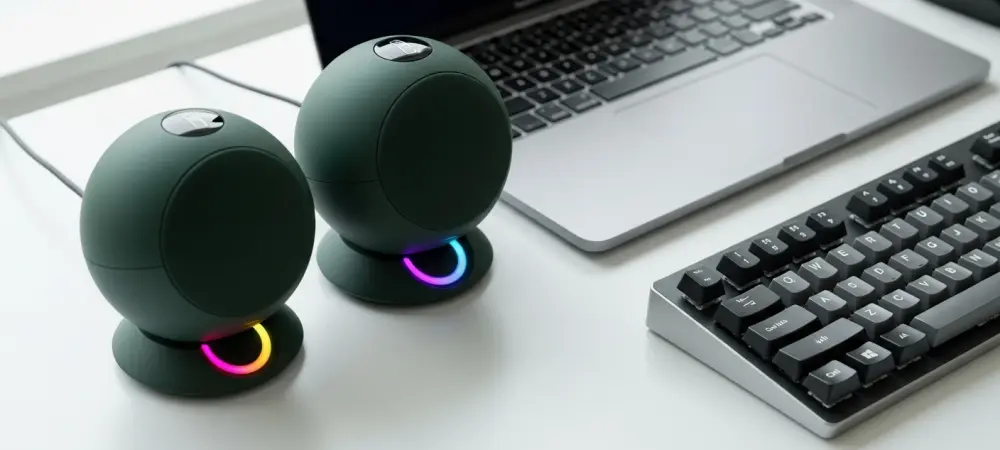
The physical architecture of the Pebble Pro is defined by its signature spherical chassis, which stands at approximately 4.5 inches, making it one of the most space-efficient audio solutions available for crowded workspaces. This compact design is not merely an aesthetic choice but a functional one, allowing the units to sit comfortably beneath low-profile monitors or alongside stacked peripherals that would traditionally preclude the use of larger bookshelf speakers. A critical aspect of this ergonomic design is the 45-degree upward angle of the drivers, a feature specifically engineered to account for the typical height at which these speakers sit relative to a seated listener. By directing sound waves toward the user’s ears rather than their chest, the system minimizes the muddled or distant quality often associated with small desktop speakers. This intentional positioning ensures that even at lower volumes, the clarity of dialogue and central frequencies remains sharp, effectively utilizing the immediate “near-field” environment of a desk to its maximum potential.
Beyond the orientation of the drivers, the build quality and weight distribution of the units reflect a deliberate focus on stability and ease of use within a professional or gaming environment. The system operates as an asymmetrical pair, where the right speaker functions as the primary intelligence hub, housing the internal power amplifier, all physical control mechanisms, and the array of connectivity ports. This concentration of hardware results in a weight of 415 grams for the right unit compared to 365 grams for the passive left speaker, providing a solid anchor on the desk surface that prevents shifting during high-volume playback. While the non-detachable link cable between the two units presents some limitations in terms of cable management, the overall visual appeal is enhanced by the inclusion of customizable RGB rings at the base. These lighting elements offer a sophisticated ambient glow that can be synchronized with other desktop aesthetics, moving the product away from the “cheap plastic” feel of entry-level peripherals toward a more premium, integrated workstation component.
Versatility: Modern Connection Standards
In a world where device compatibility can be a significant hurdle, the Pebble Pro distinguishes itself through a comprehensive suite of connection options that cater to both modern and legacy hardware. The inclusion of Bluetooth 5.3 is particularly noteworthy, providing a stable and low-latency wireless link that allows users to seamlessly switch between their primary workstation and mobile devices such as tablets or smartphones. For those who prefer the reliability of a wired connection, the system utilizes USB-C audio, which simplifies the setup process by allowing a single cable to transmit both high-quality digital audio data and power. This streamlined approach is a major advantage for users of modern laptops who are often limited by a scarcity of ports, as it eliminates the need for bulky external power bricks or complex daisy-chaining of cables. Furthermore, the presence of a 3.5mm AUX input ensures that the speakers remain compatible with older specialized equipment or dedicated audio interfaces.
One of the most technically impressive features of this system is the dual USB-C port configuration located on the rear of the primary speaker, which introduces a scalable power architecture known as high-power mode. When connected to a standard computer port, the speakers operate at a baseline of 5W RMS, providing sufficient volume for typical office tasks and casual listening. However, by utilizing the second USB-C port for Power Delivery (PD) through an external 30W adapter, the system can unlock an output of 15W RMS with a 30W peak capability. This flexibility allows the Pebble Pro to function effectively in two different worlds: as a simple, bus-powered peripheral for basic tasks or as a more powerful audio system capable of delivering greater dynamic range when high-performance power is available. The addition of dedicated headset and microphone ports on the side of the unit further cements its role as a central communication hub, making it an ideal choice for remote professionals who frequently toggle between open-air listening and private video conferencing.
Audio Performance and Functional Value
Sound Profile: Navigating Physical Constraints
The acoustic performance of the Pebble Pro is anchored by a single 2.25-inch full-range driver in each unit, a choice that necessitates a focus on midrange clarity and vocal precision over extreme frequency extension. Because these speakers lack dedicated tweeters or large woofers, the manufacturer utilized rear-facing passive radiators to assist with low-frequency resonance and provide a sense of “body” to the audio. In practice, this results in a sound profile that is exceptionally well-suited for spoken-word content, such as podcasts, news broadcasts, and virtual meetings, where clarity in the human vocal range is paramount. The high-end frequencies are rendered with sufficient crispness to satisfy casual music listeners, though audiophiles may notice a lack of the sparkling detail and airy separation found in more expensive multi-driver systems. Nevertheless, within the context of a seventy-dollar 2.0 system, the performance represents a significant leap forward compared to the thin, metallic sound produced by most internal laptop speakers.
However, the laws of physics dictate certain unavoidable limitations for a device of this size, particularly regarding the reproduction of deep sub-bass frequencies. While the passive radiators do an admirable job of preventing the sound from feeling “hollow,” they cannot replicate the visceral, room-shaking impact provided by a dedicated subwoofer. For users who primarily consume bass-heavy electronic music or play cinematic games with frequent explosions, the low-end performance may feel somewhat constrained. Additionally, while the high-power mode significantly increases the available headroom and volume, pushing the system to its absolute maximum limit can occasionally result in audible distortion as the small drivers struggle to maintain control at high excursions. Consequently, the Pebble Pro is best characterized as an elite near-field monitor intended for a single listener sitting in close proximity, rather than a primary audio source meant to fill a large living area or provide the soundtrack for a social gathering.
Software and Interface: Enhancing Professional Utility
Creative has integrated several “quality of life” features into the Pebble Pro that elevate it beyond a simple audio output device and into the realm of a productivity tool. The physical interface on the right speaker is dominated by a large, tactile multi-function dial that provides immediate control over volume and acts as a push-to-mute button for the microphone input. This mechanical simplicity is highly valued in fast-paced professional environments where navigating through software menus to silence audio or adjust volume is often too slow. Adjacent buttons allow for quick toggling between various input sources and cycling through the RGB lighting modes, ensuring that the user can adapt the system’s behavior and appearance to match their current task without needing to install complex driver packages for basic functionality. This intuitive design philosophy makes the hardware accessible to a wide range of users, from tech enthusiasts to those who prefer a “plug-and-play” experience. For those using the Windows operating system, the value of the hardware is further enhanced by the Smartcomms Kit, a specialized software suite designed to optimize digital communication. This kit includes features like AutoMute, which intelligently detects when a user is speaking and automatically silences the microphone during periods of silence to prevent background noise from distracting other participants in a call. Another significant inclusion is the NoiseClean technology, which uses digital signal processing to filter out persistent background noises—such as humming air conditioners or distant traffic—from both the user’s outgoing audio and the incoming audio of other participants. By addressing these common pain points of remote work and digital collaboration, the Pebble Pro transforms from a simple entertainment speaker into a legitimate piece of professional equipment. This combination of physical ease of use and sophisticated software assistance provides a compelling value proposition for users who spend a significant portion of their day engaged in online communication.
Strategic Competitive Positioning
Evaluating Market Alternatives: Performance versus Space
When analyzing the position of the Pebble Pro within the broader 2026 audio market, it is essential to compare it against both higher-fidelity alternatives and more feature-rich 2.1 systems. For example, the Edifier MR4 is frequently cited as a competitor for those seeking pure audio accuracy, as it offers a more balanced, studio-monitor-style sound through its larger cabinets and dedicated tweeters. However, the MR4 is nearly double the size and often requires a higher financial investment, making it a poor choice for users with extremely limited desk real estate or those who move their workstation frequently. Similarly, systems like the Logitech Z407 provide a dedicated subwoofer for superior bass response and a wireless control puck for convenience. While the Z407 excels in gaming and movie scenarios, the requirement to house a large sub-module under the desk and the higher price point make it a more invasive solution compared to the streamlined, two-piece configuration of the Creative system.
The Pebble Pro also sits at the top of its own internal product lineage, distinguishing itself from the standard Pebble V2 and V3 models through its improved 2.25-inch drivers and expanded connectivity. While the more basic models offer extreme affordability, the Pro version justifies its higher cost by providing the specific features that modern power users demand, such as the high-power PD mode and integrated communication ports. It effectively occupies a “sweet spot” in the market: it is significantly more capable than generic, no-name budget speakers but remains far more affordable and compact than mid-range audiophile gear. For the vast majority of consumers who need a reliable, good-looking, and clear-sounding set of speakers for daily tasks, the trade-offs in extreme bass and high-volume limits are often considered acceptable in exchange for the convenience and aesthetic integration the system provides. It remains a benchmark for how clever engineering can overcome the physical constraints of small-scale hardware to deliver a satisfying and professional audio experience.
Practical Implementation: A Solution for the Modern Workspace
The Creative Pebble Pro functioned as a vital tool for users who prioritized efficiency and style over absolute acoustic dominance in their workstation configuration. This system addressed the most common complaints regarding desktop audio by providing an angled, near-field solution that delivered clear vocals and a modern aesthetic without requiring extensive setup or significant desk space. By leveraging USB-C power delivery and Bluetooth 5.3, the hardware maintained compatibility with the latest technological standards while remaining accessible through its standard analog inputs. The inclusion of professional-grade communication software further enhanced its value for remote workers, ensuring that it served as more than just a media playback device. While the lack of deep sub-bass and the presence of fixed connecting cables were noted as minor limitations, they did not detract from the overall utility of the package for its intended audience. Moving forward, users seeking to optimize their audio setup should consider the Pebble Pro as a primary candidate for any space-constrained environment where vocal clarity and ease of use are the highest priorities. For those requiring more robust low-end performance, the addition of a separate, compact subwoofer or the transition to a larger 2.1 system remains a necessary step, albeit one that involves greater cost and clutter. However, for the standard daily requirements of music streaming, video conferencing, and casual gaming, this 2.0 system demonstrated that high-quality sound does not always require a high-impact footprint. The success of this model suggests a future where peripheral design continues to move toward multi-functional, power-efficient units that blend seamlessly into the digital lifestyle. As desktop configurations continue to evolve, the principles of optimization through constraint seen in this device will likely remain a dominant trend in the budget-to-midrange audio market.