

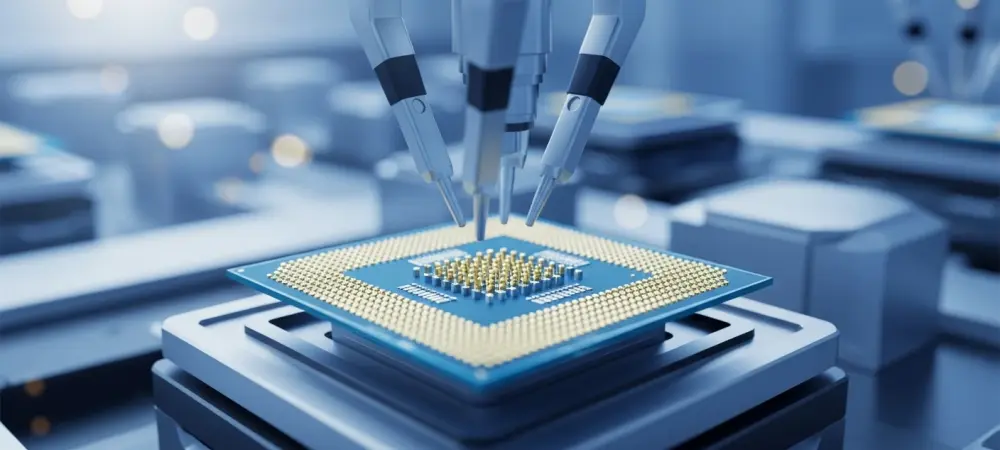
Silicon Valley has long dreamt of a self-sustaining industrial ecosystem that requires no external lifeline to keep the fires of innovation burning bright. The recent announcement that Intel is joining forces with Elon Musk’s Terafab initiative signals a tectonic shift in how the United States intends to secure its digital future. This alliance aims to merge the legacy expertise of a semiconductor pioneer with the aggressive, automation-first philosophy of a modern industrial disruptor. Wall Street responded with immediate optimism, sending Intel shares up by 2% as the market began to price in a future where American AI hardware is born on American soil. This partnership serves as a critical response to the persistent scarcity of high-end processing units that has hampered progress in robotics and data science. By focusing on localized production, the collaborators intend to eliminate the logistical bottlenecks that have historically slowed the rollout of advanced artificial intelligence. The project is not just about making more chips; it is about rewriting the playbook for how those chips are integrated into the broader economy, ensuring that the supply chain remains as robust as the software it supports.
Breaking the Dependency on Foreign Semiconductor Foundries
For many years, the American technology sector has rested on a foundation of foreign manufacturing, leaving it vulnerable to the whims of international logistics and geopolitical shifts. Relying on massive foundries in Taiwan and South Korea was once seen as an efficient global strategy, but today it is increasingly viewed as a liability. The Intel-Terafab agreement represents a deliberate pivot toward domestic self-reliance, aiming to protect the local economy from the tremors of global instability. By repatriating the fabrication of high-efficiency silicon, these companies are building a fortress around the country’s most valuable intellectual property. This shift toward domesticity is driven by a realization that digital sovereignty is impossible without hardware independence. Should external shocks disrupt traditional trade routes, this new initiative ensures that the training of generative models and the deployment of intelligent systems can continue without interruption. The goal is to create an insulated environment where the design and assembly of semiconductors occur within the same borders, fostering a more resilient and predictable industrial landscape.
Synergizing Industrial Automation with Advanced Fabrication
At the heart of this venture is a unique blend of Intel’s deep institutional knowledge in chip architecture and Musk’s “machine that builds the machine” methodology. The Terafab concept utilizes hyper-automated assembly lines to bypass the slow, manual processes that often plague traditional manufacturing. This synergy is specifically tailored to meet the needs of the humanoid robotics sector, where low-latency chips and high-density processing are essential for real-time movement and decision-making. By applying Tesla-style manufacturing speed to Intel’s precision engineering, the partnership seeks to deliver hardware at a scale previously thought impossible.
Beyond the specific needs of robotics, the initiative addresses the massive compute requirements of modern research labs and cloud service providers. As generative AI continues to evolve, the demand for raw processing power has outpaced the available supply, creating a race for whatever hardware reaches the market first. The Terafab infrastructure is designed to solve this by creating a direct pipeline from the foundry to the data center. This streamlined approach allows for faster iterations of silicon design, enabling the industry to keep pace with the rapid advancements in software.
Navigating Financial Hurdles and the Human Capital Crisis
Despite the grand vision, the road to total semiconductor independence is paved with significant financial and cultural challenges. Building a domestic foundry ecosystem requires capital investments that dwarf traditional tech ventures, and the timeline for these facilities to reach full capacity often spans several years. Critics argue that the sophisticated industrial clusters found in East Asia cannot be replicated overnight, regardless of how much capital is deployed. Furthermore, the partnership must navigate a complex labor landscape, where Intel’s recent history of workforce reductions may clash with the intense, high-output culture typical of Musk’s projects.
There are also atmospheric distractions that could impact the project’s long-term focus and public perception. Ongoing scrutiny surrounding the SpaceX IPO and reports of Musk’s efforts to drive subscriptions for Grok AI have introduced an element of unpredictability into the business environment. For the Intel-Terafab alliance to remain viable, both parties will need to maintain a strict focus on hardware production and avoid being sidetracked by secondary corporate interests. Successfully managing the human element while maintaining high-intensity production schedules will be the ultimate test for this industrial marriage.
A Strategic Framework for Scaling Domestic AI Hardware
Success for the Intel-Terafab initiative will depend on the execution of a closed-loop manufacturing strategy that prioritizes speed and supply chain transparency. This framework involves establishing regional hubs where raw materials are processed and turned into finished silicon products within a tightly controlled automated environment. By reducing the distance between material sourcing and final assembly, the partnership can significantly cut the time-to-market for next-generation chips. This model provides a clear blueprint for how domestic industry can reclaim its competitive edge in the global market.
The focus eventually shifted toward empowering local research centers and ensuring that the evolution of AI software was never again limited by a lack of physical components. Stakeholders prioritized the development of an adaptable fabrication process that could be reconfigured as new architectures emerged. This forward-looking strategy moved beyond the immediate crisis of chip shortages to establish a permanent foundation for technological growth. By securing the hardware pipeline, the initiative ensured that the next leap in machine intelligence would be supported by a stable and sophisticated domestic industrial base.