

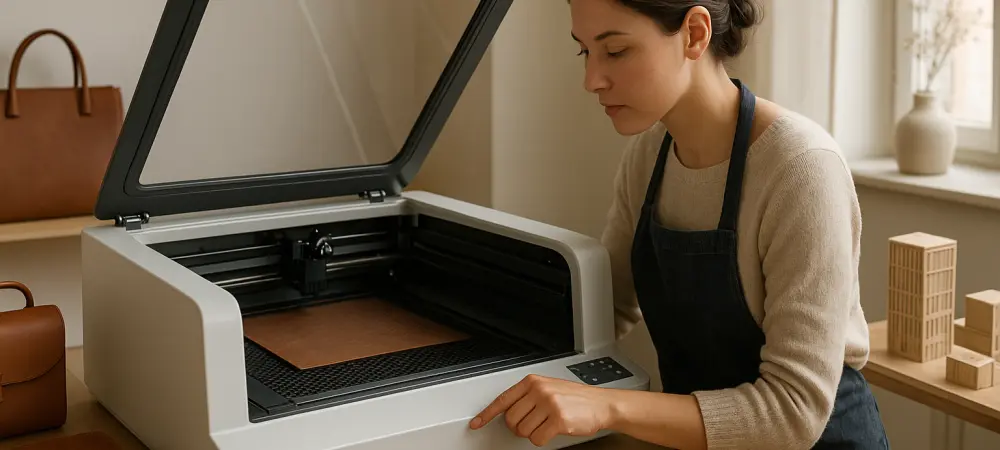
Weighing 33.5 kg and occupying a 940 x 560 mm footprint, the R1 is designed to fit onto a standard workshop bench while providing professional-level power. The rapid transformation of the desktop manufacturing landscape has often forced creators to choose between accessible but underpowered hobbyist equipment and massive industrial systems that require specialized facilities and maintenance teams. Bambu Lab, having already redefined the expectations for desktop 3D printing through high-speed automation and vertical software integration, is now applying that same disruptive philosophy to the laser cutting and engraving sector. While the company previously experimented with hybrid technology, the R1 represents a significant milestone as their first dedicated, standalone 55W CO2 laser system. This machine is not merely a refinement of existing concepts but a strategic attempt to bridge the gap between casual making and professional-grade production, offering a level of material compatibility that was previously out of reach for most desktop users. By focusing on the 55W CO2 wavelength, the manufacturer has bypassed the limitations of diode lasers, specifically in their inability to process clear acrylic and glass with high efficiency.
Engineering a Modern Laser Experience
Breaking the Barriers: Manual Calibration
Historically, the maintenance of a CO2 laser has been viewed as a high-stakes technical hurdle that deters many potential users from adopting the technology. Because these machines rely on a series of mirrors to bounce a laser beam from a fixed tube at the rear to a moving toolhead, even a microscopic misalignment can lead to a significant loss in cutting power or focal precision. For years, the standard procedure involved a tedious “tape-and-pulse” method where users would manually adjust mirror screws, fire the laser, and check the burn patterns—a process that could take hours and require considerable expertise to master. The R1 eliminates this friction by introducing an automated mirror alignment system that leverages motorized actuators and magnetic sensors. This system allows the machine to calibrate its own internal optics in approximately five minutes, ensuring that the beam path is perfectly centered and optimized without requiring any manual intervention from the operator, thereby democratizing access to professional-grade hardware for those who lack a background in optical engineering.
This shift toward automation reflects a broader industry trend in 2026 where “smart” manufacturing tools are expected to handle their own health monitoring and corrective maintenance. By removing the intimidation factor of mirror alignment, the R1 transforms the laser cutter from a temperamental tool into a reliable appliance. This reliability is further reinforced by the machine’s robust construction, which features high-quality gantry systems and integrated cooling loops that maintain the stable operating temperature required for the CO2 tube. When the machine detects a drop in performance or a physical shift due to transport, the automated calibration routine can be triggered with a single tap on the onboard touchscreen. This level of autonomy not only saves time for experienced professionals but also ensures that beginners do not accidentally operate the machine in an inefficient or unsafe state, effectively lowering the barrier to entry while maintaining the high standards expected in a professional workshop or educational setting.
Precision Through TriSense: The Sensor Array
To achieve a positioning accuracy of less than 0.2 mm across a large work area, the R1 utilizes a comprehensive suite of hardware known as the TriSense system. This array includes a wide-angle BirdsEye camera that captures the entire 600 x 300 mm workspace, providing a digital twin of the material bed on the user’s computer screen. Complementing this is a secondary toolhead camera that allows for ultra-fine placement of artwork on small or irregularly shaped scraps, significantly reducing material waste. These visual tools are not just for convenience; they form the foundation of a sophisticated computer vision workflow that permits users to drag and drop designs onto their materials with near-perfect alignment. Such precision is vital for high-value projects where there is little room for error, such as engraving custom electronics or high-end leather goods, where the cost of a misaligned burn could be substantial.
Furthermore, the TriSense system incorporates a specialized distance-measurement laser that facilitates a groundbreaking feature known as curved-surface machining. Traditional laser cutters are limited to flat planes because the beam must stay in sharp focus to cut or engrave effectively; as the surface height changes, the beam becomes blurred and loses its power. The R1 overcomes this by creating a detailed height map of the object before the operation begins. As the toolhead moves across a wooden bowl, a log, or an arched panel, the gantry dynamically adjusts the focal height in real-time. This ensures that the engraving remains crisp and consistent regardless of the object’s geometry, opening up new creative possibilities for artisans who work with organic, non-flat materials. This integration of sensor-driven automation and mechanical agility marks a departure from the static operation of previous generations, positioning the machine as an intelligent collaborator rather than a simple execution tool.
Software Integration and Performance
Navigating the Bambu Suite: The Digital Ecosystem
While the physical hardware of the R1 is remarkably sophisticated, the success of the system relies heavily on the Bambu Suite software, which serves as the primary interface for both design and machine control. The software is designed to be a stable bridge for both Windows and macOS users, offering a workspace where vector files, raster images, and material settings converge. One of the most significant advantages of this ecosystem is the inclusion of highly accurate material presets for common substrates like basswood, acrylic, and leather. In the past, users had to spend hours running “test grids” to find the perfect balance of speed and power for each new batch of material. With the R1, these settings are pre-configured and optimized, allowing for a “load and go” workflow that mirrors the ease of use found in modern office printers, which is a major shift for the laser industry in 2026.
However, as with many early-stage software platforms, the user interface currently presents certain friction points that require refinement to match the maturity of the hardware. Users have observed that the workflow logic can feel somewhat segmented, particularly when moving between the initial design phase and the final preparation for cutting. For instance, common tasks like importing a vector file may be labeled under unintuitive terms, and making mid-process adjustments to layer settings often requires navigating back through multiple menus rather than using a streamlined context menu. There are also occasional interface bugs, such as camera feed “ghosting” or the need to refresh measurements manually to see the updated workspace. These issues are largely seen as growing pains that can be addressed through iterative firmware and software updates, which the manufacturer has a history of providing frequently to improve the user experience and expand the functional capabilities of the machine.
Raw Power and Material: Versatility and Speed
The 55W CO2 laser source within the R1 provides a level of raw power and versatility that fundamentally changes what a desktop machine can accomplish. In rigorous performance testing, the unit has demonstrated an ability to cut through clear and colored acrylic up to 20mm in thickness, a feat that is physically impossible for even the most powerful diode lasers. Beyond plastics, the machine excels at processing thick hardwoods and structural materials, successfully penetrating 18mm plywood and 16mm MDF with clean, vertical edges. This capability is essential for users who want to create functional furniture, architectural models, or robust mechanical prototypes. The high-speed gantry, capable of accelerations up to 20,000mm/s², ensures that even complex, intricate engravings are completed in a fraction of the time required by entry-level machines, making the R1 a viable tool for small-batch manufacturing.
Despite this impressive power, the machine is also capable of extreme delicacy when handled correctly through the software’s power-modulation settings. It can engrave high-resolution photographs onto glass, etch intricate patterns into fine silk, or cut complex paper designs without scorching the edges. One hardware consideration noted during heavy production is the design of the internal support slats, which are spaced in a way that allows very small cut-outs to fall through to the base of the machine. While this is common in many laser systems, it can lead to secondary burns if the laser hits a fallen piece. To mitigate this, many professionals opt for an optional honeycomb bed, which provides uniform support for tiny parts and improves air circulation beneath the material. This versatility, combined with the machine’s speed, allows businesses to pivot quickly between diverse projects, from heavy-duty industrial signage to delicate personalized gifts, all within the same hardware footprint.
Customization and Market Value
Expanding the Machine: Capabilities and Modules
The R1 is designed with a modular architecture that allows it to grow alongside the needs of a business or a sophisticated maker studio. One of the most impactful expansion options is the riser base and conveyor system, which transforms the machine from a fixed-bed cutter into a continuous production line. This attachment allows users to feed through materials up to three meters in length, making it possible to create large-scale signage, long wall panels, or repeated patterns on rolls of fabric or leather. For those specializing in cylindrical objects, a rotary attachment can be integrated to engrave tumblers, bottles, and baseball bats with high precision. These accessories are not merely afterthoughts but are fully integrated into the software’s workflow, allowing the machine to recognize the new hardware and adjust its motion profiles and camera calibration accordingly.
Safety and environmental control are also paramount in the design of the R1 expansion ecosystem, particularly for users operating in home offices or school environments. The machine is rated as a Class 1 laser in its standard configuration, meaning it is safe to operate without specialized eye protection as long as the lid remains closed. To handle the smoke and fumes generated during high-power cutting, the company offers a professional-grade air purifier that uses a multi-stage filtration system to remove particulates and odors. Additionally, an optional automatic fire extinguishing system can be installed inside the enclosure, providing an extra layer of security when processing flammable materials like wood or acrylic. While these modular upgrades increase the total cost of ownership, they provide a scalable path for users to build a professional-grade manufacturing hub that meets specific safety and production requirements.
Defining a New Standard: Prosumers and Small Business
In the current landscape of 2026, the Bambu Lab R1 sits in a strategic “prosumer” bracket that offers high-end performance without the prohibitive cost or complexity of industrial machinery. Its primary value proposition is the significant reduction of operational friction; by automating the most difficult aspects of laser maintenance—such as alignment and focusing—the machine allows users to focus their energy on the creative and commercial aspects of their work. This is particularly valuable for small businesses and independent designers who may not have the time or technical staff to manage the constant calibration required by older CO2 systems. The R1 represents a shift toward a more reliable, “always-ready” tool that can be integrated into a broader digital fabrication workflow alongside 3D printers and CNC routers, creating a comprehensive micro-factory environment.
The market positioning of the R1 suggests that it is intended to be the go-to solution for those who have outgrown entry-level diode lasers and require the professional capabilities of a CO2 system. While the initial investment and the cost of optional accessories like the air purifier or honeycomb bed are notable, the efficiency gains from high cutting speeds and automated setup routines offer a clear return on investment. The machine’s ability to handle clear acrylic and thick wood expands the range of sellable products a small business can produce, while the integrated cameras and software material presets minimize the cost of scrapped materials. As the digital fabrication market continues to mature, the R1 sets a new benchmark for what users should expect from a desktop-sized machine: industrial-grade power delivered through a user-friendly, automated interface that prioritizes productivity over hardware tinkering.
Strategic Implementation: Future Operational Considerations
The integration of the R1 into a professional workflow was most successful when businesses treated the machine as a high-throughput production asset rather than a hobbyist tool. To maximize the longevity of the CO2 tube, it proved essential to utilize the dedicated cooling system with high-quality distilled water and to adhere strictly to the maintenance prompts provided by the onboard software. Those looking to scale their production should have prioritized the acquisition of the air filtration unit early in the process, especially when working with high volumes of acrylic or MDF, which generate significant odors and particulates. By centralizing the design process within the Bambu Suite and utilizing the material presets, operators were able to reduce setup times by nearly forty percent compared to traditional laser systems that lacked such integration.
For educational institutions and shared makerspaces, the Class 1 safety rating and the automated mirror alignment provided a secure environment that reduced the liability and technical oversight typically required for CO2 lasers. The next logical step for users was to explore the modular conveyor and rotary attachments, which allowed for a more diverse product catalog and larger-scale projects. Those who invested in the fire suppression module added an extra layer of protection that was highly valued in commercial settings. Moving forward, the most effective strategy for R1 owners involved regular software updates to stay current with the rapidly evolving UI improvements and new material profiles. This proactive approach ensured that the hardware remained at the cutting edge of desktop manufacturing capabilities, providing a reliable foundation for long-term growth and creative experimentation.