

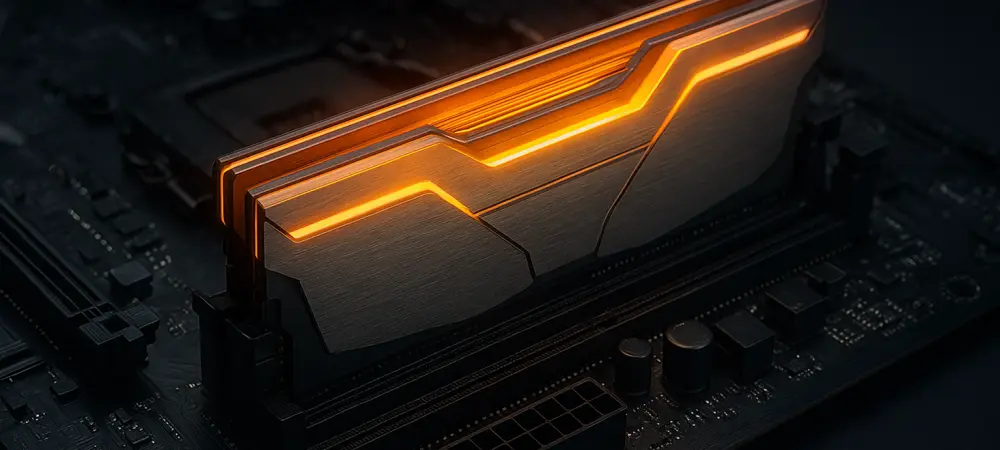
The Ryzen 7 9800X3D challenges the long-held belief that ultra-fast system memory is mandatory for achieving flagship-level gaming performance. While previous generations of processors demanded the tightest possible timings and highest frequencies to prevent frame-time stutters, this modern powerhouse leverages its massive 96 MB of L3 3D V-Cache to act as a significant buffer. In the past, the communication between the CPU cores and system RAM was a constant race against latency, often bottlenecking performance in CPU-bound scenarios. However, the architecture of the 9800X3D effectively creates a massive on-chip library where the most critical gaming data is stored, reducing the frequency of requests to external memory modules. Consequently, the reliance on high-priced, enthusiast-grade DDR5 kits has become a topic of intense debate among hardware analysts. This shift represents a departure from traditional overclocking wisdom, suggesting that the processor’s internal engineering can now compensate for secondary component limitations.
Architectural Nuances: The Impact of Cache Layers
At the heart of the Ryzen 7 9800X3D lies the specialized 3D V-Cache technology, which physically stacks additional memory directly on top of the core complex die. This design allows the processor to keep an immense amount of instructions and data closer to the execution units than any standard desktop CPU. Because the hit rate for this massive L3 cache is remarkably high in modern gaming titles, the processor rarely needs to traverse the Infinity Fabric to fetch data from the relatively slow system RAM. When the CPU finds what it needs within its own silicon, the speed of the external memory becomes secondary to the efficiency of the internal data pathways. This decoupling of core performance from memory speed is particularly evident in high-refresh-rate gaming, where the 9800X3D maintains exceptionally high minimum frame rates regardless of whether the system uses mid-range or flagship DDR5 kits. This architectural breakthrough fundamentally changes the value proposition for builders.
Despite the massive on-chip cache, the AM5 platform still utilizes a chiplet design where the memory controller resides on a separate I/O die from the processing cores. This physical separation necessitates the use of the Infinity Fabric, a high-speed interconnect that remains sensitive to the clock speeds of the installed memory modules. While the 3D V-Cache mitigates many of the latency penalties associated with fetching data from RAM, certain tasks—especially those involving large data sets that exceed 96 MB—still force the processor to communicate across this fabric. In these specific instances, the synchronization between the memory clock and the fabric clock remains paramount. If the memory speed is too low, the fabric cannot operate at its peak efficiency, potentially creating a bottleneck that even the largest cache cannot entirely overcome. Therefore, understanding the relationship between internal cache hits and external fabric synchronization remains vital for enthusiasts today.
Performance Scaling: Finding the Hardware Sweet Spot
Extensive testing across various memory configurations reveals a clear trend of diminishing returns once a certain performance threshold is met. Moving from a standard DDR5-5200 kit to a well-optimized DDR5-6000 setup provides a measurable uplift in both synthetic benchmarks and specialized gaming scenarios. However, pushing beyond this threshold into the realm of DDR5-8000 and above yielded surprisingly marginal gains for the 9800X3D compared to its non-X3D counterparts. This phenomenon occurs because the oversized L3 cache effectively hides the latency of slower memory modules, making the system less sensitive to the high-frequency overhead that premium RAM provides. While an enthusiast might see a tiny improvement in average frame rates with extreme overclocking, the actual perceived smoothness during gameplay remains virtually identical. This suggests that for the average user, the stability of a medium-speed kit may be more valuable than the theoretical peak speed of a flagship module.
The emergence of the Ryzen 7 9800X3D redefined how performance was extracted from the AM5 platform, demonstrating that massive on-die cache could effectively neutralize memory-related bottlenecks. Builders who moved forward with this processor found that prioritizing the 6000 MT/s frequency offered the most reliable balance of speed and system integrity. Those looking to optimize their setups further should have looked into fine-tuning primary timings rather than chasing extreme frequencies that pushed the limits of the memory controller. Future considerations for system upgrades ought to focus on the expansion of on-chip storage technologies, as these advancements continued to diminish the necessity for expensive, high-voltage DRAM. By sticking to validated memory lists and avoiding the trap of diminishing returns, enthusiasts ensured their hardware remained efficient and stable. The era of needing flagship RAM to support a flagship CPU largely ended with this architectural shift, proving that internal cache was the key.