

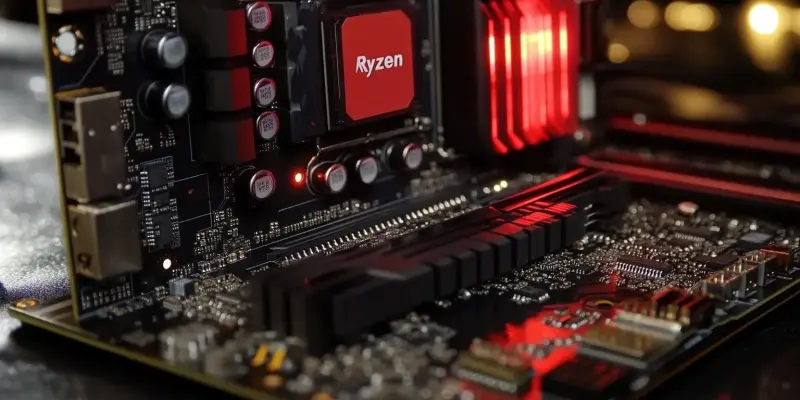
With the gaming industry continually pushing the boundaries of visual realism, performance, and immersive experiences, finding the perfect hardware combination is crucial for gamers. The AMD Ryzen 7 7800X3D CPU paired with the MSI PRO B650-P Wi-Fi ProSeries motherboard offers a tantalizing option, especially at the current discounted price of $629.99. This might seem like a deal too good to pass up, but is it truly the ideal choice for gamers seeking high frame rates and smooth gameplay?
AMD’s 3D V-Cache: Game-Changer for Performance
The AMD Ryzen 7 7800X3D CPU is a standout performer primarily due to its innovative 3D V-Cache technology. Despite being from a previous generation, this eight-core processor can boost clocks up to an impressive 5 GHz, making it a formidable competitor in both gaming and productivity tasks. The added L3 cache doesn’t just enhance gaming performance; it transforms it. The CPU can handle high-intensity workloads with ease, making it an all-rounder component that appeals not only to gamers but also to content creators and professionals.
What sets the Ryzen 7 7800X3D apart is its exceptional ability to maintain high frame rates even during graphically demanding situations. Gamers will appreciate the reduced latency and increased throughput, allowing for smoother and more responsive gameplay experiences. While AMD’s newer CPUs continue to push boundaries, the 7800X3D remains a sweet spot in terms of performance-to-price ratio. However, configurations like this are often accompanied by the challenge of balancing budget with future-proofing, a task this CPU handles surprisingly well.
MSI PRO B650-P: Balancing Features with Affordability
Complementing the Ryzen 7 7800X3D is the MSI PRO B650-P Wi-Fi ProSeries motherboard, a mid-range board that doesn’t skimp on essential features. It supports dual-channel DDR5-6400 memory, which is crucial for maximizing the CPU’s potential. The inclusion of multiple M.2 PCIe 4.0 slots ensures that storage needs are not only met but exceeded. Gamers who require fast load times and extensive storage for their gaming libraries will find this combination particularly appealing.
Additionally, the motherboard features USB 3.2 Gen2 interfaces and onboard Wi-Fi 6E, providing high-speed connectivity essential for modern gaming setups. Onboard Wi-Fi eliminates the need for additional network cards, simplifying the build process and reducing costs. Considering the feature set, the MSI PRO B650-P stands out as an excellent complement to the Ryzen 7 7800X3D, ensuring that gamers get the most out of their investment. However, some might argue that investing in a more premium motherboard could provide additional benefits and future-proofing capabilities.
Building a Robust Gaming System on a Budget
As the gaming industry continues to push the envelope in terms of visual realism, performance, and immersive experiences, it’s vital for gamers to find the right hardware combination. The AMD Ryzen 7 7800X3D CPU coupled with the MSI PRO B650-P Wi-Fi ProSeries motherboard presents an enticing option, especially now, at the reduced price of $629.99. This combination promises high performance and smooth gameplay, but one might wonder if it’s truly the best choice for gamers who demand high frame rates and a seamless gaming experience. The Ryzen 7 7800X3D, known for its impressive processing power, can handle demanding games and multitasking with ease. Paired with the MSI PRO B650-P, which offers robust Wi-Fi capabilities and solid build quality, this duo is designed to meet the needs of both casual and hardcore gamers. However, it’s always wise to consider your specific gaming requirements and do thorough research before making a purchase, ensuring this combination aligns with your expectations for elite gaming experiences.