

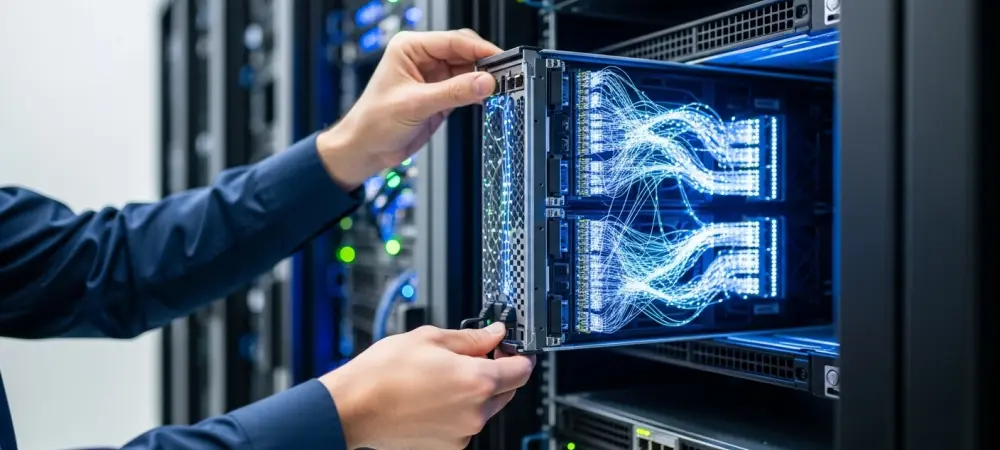
As the digital world hurtles forward on the back of artificial intelligence, the very foundation of modern computation—the silicon chip—is beginning to show cracks under the immense strain of ever-expanding data and model complexity. The relentless pursuit of smaller, faster transistors is colliding with the fundamental laws of physics, creating a performance bottleneck that threatens to stifle innovation. With AI’s voracious appetite for processing power pushing silicon to its physical limits, the solution may be found not in manipulating electrons, but in harnessing the pure speed of light itself. This technological crossroads is forcing industry leaders to look beyond traditional architectures toward a radical alternative: photonic computing.
The Silicon Ceiling and Today’s Performance Crisis
The exponential growth of artificial intelligence is the primary driver behind the current data center performance crisis. Large language models and complex neural networks demand computational resources that scale at an unsustainable rate. Each new generation of AI requires more data for training and more intricate calculations for inference, pushing existing hardware to its breaking point. This relentless demand creates a cycle where data centers must constantly upgrade, yet still struggle to keep pace with the computational needs of cutting-edge AI research and deployment.
This challenge is compounded by the physical constraints inherent in electron-based computing. For decades, Moore’s Law reliably predicted the doubling of transistors on a chip, but this trend has slowed dramatically. As components shrink, the challenges of heat dissipation and quantum tunneling effects in silicon become formidable obstacles. Electrons moving through copper interconnects face resistance and capacitance, creating signal delays, or latency, that fundamentally limit processing speed. This “silicon ceiling” represents a hard physical wall that cannot be overcome simply by making things smaller.
Consequently, the operational costs of running a modern data center have escalated dramatically. The immense power required to run high-performance processors generates a tremendous amount of heat, which in turn necessitates vast, energy-intensive cooling systems. This dual burden of powering and cooling contributes significantly to both the financial and environmental footprint of data centers, making the current model increasingly untenable as the demand for computation continues its upward trajectory.
A New Dawn with an Introduction to Photonic Computing
Photonic computing represents a fundamental shift in processing, moving from electrons to photons—particles of light. The core of this technology lies in Photonic Integrated Circuits (PICs), which use light to perform complex calculations like matrix multiplication, a foundational operation in AI, directly within the optical domain. Unlike classical computing that relies on electrical signals traversing silicon, photonics encodes information onto light waves, guiding them through microscopic on-chip structures to process data.
It is critical to distinguish photonic computing from other advanced computing paradigms. While some quantum systems use photons, the photonic accelerators being developed for data centers are not inherently quantum. They operate on classical principles and do not require the exotic, cryogenically cooled environments associated with most quantum computers. This distinction positions photonic computing not as a far-off replacement for everything, but as a specialized, high-performance accelerator designed to solve today’s most pressing computational bottlenecks, particularly in AI.
The advantages of processing with light are compelling. Photons travel at the speed of light and encounter virtually no resistance, eliminating the electronic latency that plagues traditional chips and enabling near-instant data processing. Furthermore, photonics is exceptionally well-suited for the massive parallelism required by AI workloads, allowing for many calculations to be performed simultaneously. This inherent efficiency also translates to a greener solution; by minimizing electrical resistance, photonic systems radically reduce energy consumption and thermal output. This allows for greater compute density, packing more processing power into a smaller physical footprint without overwhelming cooling systems.
From Lab Bench to Data Rack as Evidence of Momentum
The transition of photonic computing from a theoretical concept to a practical technology is accelerating, marked by significant milestones. Recent breakthroughs in designing and fabricating complex PICs, along with the development of photonics-based memory devices, signal that the technology is maturing rapidly. These advancements are moving photonics out of research labs and into prototypes that demonstrate real-world viability for specific, high-value tasks.
This progress has captured the attention of industry experts, who increasingly view photonic solutions as being on the “near horizon.” While a general-purpose photonic computer remains a long-term goal, the consensus is that specialized photonic co-processors and accelerators are poised for integration within the next few years. These systems are not intended to replace CPUs or GPUs entirely but to augment them, offloading the most demanding parallel processing tasks that currently create performance bottlenecks.
Clear evidence of this momentum can be seen in the emergence of specialized photonic AI accelerators. Several pioneering companies are already demonstrating chips that perform neural network operations using light, achieving performance and energy efficiency metrics that are orders of magnitude better than their electronic counterparts for specific tasks. These real-world applications serve as a powerful proof of concept, showing that photonic hardware can deliver tangible benefits for AI training and inference in a data center environment today.
Integrating the Light with a Guide for Data Center Evolution
Adopting photonic computing is projected to be an evolution, not a revolution, for data center infrastructure. Early photonic systems are being designed to fit within standard server rack dimensions and to utilize existing power and cooling infrastructure. This compatibility is a crucial factor for adoption, as it allows data center operators to integrate the new technology incrementally without the prohibitive cost and complexity of a complete facility overhaul.
However, capitalizing on the full potential of photonics will require strategic adjustments to data center design. The exceptional compute density of photonic processors means that rack layouts can be rethought to pack more processing power into the same physical space. More importantly, to prevent the internal network from becoming a new bottleneck, facilities will need to upgrade their interconnects. It would be counterproductive to pair light-speed processors with a network that cannot feed them data fast enough.
While widespread deployment is not imminent, the time for data center architects and operators to begin strategic planning is now. The rapid pace of development suggests that photonic accelerators will become a commercially viable and compelling option later this decade. Formulating a long-term integration strategy, evaluating potential vendors, and identifying the most suitable workloads for photonic acceleration are prudent steps. Preparing for a future where computation moves at the speed of light will be essential for maintaining a competitive edge.
The journey toward photonic integration in data centers was defined by a clear and growing need to overcome the physical limitations of silicon. As the demands of artificial intelligence continued to surge, the industry recognized that a paradigm shift was not just an opportunity but a necessity. The core advantages of speed, parallelism, and energy efficiency offered by light-based processing provided a compelling path forward. Through strategic integration and thoughtful planning, data center operators began leveraging these systems not as a replacement for existing hardware, but as a powerful accelerator, paving the way for a more efficient and capable computational future.