

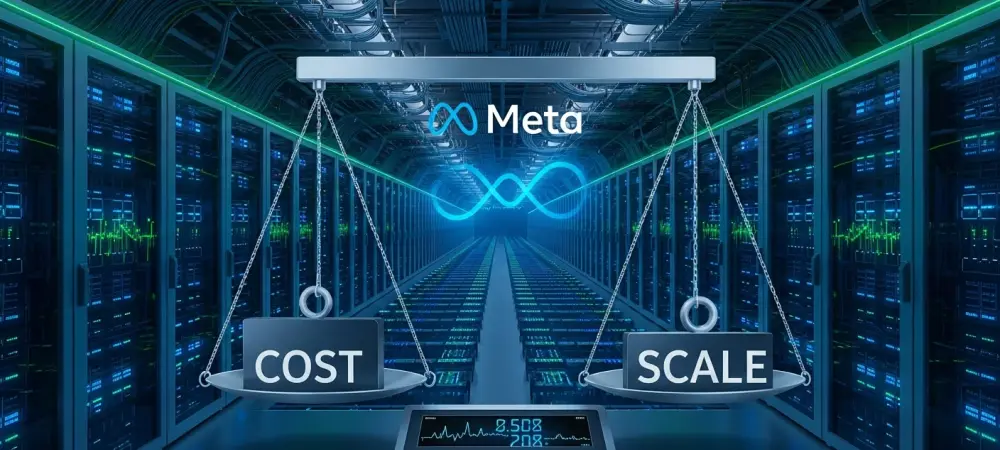
The Billion-Dollar Balancing Act: Meta’s Infrastructure Dilemma
As Meta charts a course through an era of unprecedented technological demand, it finds itself at a critical juncture. The parent company of Facebook, Instagram, and WhatsApp recently celebrated a remarkable financial quarter, with revenues soaring to $58.9 billion. Yet, this impressive growth casts a long shadow in the form of escalating operational expenses, projected to climb as high as $169 billion in 2026. At the heart of this financial tension lies a complex and costly challenge: how to scale its vast datacenter infrastructure to power future innovations without letting costs spiral out of control. This article will explore Meta’s multifaceted strategy, examining its dual-pronged approach to capacity planning, its push for internal innovation, and what this balancing act signals for the future of hyperscale computing.
From Self-Built Empires to a Hybrid Horizon
For years, the playbook for tech giants like Meta was clear: build massive, company-owned datacenters. This approach offered maximum control, long-term cost efficiencies, and the ability to customize every aspect of the infrastructure, from the servers to the cooling systems. This self-reliant model was the foundation upon which the modern internet was built, allowing companies to scale predictably alongside user growth. However, the sudden and explosive demand driven by artificial intelligence has rewritten the rules. The lead times required to plan, build, and operationalize a new datacenter are now often too long to meet the immediate, voracious appetite for computational power, forcing a fundamental re-evaluation of this once-dominant strategy.
Navigating the Capacity Conundrum: A Two-Pronged Strategy
The Bedrock of Control: Investing in Owned Infrastructure
Meta’s long-term vision remains firmly rooted in the strategic advantages of owned and operated infrastructure. The company is continuing to make significant capital expenditures in building out its own datacenters, a strategy designed to yield greater customization and superior efficiency over the long haul. By controlling its own facilities, Meta can fine-tune its hardware and software for specific workloads and secure its supply chain against market volatility. However, this approach is a game of patience. Company financial guidance has indicated that much of this new, self-owned capacity is not expected to come online until 2027 or later, creating a significant gap between current needs and future capabilities.
The Agile Bridge: Leveraging Public Cloud for Immediate Scale
To bridge that capacity gap, Meta is making a pragmatic short-term pivot toward public cloud providers. Faced with pressing constraints, the company has been actively signing cloud deals to bring resources online far more rapidly than its own construction timelines allow. As explained by company executives, cloud vendors offer pre-staged capacity with much shorter lead times, providing the agility needed to meet immediate market demands. This hybrid strategy allows Meta to essentially rent the speed and flexibility it needs now, while its long-term, more cost-effective infrastructure is being built. The trade-off is a potential increase in near-term operational costs and less direct control, but it is a necessary measure to avoid falling behind.
Engineering Efficiency from the Inside Out
Meta’s strategy extends beyond simply deciding whether to build or buy capacity. The company is aggressively tackling the root of its cost problem by innovating from within. A key initiative is the expansion of its Meta Training and Inference Accelerator (MTIA) program, which develops custom silicon designed to run AI workloads more efficiently than off-the-shelf chips. By diversifying its chip procurement and developing its own hardware, Meta aims to reduce its reliance on third-party suppliers and lower the cost per computation. Furthermore, the company is actively exploring ways to reduce the cost of energy production, a critical and ever-growing expense for its massive compute clusters, addressing a fundamental driver of datacenter operational costs.
The Future of Hyperscale: A Flexible and Diversified Footprint
Meta’s evolving strategy signals a broader shift in the hyperscale landscape. The future of datacenter infrastructure is likely not a binary choice between owning and renting but a fluid, hybrid model. As the market for critical components like servers, memory, and storage remains highly dynamic, the ability to flexibly toggle between different capacity sources will become a key competitive advantage. The success of internal R&D programs like MTIA will be a crucial factor, potentially reshaping supply chains and giving companies like Meta greater leverage over both cost and performance. This move toward a diversified, agile, and internally optimized footprint may well become the new industry standard.
Strategic Takeaways for a New Era of Infrastructure
The core takeaway from Meta’s approach is that a monolithic infrastructure strategy is no longer sufficient in the age of AI. The company’s response provides a clear blueprint for navigating similar challenges, centered on a two-pronged capacity plan that balances long-term investment with short-term agility. For professionals in the technology and finance sectors, this highlights the importance of a diversified supply chain—not just for physical components, but for compute capacity itself. The key lesson is that marrying the strategic control of owned datacenters with the tactical speed of the public cloud, all while driving down costs through internal innovation, is the most resilient path forward.
Redefining the Datacenter Blueprint for the AI Age
In conclusion, Meta did not just build more datacenters; it fundamentally redesigned its infrastructure philosophy. By embracing a hybrid model of owned and cloud-based resources and investing heavily in custom hardware and energy solutions, the company tackled the immense challenge of scaling for the future while managing today’s costs. This strategic balancing act was more than just an internal financial decision; it was a bellwether for the entire tech industry. How successfully Meta navigated this complex terrain not only shaped its own future but also likely set the precedent for how the digital world was built and powered for years to come.