

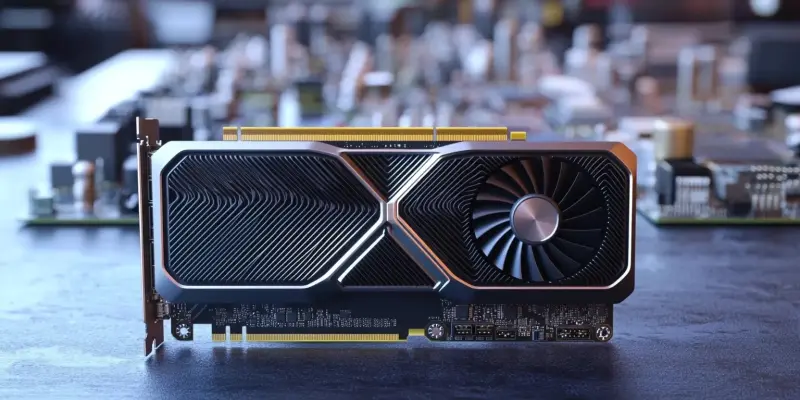
The world of gaming laptops anticipates a powerful new addition with the upcoming Nvidia RTX 5080 mobile GPU. With a Geekbench score of 190,326, it promises to elevate gaming performance, but the initial reactions are mixed. Conducted during CES 2025 on an Alienware 18 Area 51 gaming laptop, this score has sparked both excitement and skepticism.
Key Performance Metrics and Initial Reactions
Benchmark Comparisons with RTX 4080 and RTX 4090
The RTX 5080 mobile GPU, poised to be a game-changer, emerged with an 18% performance enhancement over the RTX 4080 mobile GPU, a significant boost in the gaming laptop arena. This improvement, revealed through the benchmark, is intriguing yet controversial. While an 18% leap is notable, a subset of users argued that their RTX 4080-equipped notebooks have reached similar scores, thereby questioning the magnitude of this improvement. Despite these debates, the RTX 5080 boasts an edge, surpassing the RTX 4090 mobile GPU by 6% notwithstanding the latter’s 25% greater CUDA cores.
This comparison places the RTX 5080 in a unique position. The RTX 5080’s performance parallel to the desktop RTX 4070 Super highlights its potential; however, this achievement is overshadowed by questions regarding the credibility of the benchmark. The phrase “cautious optimism” pervades discussions about the RTX 5080, as gamers and tech enthusiasts eagerly await more comprehensive evaluations. Pre-release drivers and the benchmarking on an Alienware model specifically may have impacted the results, echoing calls for results from a diverse spectrum of conditions and setups.
Evaluated Clock Speeds and Pre-release Drivers
Scrutiny arose about the benchmark’s conditions, particularly the lower-than-expected clock speed of the RTX 5080, clocked at 1.5GHz. In contrast, the RTX 4080 mobile GPU, which can boost beyond 2GHz, set the stage for doubt. Enthusiasts argued that this disparity signifies incomplete results, suggesting the RTX 5080’s actual performance might surpass initial figures considerably. This variance emphasizes the necessity for more robust and finalized testing to ascertain the RTX 5080’s true potential.
The employment of pre-release drivers further complicates the reliability of this benchmark. Historically, pre-release drivers have under-delivered compared to their finalized counterparts. They often lack the optimization needed to fully exploit a GPU’s capabilities, making premature conclusions potentially misleading. In essence, the underperformance could be more indicative of incomplete software development rather than the hardware’s limitations. Thus, the community leans toward reserving final judgments until more empirical data is available.
Future Prospects and Community Consensus
Expectations for the RTX 5090 and Gaming Laptop Evolution
Despite mixed feedback from the initial benchmark, the dialogue surrounding Nvidia’s forthcoming Blackwell architecture and the flagship RTX 5090 highlights significant enthusiasm. The anticipated leap in performance and capabilities represents a substantial step forward for gaming laptops, potentially transforming how we experience gaming on portable devices. Nevertheless, this optimism is laced with a call for skepticism and rigorous analysis.
The RTX 5080’s modest improvement over its predecessor invites curiosity about the RTX 5090’s potential. Enthusiasts speculate that once Nvidia addresses the preliminary issues identified in the RTX 5080’s benchmarks, the RTX 5090 could deliver unparalleled gaming performances. The buzz centers on advances in ray tracing, AI-driven rendering enhancements, and overall efficiency improvements. The gaming community, while excited, urges for robust and finished software support to maximize the next-gen GPUs’ capabilities.
Cautious Optimism and Awaiting Final Verdicts
The arrival of the Nvidia RTX 5080 mobile GPU has the gaming world buzzing with anticipation. This new powerhouse, tested during CES 2025 on an Alienware 18 Area 51 gaming laptop, achieved a remarkable Geekbench score of 190,326. Such a score hints at a significant leap in gaming performance, promising smoother gameplay and cutting-edge graphics.
However, the reaction to this news has been mixed. While many gamers and tech enthusiasts are excited by the potential of this new GPU, others remain skeptical. Questions linger about its real-world performance and whether it will live up to the high expectations set by its impressive benchmark score. Additional concerns include its impact on battery life, thermal management, and overall efficiency in demanding gaming scenarios.
This split in opinion underscores a broader trend in the gaming community, where excitement often meets cautious optimism. As more details emerge and reviews pour in, the true capabilities of the Nvidia RTX 5080 will be more thoroughly assessed. For now, it remains a promising but scrutinized addition to the realm of gaming technology.