

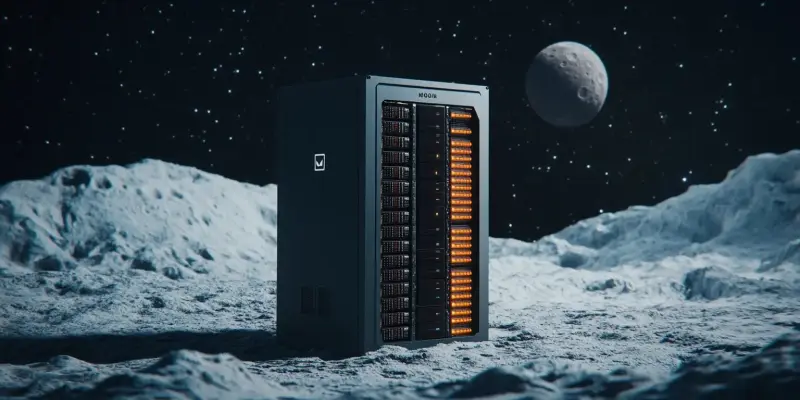
Lonestar Data Holdings has recently made headlines with their successful operation of a data center payload in space, moving towards establishing the first commercial lunar data center. This groundbreaking achievement represents a major leap in the field of data storage, suggesting a future where the Moon could play a crucial role in safeguarding vital information.
Pioneering Space-Based Data Storage
Breaking New Ground
Lonestar’s journey began with the launch of their Freedom Data Center payload on February 26, 2023. Traveling over 300,000 kilometers, the payload has now entered lunar orbit onboard Intuitive Machines’ Athena Lunar Lander. Positioned in the harsh environment of space, the data center endured the rigors of this journey, showcasing its robust engineering and design. This endeavor marks a pivotal moment, underscoring the potential for space-based technologies to revolutionize how we manage and secure critical data.
The idea of using space for data storage isn’t just a concept; Lonestar’s efforts bring it into reality, proving that our Moon can be a reliable place for housing data far removed from Earth’s vulnerabilities. This breakthrough opens a new chapter in data storage, hinting at a time when the confines of Earth won’t limit us. Lonestar’s achievements so far are not just a feat of engineering but a testament to human ingenuity and the relentless pursuit of innovation.
Proving Technology Viability
The successful completion of critical commercial operational tests in space has proven the viability and functionality of Lonestar’s technology. These tests included storing and recovering data, performing edge processing tasks, and showcasing the resilience of their systems in space’s harsh environment. Lonestar’s payload managed to execute file uploads and downloads, along with complex tasks like data encryption, decryption, and authentication. Such capabilities are essential for ensuring that data remains secure and accessible, even when stored millions of miles away.
Lonestar’s ability to maintain stable operations despite space’s extreme conditions also highlights the resilience of their technology. The data center’s power, temperature, CPU memory, and telemetry readings remained steady throughout testing, underscoring its endurance. By proving that their systems can function reliably in space, Lonestar has taken a significant step towards making space-based data centers a feasible and practical solution for future data storage needs. Their advancements could set a new standard for data security and resilience, extending beyond Earth’s atmosphere.
Addressing Critical Needs
Data Security and Resilience
Lonestar’s efforts emphasize the importance of secure and resilient data storage solutions. The company’s technology aims to provide mission-critical data storage that is independent of Earth’s vulnerabilities, ensuring data sovereignty and security. In today’s digital age, protecting data from natural disasters, cyber-attacks, and other threats is paramount. By positioning data centers on the Moon, Lonestar is creating a new layer of resilience that can offer unprecedented protection for critical information. Their approach challenges traditional data storage methods and proposes a futuristic yet viable alternative.
In addition to enhancing security, Lonestar’s lunar data centers can help ensure that essential information remains accessible even during catastrophic events on Earth. This level of redundancy is crucial for sectors like finance, healthcare, and government, where data integrity and availability are non-negotiable. As the digital landscape evolves and threats become more sophisticated, having an off-Earth backup solution could become an industry standard, illustrating Lonestar’s forward-thinking approach to data management.
Success in Edge Processing
The data center payload performed edge processing tasks, handling data for clients like Valkyrie AI and the Exploration Institute. This demonstrates the potential for in-space data manipulation, offering new opportunities for data management beyond Earth. By bringing computational processes closer to the source of data, edge processing reduces latency and bandwidth usage, making it a highly efficient solution for managing large volumes of information. Lonestar’s success in this area opens up new possibilities for real-time data processing in space.
Moreover, edge processing capabilities mean that data can be analyzed and acted upon immediately, without the need to send it back to Earth. This is particularly important for space missions and other time-sensitive operations where delays can have significant consequences. Lonestar’s advancements in this field show that their technology is not only about storage but also about enhancing the overall efficiency and effectiveness of data management. As more organizations recognize the benefits of edge processing, Lonestar’s pioneering efforts could set a new benchmark for data handling in space.
Lonestar’s Vision for the Future
A Historic Milestone
Rob Long, President and CEO of Space Florida, praised Lonestar’s achievement, highlighting its significance in advancing space infrastructure and fostering the growth of the space economy. Space Florida has been instrumental in supporting ventures that push the boundaries of what’s possible in space exploration and commercialization. Long’s acknowledgment of Lonestar’s success indicates the broader implications of their mission, not just for the company but for the entire space industry. This milestone demonstrates that integrating space technology with everyday applications like data storage is not just feasible but also highly beneficial.
Furthermore, Rob Long emphasized the importance of such milestones for the burgeoning space economy. As more companies invest in space-based technologies, the infrastructure to support these innovations will continue to expand, leading to new opportunities and economic growth. Lonestar’s successful mission is a crucial step towards realizing this vision, setting the stage for more ambitious projects that leverage space as a resource for technological advancement and sustainability.
Building the Next Layer of Infrastructure
Chris Stott, CEO of Lonestar Data Holdings, likened this success to a “Kitty Hawk moment.” He emphasized the goal of creating a resilient layer of global infrastructure, utilizing the Moon and the Lunar L1 Lagrange Point for data storage. Stott’s analogy to the Wright brothers’ first flight underscores the transformative potential of Lonestar’s achievement. Just as powered flight revolutionized transportation and communication, lunar data centers could fundamentally change how we think about data storage and security. Stott envisions a future where the Moon serves as a critical hub for global data operations, offering unparalleled resilience and independence from terrestrial vulnerabilities.
Chris Stott also highlighted the strategic importance of the Lunar L1 Lagrange Point, a location in space where gravitational forces balance perfectly, providing a stable environment for satellites and other space-based infrastructure. By positioning data centers at this vantage point, Lonestar can offer highly dependable storage solutions that are less susceptible to the challenges faced on Earth. This forward-thinking approach lays the groundwork for a new era in data management, where space serves as a backbone for secure and resilient global infrastructure.
Commitment to Innovation and Sustainability
Ensuring Data Sovereignty
Lonestar aims to use the Moon’s environment to provide secure data storage, focusing on data sovereignty, security, resiliency, and redundancy. Their Resiliency as a Service (RaaS) model underscores their commitment to safeguarding critical digital assets. By leveraging the Moon’s stable environment, Lonestar can offer data storage solutions that are virtually immune to terrestrial disruptions, ensuring that essential information remains protected and accessible. This approach not only enhances data security but also promotes data sovereignty, giving organizations greater control over their information.
In an era where data breaches and cyber-attacks are increasingly common, having a secure off-Earth storage solution could become a competitive advantage for businesses and governments alike. Lonestar’s innovative approach addresses the growing need for data sovereignty, ensuring that critical information is stored in a secure and independent environment. Their RaaS model highlights their dedication to providing premium data storage solutions that prioritize security, resilience, and redundancy, setting a new standard for the industry.
Supporting a Carbon-Negative Future
Lonestar Data Holdings has recently made headlines with its successful operation of a data center payload in space. This groundbreaking achievement signifies a major step forward in the realm of data storage and management. With this operation, Lonestar is moving towards establishing the world’s first commercial lunar data center. This innovative concept could revolutionize how and where vital information is stored, emphasizing the Moon’s potential role in safeguarding critical data. The implications of such a development are profound, as it opens up new possibilities for data security, redundancy, and storage efficiency. By leveraging the Moon’s unique environment, Lonestar aims to provide a resilient and secure solution for data preservation. This move also highlights the growing importance of space technology in everyday applications and its potential to address some of the biggest challenges in data management. As Lonestar continues to pioneer in this field, we may soon see the Moon becoming an integral part of our digital infrastructure, safeguarding information for future generations.