

The global race for artificial intelligence has shifted from a desperate search for silicon to a desperate struggle against the invisible and unyielding laws of thermodynamics. While a corporation can theoretically write a check for ten thousand new graphics processing units, it cannot simply purchase a bypass for the heat these machines generate. As server racks transition from drawing the power of a single-family home to the consumption levels of an entire neighborhood block, the industry is hitting a wall not made of silicon, but of thermal energy. The true challenge of this decade is not just the generation of intelligence but preventing the hardware that creates it from melting under the weight of its own calculations.
This silent physical limit is beginning to stall even the most ambitious global projects. High-density data centers are no longer just real estate investments; they have become complex mechanical engineering feats where the ability to shed heat determines the ultimate return on investment. If the thermal energy cannot be removed efficiently, the most expensive chips in the world become nothing more than high-priced heaters. This reality is forcing a complete rethink of how the digital world is built, moving the focus from the speed of the processor to the efficiency of the cooling loop.
The Invisible Ceiling of Artificial Intelligence
The physical reality of modern computing is that every watt of electricity pushed into a processor is eventually emitted as a watt of heat. In the current landscape, the density of this heat is reaching unprecedented levels that defy traditional facility management. A single modern server rack can now dissipate as much heat as a small industrial furnace, creating a concentrated thermal load that most existing data centers were never designed to handle. This creates an invisible ceiling for growth where the availability of power and chips is secondary to the ability to keep the hardware within its functional temperature range.
Scaling an AI cluster is no longer a matter of simply adding more floor space or more racks. Instead, it is an exercise in managing fluid dynamics and heat exchange at a granular level. When density increases, the cost of cooling does not just rise linearly; it often hits a point of diminishing returns where the energy required to move air or water begins to rival the energy used for the actual computation. This thermal wall represents the most significant barrier to the next generation of massive language models and synthetic intelligence.
From Silicon Scarcity to Thermal Constraints
For years, the primary concern for AI scaling was compute poverty, characterized by an inability to secure enough high-end hardware to train models. However, as supply chains have stabilized and power grids have begun to adapt to the massive demands of the AI era, a new fundamental bottleneck has emerged in the form of heat rejection. This shift is transformative because it changes the very nature of data center design. What was once a relatively simple exercise in providing a climate-controlled room has become a battle against the physics of energy transfer. The inability to shed thermal energy effectively creates a direct financial penalty for infrastructure investors. When heat builds up, processors automatically reduce their clock speeds to prevent physical damage, a process known as thermal throttling. This effectively turns a top-of-the-line accelerator into an underperforming asset that consumes significant power without delivering the expected results. Consequently, the ability to maintain optimal junction temperatures is now a core metric of operational success, rivaling the importance of raw teraflops.
The Physical Collapse of Traditional Cooling Paradigms
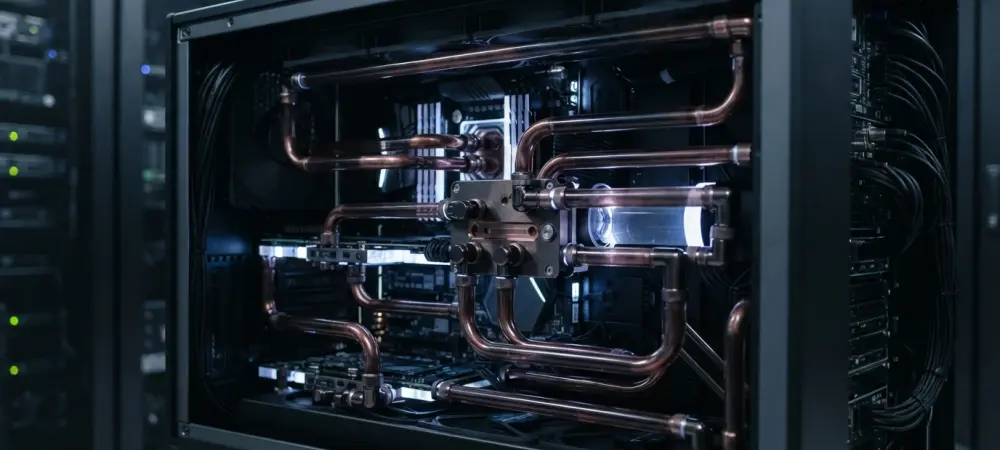
The era of air cooling, which served the industry for decades at 10kW per rack, has officially reached its end as power densities soar toward 120kW. Moving the massive volumes of air required to cool these racks has become physically impossible due to the sheer noise, energy consumption, and space required for ducting. Air is a poor conductor of heat compared to liquids, and the fans required to push it through dense server chassis consume an ever-increasing percentage of the total power budget, leading to systemic inefficiency. In contrast, liquid cooling offers a 3,500x advantage in thermal efficiency because water can carry significantly more heat than air per unit of volume. This transition is no longer optional for high-density accelerators that generate localized heat levels comparable to the surface of a high-performance engine. By utilizing liquid-to-chip cold plates, operators can transport heat directly away from the silicon, preventing the throttling tax and allowing hardware to run at peak performance indefinitely. This shift represents the most significant change in server architecture since the invention of the microchip.
Expert Perspectives on the “Intelligence Factory”
Industry experts such as Ajay Sekar of Nvidia have argued that the world must stop viewing cooling as mere facility plumbing and start viewing it as a core component of computing architecture. The consensus among thermal engineers is that physics does not negotiate; as the industry approaches a terawatt-hour of heat generation by 2030, the geography of AI is shifting. Success is no longer defined by who has the most GPUs, but by who has the most sophisticated warm-water loops that allow for operation without energy-intensive mechanical chillers.
The movement toward regions where heat rejection is naturally more efficient is already underway. This expert-led transition emphasizes that the most successful AI deployments utilize designs that reject heat into the ambient air using dry coolers rather than consuming millions of gallons of water. By integrating thermal management at the earliest stages of hardware design, engineers are creating intelligence factories that are more resilient, more sustainable, and capable of operating at densities that were considered impossible only a few years ago.
Strategic Frameworks for Future-Proofing AI Sites
The path forward for AI infrastructure required a fundamental shift in design philosophy that prioritized thermal management from the outset. Technologists discovered that adopting a cooling-first approach allowed them to integrate heat rejection at the silicon and server levels long before ground was broken on new facilities. This strategy involved moving toward warm-water liquid loops that utilized 45°C coolant, which eliminated the need for expensive chillers and significantly reduced on-site water consumption. These systems proved that operating at higher temperatures could actually improve overall facility efficiency.
Operators also found that granular thermal monitoring was essential for maintaining the longevity of next-generation hardware. Instead of relying on ambient room sensors, they implemented real-time tracking of device junction temperatures and coolant delta-T to catch thermal spikes before they caused performance degradation. Furthermore, designing for end-of-life conditions allowed these facilities to account for system fouling and pump wear over time. This forward-looking perspective ensured that the infrastructure remained capable of supporting even higher power densities as the next wave of AI accelerators arrived.