

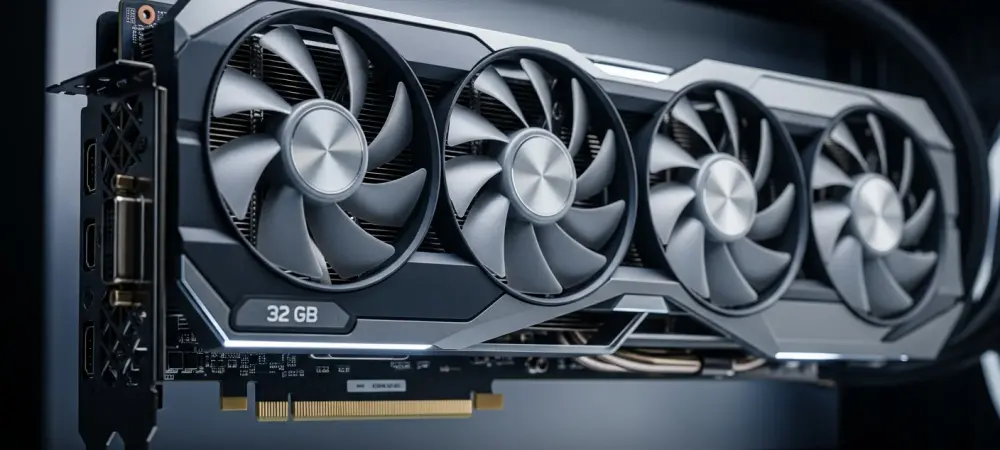
A quiet tremor is running through the high-stakes world of professional graphics, suggesting the long-standing duopoly of NVIDIA and AMD may soon face a significant challenge from a rival armed with an abundance of memory. Recent leaks point toward Intel preparing a new workstation graphics card, the Arc Pro B70, featuring a massive 32 GB of VRAM. This move signals a deliberate and strategic push into a market where memory capacity is not just a feature but a fundamental requirement for innovation and productivity.
Charting the Professional Graphics Landscape
The professional GPU market operates on a different axis than its consumer counterpart, driven by the intense demands of high-performance computing, AI model training, and complex creative workflows. This sector has long been the domain of NVIDIA and AMD, which have cultivated powerful, mature ecosystems around their CUDA and ROCm platforms, respectively. For professionals in fields like engineering, media production, and scientific research, these ecosystems provide a foundation of reliability and performance. In this environment, two factors reign supreme: video memory (VRAM) and driver stability. Large datasets, intricate 3D models, and high-resolution video timelines consume vast amounts of VRAM, making it a critical bottleneck for productivity. Consequently, professionals depend on meticulously validated drivers that ensure seamless operation with certified software, as any instability can result in lost work and significant project delays.
The Battlemage Era Leaks Specs and Market Projections
The Insatiable Demand for Memory and Next-Gen Architectures
Industry trends unmistakably point toward an exponential increase in memory requirements. The growth of large language models, the adoption of 8K video editing, and the complexity of architectural simulations are pushing existing hardware to its limits. This creates fertile ground for disruption, where a product offering substantial VRAM at a competitive price point could quickly gain traction.
Intel’s upcoming Xe2 “Battlemage” architecture represents its next major attempt to capture a meaningful slice of the GPU market. The leak of an Arc Pro B70 built on this new architecture is particularly telling. By equipping its flagship professional card with 32 GB of memory, Intel appears to be targeting the very workloads where its competitors command the highest premiums, creating a new competitive dynamic centered on memory-per-dollar.
By the Numbers: Forecasting the B70’s Market Position
The leaked specifications for the Arc Pro B70 paint a picture of a potent workstation tool. It is expected to feature 32 Xe2 cores, a 32 GB VRAM pool on a 256-bit bus, and a power draw estimated at around 300 W. This configuration positions the B70 as a compelling, cost-effective alternative to high-end NVIDIA offerings for professionals whose primary constraint is memory capacity rather than raw compute performance.
Moreover, the BMG-G31 chip at the heart of the B70 suggests a scalable architecture. This opens the door for other professional SKUs, such as a potential Arc Pro B65, which could address different segments of the workstation market. The strategic decision to lead with a high-VRAM professional card indicates a clear focus on establishing a foothold in the enterprise space before potentially addressing the consumer market.
Intel’s Gauntlet: Challenges in a Two-Horse Race
Despite promising specifications, Intel faces a formidable challenge in breaking into a market solidified by decades of dominance. The primary obstacle is not hardware but the entrenched software ecosystems of its rivals. Developers and professionals have invested years in workflows built around platforms like CUDA, creating a significant barrier to entry for any newcomer. Beyond the software ecosystem, Intel must deliver on the promise of robust driver support. The professional community is unforgiving of instability, and achieving broad ISV (Independent Software Vendor) certification is non-negotiable for serious adoption. This requires a massive investment in engineering and quality assurance to ensure that the Arc Pro B70 performs reliably with critical applications from day one.
The Compliance Checkpoint: Navigating Professional Standards
Gaining market credibility in the professional space is a marathon, not a sprint, and it begins with meeting stringent industry standards. Professional-grade hardware is defined by its driver validation, enterprise-level support, and long-term reliability—qualities that must be proven, not just promised. Crucial to this effort will be securing software certifications from industry leaders like Adobe, Autodesk, and Dassault Systèmes. These certifications act as a seal of approval, assuring customers that the hardware has been tested and verified to work seamlessly with their essential tools. Intel’s ability to navigate this complex compliance landscape will be a key determinant of the Arc Pro B70’s success.
Beyond the Horizon: The Future of Professional and Consumer GPUs
The introduction of a viable third competitor has the potential to disrupt the GPU market’s pricing and innovation cadence. A successful launch for the Arc Pro B70 could apply downward pressure on workstation card prices, making high-VRAM solutions more accessible to a broader range of professionals and smaller studios.
This professional-first strategy also casts a shadow of uncertainty over the consumer Battlemage lineup. While the pro market gets a 32 GB card, its gaming counterpart, the rumored Arc B770, may arrive with only 16 GB of VRAM. A strong reception in the professional sector, however, could fuel further investment and ambition within Intel’s graphics division, potentially leading to more competitive offerings across all market segments in the future.
Final Analysis: A Bold Play for the Professional Market
The emergence of the Arc Pro B70, with its leaked specifications, represents a calculated and aggressive move by Intel. The card’s massive 32 GB VRAM capacity is a direct challenge to the market’s status quo, targeting a clear pain point for many creative and technical professionals. Its success hinges on Intel’s ability to pair this impressive hardware with the bulletproof drivers and critical software certifications the enterprise market demands.
This launch is more than just a new product; it is a statement of intent. The Arc Pro B70 has the potential to carve out a significant niche for Intel by offering an unmatched memory-to-cost ratio. If executed successfully, this strategy could not only establish Intel as a serious player in professional graphics but also reshape the competitive landscape, offering professionals a powerful new tool and fostering a more dynamic and innovative market for all.