

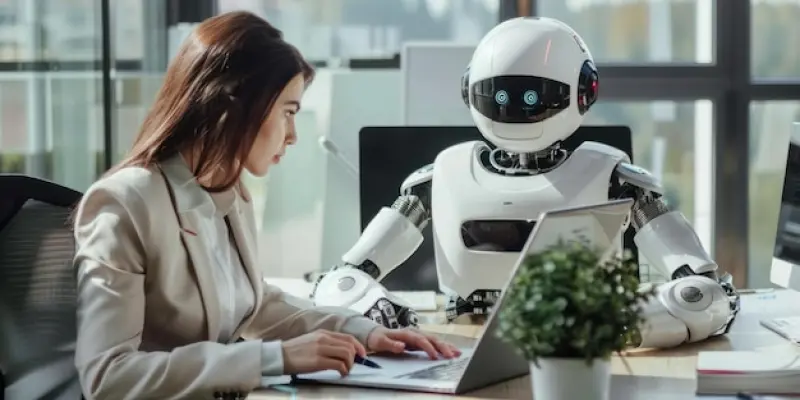
Artificial intelligence (AI) has rapidly evolved and integrated itself into various sectors, transforming how organizations approach workplace efficiency and innovation. The conversation around AI is no longer limited to its potential future impact but rather its current and tangible influence on the way businesses operate. Salesforce’s decision to transition from hiring traditional software engineers to utilizing their AI system, Agentforce, underscores the urgency of understanding AI’s role in today’s work environment. As businesses progressively incorporate AI technologies, the emphasis shifts from replacement to collaboration, ensuring a synergistic relationship between human employees and AI systems. This partnership fosters a new era of enhanced productivity and provides ample opportunities for growth. The key challenge lies in not viewing AI as a replacement tool but as an augmentation to human capabilities, aligning with the broader goal of leveraging technology to support and enhance human effort rather than supplant it.
Emphasizing Human-AI Collaboration
An essential aspect to consider when integrating AI into workplaces is building a harmonious relationship between these systems and human employees. Unlike the approach taken by Klarna’s CEO, Sebastian Siemiatkowski, who suggests that AI could replace human workers entirely, a balanced strategy focuses on collaboration. Complete reliance on AI systems can create apprehension among employees, leading to diminished morale and engagement. Instead, effective integration requires fostering an environment where human and AI capabilities complement each other. Organizations must establish clear communication and set realistic goals to address fears regarding AI adoption. By doing so, they not only dispel concerns but also encourage a culture of collaboration and adaptability. Leaders should prioritize identifying tasks where AI can enhance human performance, allowing both entities to play to their strengths. Through thoughtful policies and practices, AI becomes a tool that assists, rather than dominates, the workplace ecosystem.
To make the integration successful, organizations must develop environments that support the dynamic interaction between AI systems and human workers. Ensuring that human employees understand the potential and limitations of AI is crucial in achieving this balance. By providing reliable data and integrating feedback loops, organizations can enhance AI efficiency while empowering employees to utilize the technology effectively. Regular interaction with AI systems can help employees become familiar with their functions, reducing anxiety and encouraging innovation. This collaborative environment fosters a culture of continuous improvement, where feedback from human employees informs AI updates and adaptability. When implemented thoughtfully, AI transforms into a strategic partner, helping businesses streamline processes, boost productivity, and remain competitive in an evolving market. Such an approach leads to a more engaged workforce and an adaptable business model that thrives in the technologically advanced landscape.
Harnessing Creativity with AI
Incorporating AI into creative work processes holds significant potential but also confronts inherent limitations that highlight the enduring importance of human intuition and creativity. While AI can process and analyze large amounts of data efficiently, it lacks the instinctive decision-making ability and emotional intelligence that humans possess. Consequently, AI can assist with routine or data-heavy tasks but cannot replace humans in areas requiring nuanced judgment and interpersonal skills. Acknowledging these boundaries enables organizations to employ AI in ways that support and elevate creative processes rather than constrain them. In the creative sphere, AI can be a valuable tool, generating drafts or analyzing trends, thereby freeing human collaborators to focus on building narratives, fostering relationships, and engaging in higher-order thinking. As AI becomes more integrated into workplaces, the importance of driving innovation through uniquely human skills becomes even more significant. Employees across various sectors increasingly recognize the need for empathy, creativity, and interpersonal skills as technological systems become entrenched in business operations. Organizations can maximize the potential of both AI and human employees by establishing environments conducive to creative thought and collaboration. Encouraging brainstorming and idea-sharing sessions, where AI serves as a supportive tool, not only nurtures innovation but also builds a strong community of engaged and motivated individuals. By understanding the unique capabilities of AI and human creativity, businesses can utilize AI to handle data processing and analysis, allowing human workers to concentrate on developing ideas, strategies, and solutions suited to the complex and ever-changing demands of the modern business environment.
Navigating Employee Engagement and AI Policies
Addressing the diverse reactions of employees towards AI adoption is crucial in facilitating a smooth transition to a technologically integrated workplace. As organizations employ AI systems, perceptions can vary widely, with some individuals embracing the potential while others harbor cautious skepticism. Surprisingly, a lack of formal AI policies in many organizations contributes to confusion and reluctance among employees to engage with AI tools. This hesitancy can impede opportunities for leveraging AI’s full potential, underscoring the need for clear guidelines and transparent communication from leadership. By establishing policies that define AI’s role, organizations can dispel fears and encourage broader participation. Open discussions regarding AI functionality and expectations enable teams to explore AI-driven enhancements without apprehension, creating an environment that fosters learning and adaptation. In developing strategies for AI use, organizations should consider the varying comfort levels of their workforce. Recognizing the diverse perspectives, from “Maximalists” who enthusiastically embrace AI advancements to “Observers” who may require more convincing, allows organizations to tailor approaches to AI training and implementation. Formal AI policies can aid in navigating these differences by establishing clear parameters for AI use and educating employees on the technology’s scope and benefits. Facilitating open conversations about AI’s applications cultivates a sense of inclusion and ownership, encouraging employees to actively engage with newly adopted systems. Through education, guidance, and transparent governance, organizations create pathways for employees to become confident collaborators in AI-enhanced environments, ensuring that teams not only adapt to technological shifts but thrive within them.
Unlocking New Potentials with Deliberate Integration Strategies
Artificial intelligence (AI) has seen rapid evolution, embedding itself in various sectors and revolutionizing how organizations tackle workplace efficiency and innovation. The focus on AI has shifted from speculative future impacts to its present, tangible influence on business operations. For example, Salesforce’s transition from employing traditional software engineers to leveraging their AI system, Agentforce, highlights the urgency in comprehending AI’s current role in the work environment. As businesses increasingly incorporate AI technologies, the focus is moving away from the idea of AI as a replacement. Instead, the aim is to foster a collaborative relationship between human employees and AI systems. This partnership ushers in a new era of enhanced productivity, offering significant opportunities for growth. The challenge lies in viewing AI not as a tool for replacement but as a means to augment human capabilities, aligning with the broader objective of using technology to enhance, rather than replace, human effort in the workplace.