

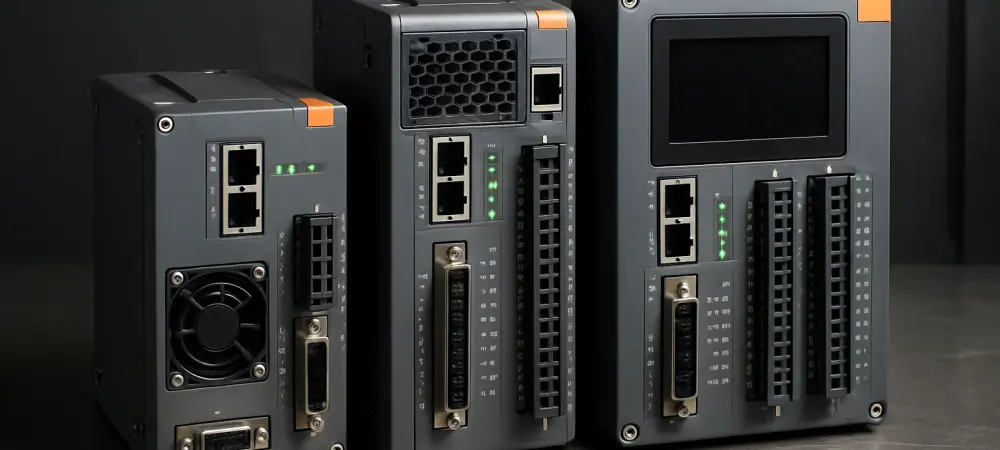
The long-held vision of fully autonomous factory floors, operating with seamless efficiency and minimal human intervention, is rapidly transitioning from a distant goal into a tangible reality through the power of edge artificial intelligence. The emergence of dedicated industrial AI controllers represents a significant advancement in factory automation and robotics. This review explores the evolution of this technology, its key features, performance metrics, and the impact it has on applications like autonomous mobile robots (AMRs). The purpose of this review is to provide a thorough understanding of the technology, its current capabilities as exemplified by new hardware, and its potential future development.
The Dawn of Intelligent Industrial Automation
The concept of industrial AI controllers signals a fundamental shift in processing, moving intelligence from centralized, cloud-based servers to decentralized, on-device (edge) systems. At its core, this technology integrates powerful System-on-Modules (SoCs), high-performance GPUs, and ruggedized hardware specifically designed to withstand harsh industrial settings. This evolution is critical for real-time applications where low latency and operational reliability are paramount.
This migration to the edge addresses the inherent limitations of cloud computing in dynamic factory environments, where network interruptions or delays can lead to costly downtime or safety hazards. By empowering devices to think for themselves, these controllers are fundamentally changing the landscape of smart factories and autonomous systems, laying the groundwork for a new era of industrial productivity and resilience.
Core Architecture and Key Features
High-Performance Onboard Processing
The Lanner EAI-I351 is built on the NVIDIA Jetson Thor SoC and Blackwell architecture, featuring a 12 or 14-core ARM Neoverse processor and an NVIDIA T5000 or T4000 GPU. This potent configuration, supported by up to 128 GB of memory, enables complex AI algorithms to run directly on the device. This capability is significant as it facilitates the real-time, high-power computations essential for modern robotics, moving far beyond the limitations of traditional industrial PCs.
The onboard processing power means that tasks once offloaded to a central server can now be handled locally with minimal delay. For an autonomous robot, this translates to instantaneous decision-making, such as re-routing around an unexpected obstacle or adjusting its task based on new sensor input. Consequently, this architecture provides a level of responsiveness and autonomy that was previously unattainable.
Advanced Vision System Integration
A standout feature of modern industrial controllers is the inclusion of specialized input ports designed to support sophisticated sensor arrays. The EAI-I351, for instance, includes eight GMSL2 deserializer ports, which are engineered to support automotive-grade cameras. These ports provide the high-bandwidth, low-latency connections required for processing vast amounts of visual data in real time, a prerequisite for accurate environmental perception.
When paired with advanced AI vision software like NVIDIA Metropolis, this hardware allows an AMR to accurately interpret its surroundings in three dimensions. This is a critical function for safe and efficient autonomous navigation on dynamic factory floors, where human workers, forklifts, and other machines create a constantly changing environment. The ability to see, understand, and react instantly is what separates a truly intelligent robot from a simple automated vehicle.
Emerging Trends in On-Device AI
The EAI-I351 exemplifies the industry trend toward creating truly autonomous systems that operate independently of constant network supervision. This marks a clear shift from robots reliant on cloud-based fleet management for every decision to intelligent agents capable of dynamic pathing and obstacle avoidance on their own. This trend is driven by the powerful synergy between purpose-built edge hardware and sophisticated AI software frameworks.
Platforms like NVIDIA Isaac provide the software foundation to unlock the potential of this powerful hardware, offering pre-trained models and simulation tools that accelerate development. Together, this combination of hardware and software unlocks a new level of robotic intelligence, allowing machines to perform complex tasks in unpredictable environments with greater efficiency and safety.
Real-World Applications and Impact
Revolutionizing Autonomous Mobile Robots
The primary application for this technology is in enhancing the capabilities of AMRs within smart factories. By embedding powerful AI processing directly onto the robot, controllers like the EAI-I351 solve long-standing AMR limitations, such as navigating unstructured environments and dependency on high-speed Wi-Fi for communication with a central command system. This onboard intelligence enables AMRs to perform real-time route optimization locally, drastically improving their operational efficiency, reliability, and safety. Instead of stopping and waiting for instructions when their planned path is blocked, these next-generation robots can analyze the situation and plot a new course on the fly, ensuring that material flow remains uninterrupted.
Versatility Beyond Mobile Robotics
While optimized for AMRs, the powerful GPU and robust I/O of controllers like the EAI-I351 make them versatile platforms for a wide range of industrial edge AI applications. These use cases extend to automated quality inspection systems on production lines, where AI algorithms can detect microscopic defects in real time. Moreover, they can be deployed for predictive maintenance analysis on heavy machinery or to power intelligent video surveillance systems that monitor for safety compliance. The controller’s ability to process complex AI workloads at the edge makes it suitable for any industrial scenario that requires rapid, data-driven decision-making without relying on the cloud. This versatility ensures that the investment in such technology can deliver benefits across multiple areas of a manufacturing operation, from logistics to quality control.
Challenges and Development Considerations
Despite these advancements, a key challenge in deploying such powerful edge AI systems is managing their thermal output. Concentrating immense computational power into compact, fanless industrial enclosures requires sophisticated thermal engineering to ensure long-term reliability. Another consideration is the complexity of integrating and optimizing sophisticated AI software stacks on new hardware platforms, which often requires specialized expertise.
Ongoing development efforts are focused on improving energy efficiency to reduce heat generation and simplify power requirements. In addition, developers are working to streamline software deployment through containerization and more intuitive development kits. Ensuring long-term reliability in demanding 24/7 operational environments remains a top priority, driving innovation in both hardware design and software stability.
The Future of Industrial AI Controllers
The trajectory for industrial AI controllers points toward even greater integration of processing power, energy efficiency, and specialized AI accelerators. Future developments will likely focus on enabling more complex collaborative robotics, where fleets of robots work together seamlessly to accomplish tasks without centralized coordination. This will also enhance human-robot interaction, making it safer and more intuitive for people to work alongside their robotic counterparts. Ultimately, the goal is to create fully autonomous factory ecosystems that can adapt to changing production demands with minimal human intervention. The long-term impact of this technology will be a significant reduction in operational dependencies, lower training requirements for personnel, and a new paradigm of hyper-flexible and resilient manufacturing operations.
Concluding Assessment
Industrial AI controllers, exemplified by platforms like the Lanner EAI-I351, represented a pivotal step in the evolution of industrial automation. By bringing high-performance computing to the operational edge, this technology effectively unshackled robotic systems from the constraints of network connectivity and centralized control. The combination of powerful processing, advanced vision capabilities, and a robust design provided a clear roadmap for the future of smarter, more autonomous, and highly efficient industrial environments. Its capabilities transformed mobile robotics, and its potential for future advancements promised to redefine the factory of the future.