

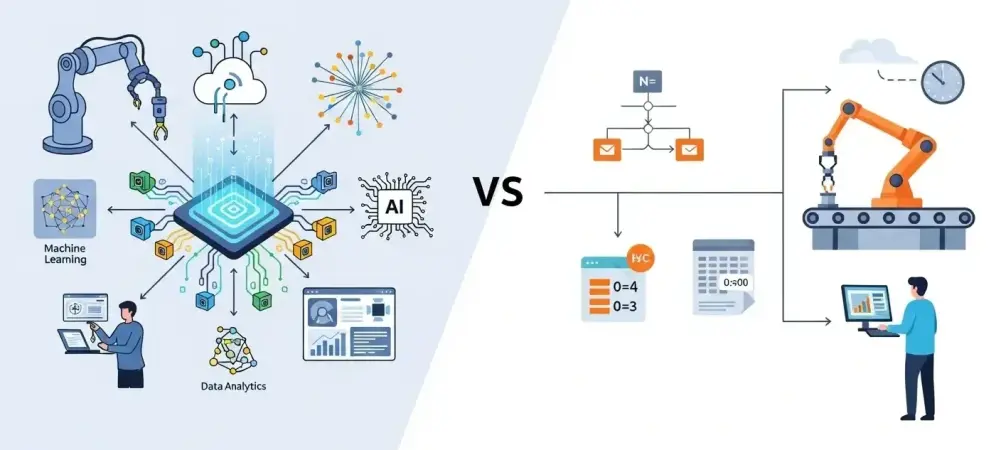
The evolution of business operations is no longer defined by incremental improvements but by a fundamental rethinking of how work gets done, shifting from isolated scripts to intelligent, interconnected ecosystems that operate with minimal human oversight. This journey pits two distinct philosophies against each other: the familiar, task-oriented world of traditional automation and the ambitious, holistic vision of hyperautomation. Understanding the profound differences between these paradigms is not merely a technical exercise; it is a strategic imperative that dictates an organization’s capacity for resilience, scalability, and innovation.
Defining the Automation Paradigms
To grasp the distinction between these two approaches, it is essential to understand their core philosophies and the technologies that underpin them. Traditional automation focuses on executing discrete, repetitive tasks. This approach commonly employs tools like Robotic Process Automation (RPA) to serve as a reliable digital assistant, handling high-volume, rule-based activities such as data entry or form completion. The goal is tactical: to free human workers from monotonous labor within a well-defined process. In contrast, hyperautomation is a strategic business discipline aimed at systematically identifying and automating business processes as comprehensively as possible. It is not a single tool but an orchestrated framework that integrates a suite of advanced technologies. This ecosystem includes RPA for simple tasks, Process Mining to provide “x-ray vision” into existing workflows, and Artificial Intelligence (AI) and Machine Learning (ML) to act as the “intuition” layer for complex decision-making. At its core, hyperautomation seeks to reinvent entire workflows from end to end.
This advanced framework relies on a symphony of coordinated platforms. An IT Service Management (ITSM) tool like ServiceNow acts as the master coordinator, orchestrating complex workflows across departments. Meanwhile, an execution engine like Ansible provides the “hands,” leveraging Infrastructure as Code (IaC) to reliably carry out commands across hybrid cloud environments like AWS and Azure. This integration of a workflow orchestrator with a powerful execution tool is what allows hyperautomation to move beyond simple tasks and into comprehensive process transformation.
Core Differences: A Head-to-Head Comparison
Scope and Strategy: Tactical Islands vs. Holistic Integration
The most fundamental difference lies in scope and strategy. Traditional automation is inherently tactical and siloed, concentrating on automating simple, predefined tasks within a single department or system. This methodology creates “islands of automation”—isolated pockets of efficiency that, while beneficial in their own right, struggle to connect with broader, cross-functional business processes. They are effective for solving localized problems but often fail when a workflow must traverse multiple systems and teams. Hyperautomation, however, adopts a strategic and holistic perspective, aiming to integrate and reinvent entire business workflows. It moves beyond isolated tasks to connect disparate systems and departments into a seamless, automated continuum. A classic example illustrates this divide: when an AWS CloudWatch alert signals a CPU spike, a traditional automation might simply generate a ticket for a support engineer to manually review. In a hyperautomated workflow, that same alert could trigger a ServiceNow process that automatically invokes an Ansible Playbook to provision a new instance, migrate the workload, and decommission the faulty server—all without any human intervention.
Technological Foundation: Simple Scripts vs. an Orchestrated Ecosystem
The technological underpinnings of each approach are also vastly different. Traditional automation typically depends on script-based rule engines designed to handle specific, highly structured tasks. This approach is often brittle; if the underlying conditions change, a new data format is introduced, or an unexpected error occurs, the script is likely to fail. Its reliance on rigid logic makes it ill-suited for the dynamic and unpredictable nature of modern business environments. Conversely, hyperautomation operates as an orchestrated “symphony” of technologies, where each component performs a specialized yet coordinated role. It is a robust framework built on integration, not just execution. In this model, an execution engine like Ansible provides the powerful “hands” to interact with infrastructure, but it is guided by the “orchestrator,” such as ServiceNow, which manages the sequence of events. Above it all sits the “brains”—the AI and ML models that analyze data and inform decisions. This layered, integrated ecosystem creates a resilient system capable of managing complex processes that simple scripts cannot handle.
Adaptability and Intelligence: Rigid Rules vs. Dynamic Learning
Adaptability is another key differentiator. Traditional automation is static, operating on predefined rules that do not change unless a developer manually updates them. It excels with structured data in stable environments but lacks any capacity to learn or adapt. When faced with unstructured information or an unforeseen scenario, it grinds to a halt, requiring human intervention to resolve the exception. Hyperautomation is designed for dynamic learning and continuous improvement. By leveraging AI, ML, and Natural Language Processing (NLP), it can interpret both structured and unstructured data from sources as varied as databases, emails, and support tickets. This allows the system to analyze complex patterns, make predictive decisions, and adapt its behavior over time based on new information. This intelligent adaptability enables hyperautomation to not only execute processes but also to optimize them, identifying bottlenecks and refining workflows as business conditions evolve.
Challenges, Limitations, and Strategic Considerations
The primary challenge of traditional automation is its tendency to create disconnected “islands of automation.” While each island may represent an efficiency gain, the gaps between them become points of failure. These siloed solutions are difficult to scale, maintain, and integrate into larger processes. As business needs grow in complexity, the effort required to bridge these gaps can outweigh the benefits of the initial automation, leading to a fragmented and fragile operational landscape.
A critical consideration for hyperautomation is avoiding the misconception that a single tool can deliver its full promise. It is a common mistake to believe that adopting a powerful execution engine like Ansible is synonymous with achieving hyperautomation. While Ansible is an indispensable component for its Infrastructure as Code capabilities, it is just one piece of the puzzle. True hyperautomation is not a product to be purchased but a strategic framework to be built. A successful strategy requires integrating the execution layer with workflow engines like ServiceNow, embedding automation into CI/CD pipelines, and using process intelligence tools to guide the entire effort.
Conclusion: Choosing the Right Automation Strategy
Ultimately, the decision between traditional automation and hyperautomation hinges on the scope and complexity of the organizational goals. Traditional automation is a tactical, script-based solution perfectly suited for simple, repetitive, and rule-based tasks confined to a single domain. It is the right choice for stable processes involving structured data where the primary goal is isolated efficiency. Hyperautomation, in contrast, is a strategic, ecosystem-driven paradigm designed for dynamic, end-to-end process transformation. It is the superior path for complex, cross-functional business workflows that require intelligent decision-making, handle unstructured data, and benefit from continuous improvement. A successful implementation involves a synergistic architecture: a powerful IaC tool like Ansible provides the execution, an intelligent platform like ServiceNow orchestrates the workflow, and insights from process mining and AI guide the entire strategy toward profound operational excellence.