

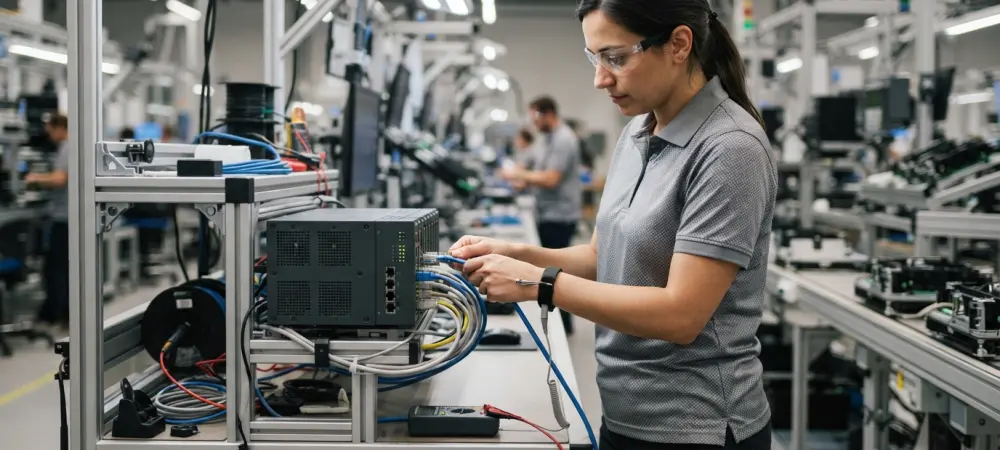
The traditional factory floor remains a digital Tower of Babel where machines speak incompatible languages, forcing engineers to navigate a labyrinth of specialized hardware and proprietary standards. For decades, the choice of a networking protocol like EtherCAT or Profinet dictated the physical design of a machine, creating rigid silos that hindered innovation. However, a new wave of modular silicon is dismantling these barriers, allowing hardware to transcend its fixed definitions and adopt new personalities through software.
Texas Instruments (TI) is leading this transformation with the introduction of the TICS100MOD system-on-module and the TIOM2212 IO-Link master. These devices represent a shift toward a unified ecosystem where protocol independence is the new standard. By integrating complex communication stacks into compact, pre-certified modules, TI is reducing the friction that has historically slowed the deployment of advanced robotics and automated assembly lines.
Breaking the Protocol Barrier in Modern Automation
Industrial facilities have long been a patchwork of competing standards, requiring engineers to design specialized hardware for every unique protocol used on the factory floor. The release of the TICS100MOD system-on-module and the TIOM2212 IO-Link master signals a shift toward a more unified approach. Rather than forcing developers to commit to a single standard during the hardware design phase, these new tools allow for a dynamic, software-defined networking environment that adapts to the needs of the application at boot time.
This flexibility changes the calculus of industrial design. Instead of maintaining a portfolio of different printed circuit boards for various markets, a single hardware platform now serves as the foundation for any major networking environment. This modularity ensures that a machine destined for a facility using EtherNet/IP can be reconfigured for a Profinet environment with nothing more than a firmware adjustment, greatly enhancing operational agility.
The High Cost of Fragmented Industrial Standards
In the world of the Industrial Internet of Things (IIoT) and advanced robotics, the requirement for real-time, deterministic communication is non-negotiable. Traditionally, supporting EtherCAT, EtherNet/IP, and Profinet meant maintaining separate hardware versions, which bloated inventory costs and extended engineering timelines. As factory automation becomes more complex, the industry faces an urgent need for interoperable hardware that can bridge the gap between high-level controllers and the smallest field-level sensors without the burden of protocol-specific circuitry.
Furthermore, the fragmentation of standards created a bottleneck in the supply chain. Manufacturers often struggled to manage the diverse components required for multi-protocol support, leading to project delays. By centralizing the communication logic into a unified silicon solution, companies can now streamline their sourcing and focus on the performance of their machines rather than the underlying plumbing of the network.
Engineering the Industry’s Smallest Multi-Protocol System-on-Module
The TICS100MOD serves as the centerpiece of this integration strategy, packing the power of the AM2612 microcontroller and the DP83826AI physical layer into a compact 30×18mm footprint. This module utilizes dual Arm Cortex-R5F cores alongside a Programmable Real-Time Unit (PRU-ICSS) to manage deterministic traffic independently of the main automation tasks. By allowing engineers to select their preferred Industrial Ethernet protocol via firmware updates, the module effectively eliminates the need for redundant hardware designs, offering a future-proof platform that scales across different factory ecosystems.
The physical size of this module is a breakthrough in itself, enabling the integration of high-speed Ethernet into space-constrained devices like small robotic grippers or compact smart sensors. Its ability to handle the heavy lifting of network timing and synchronization allows the primary application processor to remain dedicated to motion control or data analytics. This division of labor results in a more responsive and efficient system architecture.
Strengthening Field-Level Connectivity With IO-Link Integration
To complement the high-level Ethernet communication, the TIOM2212 dual-channel IO-Link master facilitates seamless data exchange at the device level. This component acts as a vital link, connecting sensors and actuators to the broader network while integrating advanced analog features and built-in protection. When paired with Sitara processors, this solution creates a comprehensive pathway for data—from the raw signal to the sophisticated decision-making processes of a central controller—streamlining the overall system architecture and reducing the risks associated with multi-vendor integration.
Integrating IO-Link mastery directly with broader Ethernet modules ensures that the lowest levels of the factory floor are no longer a blind spot. Real-time diagnostics and parameterization of field devices become accessible throughout the entire network hierarchy. This visibility is essential for predictive maintenance strategies, where the health of a single sensor can influence the scheduling of an entire production shift.
Insights From Industry Leaders on Hardware Consolidation
The shift toward hardware consolidation is not just a theoretical benefit; it is a practical necessity recognized by major industrial players like SICK. Experts note that the reliability and performance offered by these integrated solutions are critical for maintaining the uptime required in modern manufacturing. By utilizing a single hardware platform for multiple standards, companies focus their engineering resources on innovation rather than the underlying complexities of protocol qualification.
Industry analysts observe that software-defined protocols accelerate the convergence of Information Technology (IT) and Operational Technology (OT). When hardware is no longer a barrier, the flow of data from the factory floor to the cloud becomes more fluid. This integration allows for a holistic view of performance, enabling companies to optimize energy consumption and production throughput in real time across multiple facilities.
Streamlining the Path From Design to Deployment
Implementing these advancements required more than just high-performance silicon; it necessitated a framework that simplified the development cycle. TI provided engineers with production-ready hardware, certified software stacks, and comprehensive development kits that bypassed the need for ground-up software validation. This practical approach allowed teams to implement sophisticated networking capabilities—such as low-latency traffic handling and real-time data acquisition—with minimal overhead, significantly accelerating the time-to-market for next-generation industrial systems and IIoT devices. The adoption of these unified platforms ultimately paved the way for a more resilient and flexible industrial landscape from 2026 to 2028. Manufacturers who embraced these modular tools reduced their design cycles and improved their ability to respond to shifting market demands. As connectivity became more standardized, the focus shifted toward the intelligent use of data, ensuring that the next generation of automation was built on a foundation of seamless interoperability rather than closed ecosystems.