

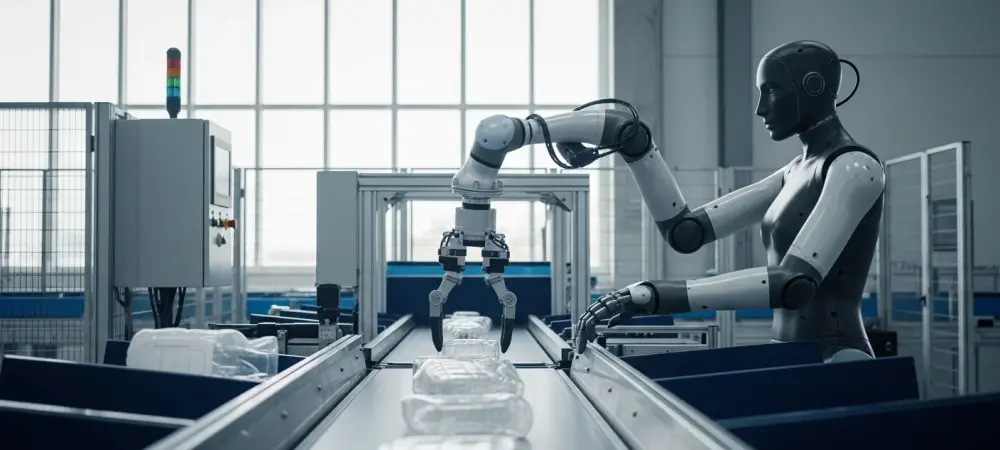
Deep within the industrial heart of East London, a tireless figure stands at the Sharp Group’s facility, processing a portion of the 280,000 tons of refuse that pass through these gates every year. This is Alpha, a humanoid robot that represents a pivotal shift from traditional mechanical sorting toward an advanced, human-centric form of automation. This pilot program is far more than a simple technological upgrade; it is a fundamental reimagining of how society manages its most difficult and undesirable labor, proving that the future of recycling is not just about faster belts, but smarter, more versatile machines.
Beyond the Conveyor Belt: The Dawn of Robotic Waste Management
The integration of robots like Alpha signals the end of an era where waste management relied solely on primitive mechanical screens or exhausted human hands. This transition suggests that the circular economy no longer needs to choose between human intuition and machine speed. Instead, these systems are designed to operate within existing infrastructure, adapting to the world as it is rather than requiring entirely new factories. Modern waste recovery is evolving into a high-tech discipline where the “dirty” work is delegated to silicon and steel. The pilot program at Rainham serves as a blueprint for global facilities, demonstrating that a humanoid robot can handle the diverse, messy reality of consumer waste. This approach moves the industry beyond the limitations of rigid automation, allowing for a more fluid and responsive processing environment that can scale according to the volume of incoming refuse.
Confronting the Crisis in Traditional Waste Recovery
For decades, the waste management sector has struggled with its reputation as one of the most hazardous industrial environments. With injury and illness rates roughly 45% higher than the industry average, the combination of extreme noise, airborne dust, and relentless physical strain has fueled a chronic labor shortage. Facilities worldwide are currently battling a staggering 40% annual staff turnover rate. As human workers increasingly opt out of these punishing roles, a critical bottleneck has formed in the global sustainability pipeline that only technological intervention can resolve.
This instability is not merely a matter of logistics; it is a safety crisis that demands a new approach to facility management. The physical toll of repetitive sorting leads to long-term health issues, making the profession increasingly unsustainable for a modern workforce. By introducing autonomous agents into these high-stress zones, operators are finally addressing the root cause of their labor instability. This shift allows the industry to maintain its environmental commitments without compromising the well-being of its remaining human staff.
Engineering Efficiency: Humanoid and AI Integration
Unlike the inflexible machinery of the past, modern humanoid robots developed by firms like TeknTrash and RealMan Robotics are engineered to navigate the unpredictability of mixed waste. These units offer distinct operational advantages, such as 24/7 continuous operation without the limitations of physical exhaustion or the need for holidays. This consistency ensures that throughput remains steady regardless of time or day, maximizing the facility’s return on investment while stabilizing the flow of recovered materials.
Furthermore, these robots work in tandem with specialized technologies to create a multi-layered defense against inefficiency. While humanoid models handle intricate picking, AI-driven air jets from companies like AMP Robotics sort materials at nearly ten times the speed of a human. Meanwhile, robotic arms from developers like Glacier are utilized to intercept dangerous items, such as firearms or pressurized canisters, before they can cause catastrophic plant damage. This layered approach ensures that every item is handled by the most appropriate tool for the job.
The Science of Sight: Data Training and Academic Insights
The transition to robotics is as much a software challenge as it is a hardware one. Academic experts from institutions like Yale University emphasize that the fusion of AI-driven vision systems and high-dexterity robotics is the only viable path to achieving the material recovery rates needed for economic survival. These robots are not “plug-and-play” devices; they require a sophisticated collaborative training phase. Through virtual reality interfaces, human workers guide the AI, teaching it to recognize subtle differences in texture and shape that define various recyclables in a cluttered environment.
This synergy ensures the machine can distinguish between a contaminated plastic bottle and a clean one, a task that often confuses standard optical sorters. The data gathered during these sessions creates a constantly evolving material database. As consumer packaging trends shift, the robots are updated via software rather than mechanical overhaul. This adaptability makes humanoid systems a future-proof investment, allowing facilities to pivot their sorting priorities in real time based on fluctuating commodity prices for recycled paper, plastic, or metal.
Navigating the Transition: Strategies for a Hybrid Workforce
Adopting humanoid robotics requires a strategic shift in facility management rather than a simple replacement of staff. To successfully modernize, plant operators are focusing on transitioning existing personnel from manual sorting to higher-value roles in robotic maintenance, system oversight, and data management. This change not only preserves jobs but elevates them, turning “dirty” labor into a technical career path. By deploying robots specifically in high-risk zones where dust and noise are most prevalent, facilities immediately lowered their reported injury rates.
Effective implementation also relied on iterative training cycles where “human-in-the-loop” systems allowed for constant refinement of the robot’s performance. Managers discovered that the most successful transitions occurred when human workers were treated as the primary teachers of the AI. As the industry looked toward the next decade, the focus remained on refining the interaction between man and machine. Leaders eventually prioritized specialized training programs to ensure that the workforce was prepared to manage a fleet of autonomous sorters, ultimately transforming the recycling center into a safe, high-efficiency technology hub.