

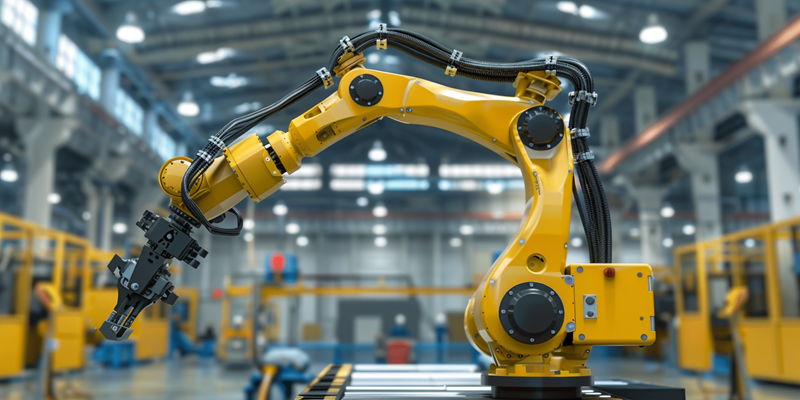
The industrial landscape is witnessing a revolutionary shift with the advancement of collaborative robots, or cobots, which are paving the way for a new era of manufacturing efficiency and worker safety. The latest contender to make waves in this sector is the TM30S collaborative robot, a heavyweight cobot from Techman Robot that is set to redefine the standards of automation in heavy industry tasks. The introduction of the TM30S is a landmark moment, designed to blend the physical prowess of a high-payload cobot with the finesse of artificial intelligence, potentially revolutionizing how industries approach tasks that have traditionally been labor-intensive and hard to automate.
Elevating Efficiency with High Payload and Reach
The TM30S collaborative robot is redefining the concept of heavy-duty automation with its ability to lift a substantial 35 kg payload. This robust capacity is of particular significance in industrial operations such as packaging, palletizing, and material handling, where the demands of lifting and precision are high. Beyond the impressive lifting strength, the TM30S is designed with six articulated joints, granting it a remarkable reach span of 1702 mm. This extended range translates to a tangible 25% faster cycle time, made possible also by a noteworthy increase in joint speed. With improved repeatability at a razor-sharp accuracy of 0.03 mm, an enhancement that boasts 70% better precision over its predecessors, the TM30S exemplifies how cobots are setting new benchmarks for operational competency in industrial automation.
The advent of the TM30S comes at a time when industries are actively seeking ways to advance productivity without compromising on consistency and quality. Factories that integrate the TM30S into their workflows can expect not only to increase their throughput but also to maintain an exceptionally high level of precision across various applications. Whether it’s handling hefty components in automotive assembly lines or arranging bulky items for shipment, the TM30S ensures repetitive tasks are executed with unparalleled efficiency.
Cognitive Capabilities: The AI Advantage
The realm of industry is undergoing a dramatic transformation with the rise of collaborative robots, known as cobots. These advanced machines are leading us into a new era characterized by heightened manufacturing productivity and enhanced worker protection. Taking center stage in this evolution is the TM30S, a powerful addition from Techman Robot. This cobot stands out as it sets new benchmarks for automation in heavy-duty industrial tasks. With the arrival of the TM30S, the convergence of high-payload capabilities and sophisticated artificial intelligence marks a significant milestone, potentially changing the traditional methods of handling tasks that were once labor-heavy and challenging to automate, heralding a future where machines and humans work in closer synergy for greater efficiency and safety in the workplace.